21.5.13

What My Family Is Reading


The Harry Potter train seems to have slid to a halt, for now, anyway.

Alice admitted defeat somewhere around the halfway mark of Order of the Phoenix, though she did devote some time to going through books 6 and 7 and folding down the corners of the pages where there were references to Tonks (her favourite character). She's still listening to the audiobooks though. Mind you, we have been almost banned from the library from borrowing them any more, because we have (ahem) hogged them somewhat.

And she's taken the new Truly Tan: Jinxed! to school to read in the mornings, which is exciting.


Meanwhile, Evie is steadily ploughing through a series by Erin Hunter called Warriors, which is about warrior -- cats! At least she is stretching her wings slightly by reading about animals other than puppies. She's also started to write her own version of Warrior Cat tales.

Tigerpaw's dark green gaze flickered as Brindlepaw came in through the medicine den with a crow cramped in his jaws. "Nice catch" purred Tigerpaw with a flick of her black-brown tail. Brindlepaw blushed but soon got over it. His heart ached for the tiny orange tabby she-cat...

Well, you get the picture.

Michael is in the grip of a book too. He's reading Robyn Annear's A City Lost and Found: Whelan the Wrecker's Melbourne which is absolutely fascinating, judging by the snippets he keeps reading out to me. Annear uses the history of the demolition company to chart the story of Melbourne's lost -- and sometimes rediscovered -- buildings. Did you know that when the Queen visited Melbourne for the Olympic Games in 1956, all the buildings along Swanston Street had to tear down their historic verandah awnings to make the street look tidier?


And I am about to embark on the monumental-looking Servants by Lucy Lethbridge (what a fabulous name) and I expect to learn heaps about what life was really like behind the green baize door. Goody, more material for shouting at the television during Downton Abbey! I can hardly wait.

Jinxes, cats, wrecking balls and housemaids. Something for everyone.

9.5.13

Abandoned Book

This week I did something that I only do very rarely -- I gave up on a book.

I'd asked Alice to choose which book from the tottering pile beside my bed I should read next, and she chose the volume at the very bottom of the pile, which already tells you I wasn't exactly ganting to read it. This was a book by a very well known and prolific American author (who is also a favourite of a good friend, though I haven't actually read any of her books before).

Perhaps the way I acquired it had an influence as well. I picked it up at the library book sale as part of a friendly exchange with a stranger. This woman had picked up a Carol Shields book and exclaimed over it, and I pointed out another Carol Shields she hadn't noticed and said how much I loved her books. So then she recommended The Abandoned Book to me, and I didn't feel as if I had any choice but to take it home with me, even though it didn't instantly appeal.

And sure enough, about eighty pages in, I was struggling badly. I can't put my finger on what exactly wasn't working for me. The writing was fine, but I just wasn't interested. And it was really long, too. Perhaps if I hadn't had another fifteen books on my pile, all of which I was more keen to read than this one, I might have persisted.

Oh, well. It was worth a mis-spent dollar to have a friendly chat with a stranger over rows of pre-owned books; a reminder that book-lovers are everywhere.

3.5.13

For those who are interested...

(this means you, Mum and Dad)

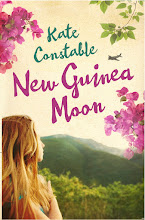
There are a couple of really nice reviews of New Guinea Moon at Readplus and What's Rebecca Reading?.

1.5.13

Party Frock

I was so chuffed to come across this 1966 edition of Noel Streatfeild's Party Frock in our secondhand shop the other day. This was a definite childhood favourite of mine and I re-read it eagerly.

The story is set in the final days of WWII; Selina, who has been living with her cousins for the duration (her parents are prisoners of war in Hong Kong), is sent a beautiful party dress and shoes by her American godmother. But with shortages of fuel and food, there are no parties or dances where she could wear it. Everyone agrees that it would be a tragedy if she doesn't get the opportunity to wear this fabulous frock at least once, and the large and energetic family of cousins come up with a solution: they'll put on an historical pageant at the nearby manor house (as you do), which Selina can introduce, dressed up in The Frock.

Events rapidly get out of hand, with Philip, the theatrical nephew of the manor house family taking over as producer (he's also a wounded Squadron Leader, so there are no niggling worries about his manliness...) Before the cousins know it, the pageant has swelled to include everyone in the village -- hordes of dancing children, forty-two knights on horseback, a hundred monks dressed in blackout material, American soldiers in jeeps sweeping across the lawns.

It's not until the dress rehearsal that Selina steps forward to give her prepared prologue, dressed in her precious frock. And then Philip dismisses her. 'Get off the stage, ducky, you're holding up the first scene.' He hasn't even realised that the whole point of the pageant was an excuse for her to wear her beautiful party dress.


Noel Streatfeild is always strong at juggling various strong characters with clashing agendas, and she is wonderful at the detail of theatre, dance and performance. The chapter devoted to the various provisions of all the hundreds of costumes that need to be supplied is simply riveting. I did squirm slightly at the classist story -- the cousins are all very comfortable ordering about the villagers and the manor house servants, who meekly submit. Even the nine year old is allowed to get away with speaking to her elders in a really bossy and disrespectful way. Also crying is really, really shameful, even if you're only eleven and your parents are prisoners of war.

But I can forgive. Party Frock has earned its place on our Girls' Book Shelf of Pride.


22.4.13

Back To Tremaris?

This is turning into a funny old year, writing-wise. Because I finished working on New Guinea Moon more quickly than I'd expected, I hadn't really lined up my next project (something I usually do well in advance). So now I find myself casting about with two or three or four half-baked ideas, but no compelling urge to tackle any of them.

Maybe I just need a break! I've produced ten books in the last twelve years, which isn't bad going.

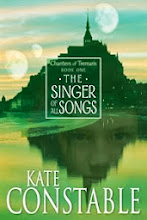
But I also find myself thinking about the place I was in, funnily enough, about twelve years ago, when I'd been chipping away for years at an adult novel that just wasn't quite working. The solution then was to put it away and write something for fun, something just for my own pleasure. That 'something' turned into The Singer of All Songs, the first book in the Chanters of Tremaris trilogy.

And I also find myself thinking about the last book in that series, the sort-of sequel The Taste of Lightning, which ended with an open door to another installment in the story.

Maybe it's time to go back to Tremaris and finish Calwyn's journey. Even if it never gets published. Even if I have to self-publish it on the internet or something. You can do that these days, right?

19.4.13

Pupppies Puppies Puppies!

Evie and I walked to the library at the weekend, and we borrowed heaps of books. Hm, guess what Evie likes to read about? She told me afterwards she went along the shelves and picked out every book with a dog on the cover; it certainly took her a very long time to choose.

Sadly, I don't think there are enough puppy books in the world to satisfy her appetite. She read her way through this lot in a couple of days.

15.4.13

Holiday Reading

Thank you so much Penni for putting us onto Ivy and Bean!

In our house, for read-aloud popularity, this is the new Ramona, and I don't say that lightly. Even though Ivy and Bean are only seven, both Alice and Evie have responded with delight to their adventures. In fact, some of the nicest days of our holidays were those spent inside, with me reading an Ivy & Bean book while Alice painted or built a treehouse for her Sylvanian families, and Evie messed around on the computer. The books are just short enough to finish in a single session (though the days when the girls demanded multiple readings were a bit hard on my throat!)

These books are absolutely charming, but not at all saccharine. Bean is energetic, untidy, bursting with enthusiasm, a little bit naughty. Ivy is quieter, a reader of big books; she is practising to be a witch when she grows up, and is full of good ideas. Together they make an irresistible team. These books are small scale and suburban, bounded by the backyards of Pancake Court, the school and the local park. But the girls' schemes are anything but dull. They tackle global warming, Great Women of History, digging for dinosaurs, and bravely exorcise a ghost in the school toilets (not Moaning Myrtle). And they are funny - not try-hard funny, not gross-out funny, just gently, believably, real-life funny.

The stories (written by Annie Barrows) are perfect and the illustrations are gorgeous too (I was chuffed to discover that the illustrator, Sophie Blackall, is an Australian living in New York).

Our only complaint is that there are only nine books in the series (so far) and we've already read them all.

As Evie would say, 'Sad face.'

10.4.13

Ssh!

I don't want to jinx it, but Alice is reading...

These holidays, she's been locked in her room, reading the first three books of Harry Potter. Now she's about 90 pages into Goblet of Fire. A couple of times I've thought, should I drag her out of her room and into the sunshine? Then I thought, no way!

Thank you, JK Rowling.

5.4.13

Cloud Atlas In The Clouds

A stranger recommended this book to me a few months ago, when I was on tour in the Wimmera. But it wasn't until I went to Perth that I got around to buying it on the Kindle (on the Kindle? for the Kindle?) to read on the plane.

As it turned out, I ended up watching TV on the plane, but I read half the book while I was in WA. And it's every bit as extraordinary as the kind stranger in St Arnaud had said. It's actually six stories cleverly spliced together, spiralling outward and then in again to finish where it began, but threading common themes and recurring images to reinforce the idea that we are all woven together across time and space. The stories range from a nineteenth century traveller's diary in the Pacific Islands; to the letters of a dissolute young composer in the 1930s; to a 1970s political thriller with a feisty heroine; to the travails in our own time of an elderly publisher trapped against his will in an old people's home that's more like a gulag; to a chilling but recognisable future of corporate dictatorship and genetic manipulation; to a post-apocalyptic adventure where civilization as we know it has all but broken down into chaos and despair, but where courage and intelligence can still win a victory of sorts. David Mitchell has written each portion of the book in a different, totally distinctive voice, the languages of past and future brilliantly playful.

There is, of course, a movie of this book out at the moment, and I ended up watching that movie on the way home, even though I was only halfway through the book. Spoilers everywhere, and the film didn't quite pull off the dazzling virtuosity of the novel, though I enjoyed the conceit of having the same group of actors play different roles in each section of the story. Also, Ben Wishaw was in it! So that was a bonus. But the film differed quite a bit from the book in the way it resolved the storylines, so it wasn't completely spoilery.

It wasn't until I was reading the reviews at the back of the book that I realised that in print form, Cloud Atlas is 500 pages long!! Bloody Kindle. It tells you what percentage of the book you've read, but it completely disguises the ACTUAL length of what you're reading. No wonder it took me nearly two weeks to finish.


15.3.13

Kind Words

Some lovely reviews of New Guinea Moon at here, at Aussie Book Review, and here, at Kids Book Review.

12.3.13

Too Hot To Blog

It's been too hot to blog, and I've got a dozen other things I should be doing right now, but I just wanted to mention this huge fat book I'm reading.

I blame Sherlock. If it wasn't for Sherlock, I wouldn't have fallen for Benedict Cumberbatch. If it wasn't for Benedict Cumberbatch, I wouldn't have decided to watch Parade's End on TV (well, okay, maybe I would, seeing as how it's a period drama partly set in the trenches of the Western Front...) If it wasn't for Parade's End coming on TV, I wouldn't have picked up this 836 page book in the second hand bookshop a few weeks ago. Yes, you read that correctly. 836 pages.

In fact it's four novels in one volume. But that doesn't make it any easier.

Ford Madox Ford published this mighty tetraology between 1924 and 1928, so very close in time to the events he's writing about. The language feels authentically 1920s, with slang and idiom which is at times almost incomprehensible. (Someone once asked me for advice about getting the 'voice' for an historical novel; I recommended reading novels written at the time.) But it's not just the dialogue (internal and external) which is making this a difficult read. Maybe it's just Ford Madox Ford's writing style -- I've never read any of his work before, so I don't know if this is typical. But I'm finding myself reading passages twice or even three times, because I just can't understand what the heck he's getting at!

Maybe it isn't just Ford's style, because when Michael and I watched the first episode of the TV version together, he kept stopping to ask me, 'What's going on now? Who's that guy again? Is that his wife? What just happened then?' And Michael, unlike some blokes, is usually pretty good at following storylines. Perhaps the main problem is that the central figure of the drama is Christopher Tietjens (sounds disconcertingly like Christopher Hitchens, unfortunately), a character who seems congenitally unable to take any kind of ACTION. He can't defend himself against his frankly horrible wife, or any of the (false) scandals that bizarrely come to surround him, because that wouldn't be honourable eg he won't simply divorce his wife, even though they are clearly miserable together, because 'only a blackguard' would subject a woman to that. And she refuses to divorce him, because she's Catholic. So... four books full of anguish and despair...

And yet for some reason I can't let it go. Reading this is WORK. I feel as if I'm trapped in some exotic landscape, in continual danger of losing the track beneath my feet, groping through the mists -- and yet I'm compelled to go on --

Not unlike the characters in the books, now that I think of it!

4.3.13

He's Ba-ack! (did he ever go away?) **UPDATED**

Harry Potter is undergoing something of a resurgence in our house. Years ago, I read the whole series to Alice (boy, is that a read-aloud marathon or what? Where's my medal?) But now, on the back of her huge crush on Stephen Fry, she has immersed herself in HIS audio versions. Admittedly, he probably does do better voices than I do. Possibly. Whatever. She's running home from school to lock herself in her room and listen to the next chapter.

Meanwhile, the craze has infected Evie too. She's pulling out and re-watching the DVDs which have been languishing at the bottom of the drawer, and re-enacting the events with a cast of Littlest Pet Shop animals, with the LPS vet clinic or whatever it is doubling as Hogwarts.
Students at Hogwarts?

And Alice has found a new way to tease her sister. After learning that in an ideal world, Evie would choose Tonks and Sirius to be her parents (thanks for that, Evie), Alice has taken to following her around the house chanting, 'Sirius DIES! Tonks DIES! Lupin DIES!'

Evie just blocks her ears and shouts back, 'I KNOW, I KNOW!'

At least with Evie, her enthusiasm has taken the form of actually re-reading the books. Yay.

**UPDATE**
Alice has declared her intention of reading Philosopher's Stone. Since Evie is already reading it and refused to give it up, and I can't ignore any expressed desire to actually read on Alice's part, I had to go out and grab another copy (2nd hand). So now we have tandem Harry Potter reading, to go along with the stereo audiobooks issuing from their respective rooms at bedtime... I just hope I don't have to duplicate the entire series...

27.2.13

A Little Princess

It might seem odd that, given that The Secret Garden is one of my all-time favourite books, if not my number one favourite, it's taken me so long to read another famous title by Frances Hodgson Burnett. Actually, I must have read A Little Princess some time in the dim and ancient past -- or if not A Little Princess itself, its predecessor, Sara Crewe. It scarcely seems possible that I could have lived so long and dodged it entirely.

Certainly the story was very familiar. Young, indulged Sara is left at a London school by her doting father, who then disappears back to India. Years pass, during which absent Papa showers Sara with gifts from afar, then tragically dies. Now plunged into penury, Sara is at the mercy of cruel Miss Minchin, and from her exalted position of richest pupil, she becomes a virtual slave, banished to the attics and half-starved while she works her fingers to the bone about the house, as well as tutoring the younger pupils as an unpaid teacher. But Sara, with the aid of her vivid imagination, always maintains her dignity and generous, loving spirit; and she is duly rewarded by the appearance of a new foster father (I was almost expecting dead Papa to come back to life, but Burnett just shies clear of this option -- just!) and a suitably fairytale ending.

A Little Princess is a Cinderella story, of course, but as I read I kept hearing echoes of other books, for which this story was surey a template. My beloved Wolves of Willoughby Chase (Joan Aiken) has tons of Little Princess in it -- the wicked schoolmistress, the tortured orphans, the magical arrival of longed-for warmth and comfort just when all seems lost. It's one of the most satisfying stories there is, which is why it keeps appearing: virtue in suffering receives its just reward. Sara is unfailingly kind, unfailingly brave, a princess in exile, and at last she is welcomed into the loving home that she has been so cruelly denied.

It struck me that there were similarities between this book and Little Lord Fauntleroy, another turn-of-last-century Burnett hit. Again, an almost perfect child is rewarded by fate by being showered with wealth, though in the little lord's case, his poverty and suffering all takes place before the book starts. The thing is, Sara is spoiled rotten by her adoring papa, her every whim indulged, but it doesn't actually spoil her; she remains thoughtful, loving and courageous, even when all her riches are stripped from her and she has nothing. Mary Lennox, in The Secret Garden, on the other hand, starts off as a most unpleasant child: sullen, sour and angry. The difference is that Mary has been neglected all her life by her beautiful, glamorous parents; she has never been loved.

I wonder if Burnett's subtext in all three books was the same. Victorian era children were often considered to be in danger of 'spoiling' if their wishes were 'indulged' - strict discipline, self-control and punishment were the order of the day. But Burnett's most loving, and loveable*, children are also those most showered with love. Even indulgent, excessive love can't ruin them; in fact, it strengthens them, and enables them to give love to others.

Modern psychology would surely agree.

*We could argue that Lord Fauntleroy is actually an obnoxious little snot, while Mary Lennox is loveable despite her prickly exterior, or even because of it; but we are clearly supposed to find Fauntleroy utterly charming, so let's leave that be!

12.2.13

NEW GUINEA MOON AND GIRL DEFECTIVE BOOK LAUNCH


What's more fun than a book launch? A DOUBLE book launch, that's what!
Consider yourself invited to come along to Readings Carlton to join Simmone and me as we launch each other's new books.

Where: Readings Bookshop, 309 Lygon St, Carlton, Melbourne

When: Wednesday 6th March 2013
6.30 - 8pm

Please RSVP by 25/2 to:
kate@kateconstable.com
or
simmonehowell@hotmail.com

See you there!

11.2.13

The World of Tomorrow

Well, I finally caved. After a long resistance, I've finished my first book on an e-reader. And I plunged in the deep end: for my first Kindle experience, I chose The World Until Yesterday, by Jared Diamond. I won't be critiquing the actual book here (which has been ably done by others, including Drusilla Modjeska), only the Kindle experience itself.

 First, the positives. This was a very big book -- about five hundred pages. That's a lot of weight to lug around. But I could slip the Kindle into my handbag (the small one!) and take my book on the bus and to Alice's tutoring session, without straining my back, and I could read anywhere round the house without getting sore arms from propping up a huge great heavy volume.

Also, the Kindle version was VERY cheap. I may not have bought this book at all had I not idly looked it up on the Kindle store and had my mouth not dropped open at its scandalous cheapness. I don't know how much of this teeny amount goes to Mr Diamond. So I guess this is a positive for me, but not necessarily for him. On the other hand, at least I did buy it, which I probably wouldn't have done otherwise.

Once I'd worked out how to operate the links in the text, I could navigate the book fairly easily -- look up pictures and footnotes, and return to my spot immediately. The little bar along the bottom of the screen told me, not how many chapters or pages I'd read, but the percentage of the text I'd consumed, which I found initially disconcerting. I'm used to measuring my progress by seeing how many centimetres of page thickness fall on either side of my bookmark. What does 37% mean? I had no real sense of how far there was to go.

Which brings me to the negatives -- which are pretty intangible, I must admit. I missed not being able to flick through pages and idly scan for things that interest me, like references to Australia, to stop and browse and dip and swoop ahead. I missed not having the pictures embedded in the text. I missed the physicality of the book -- I still have only the haziest idea of what the cover looks like.

Most of all, I fear that the book's contents won't stay with me. Maybe this is just me, but I find that the physical shape and look and feel of a book is crucial to recalling the reading experience and the story or argument within. I remember how it felt to pick it up, the colours of the cover, the thickness of the spine, the look of the font and print on the page, where I was when I read it -- all this is intrinsic to remembering what I read. I'm afraid that, unanchored to these physical memories, the contents of the book will drift away from me.

If every book I read on the Kindle looks and feels and smells like just another Kindle book, will I be able to hold onto any of them? Or is this just the world will be from now on?

I have to say that I enjoyed my first time, despite my misgivings. But now I'm hankering for a Real Book.