Showing posts with label America. Show all posts

1.6.26

Plainsong

I had never come across the American author Kent Haruf until my friend Elizabeth put Plainsong into my hands. What a revelation! I'm not usually drawn to American novels, but I was completely won over by Haruf's spare, deceptively simple prose, which matches the austere landscape of (fictional) Holt County, Colorado.

This is a very cinematic novel, though the action is mostly subtle, with occasional bursts of violence. We are never told how characters feel or what they're thinking; instead, we witness their words and actions and make our own interpretations. Haruf takes 'show, don't tell' to the extreme, but it works beautifully across a range of characters, who are all isolated in their different ways, and who end up interacting unexpectedly. A pair of elderly brothers on their remote farm; a pregnant teenager; middle-aged teacher Tom Guthrie, whose wife has withdrawn and finally left him with his two young sons; warm, humorous fellow teacher, Maggie Jones, who is the catalyst who brings the McPheron brothers and young Victoria together.

Plainsong is true to its title -- unadorned, no fuss, but deeply moving. Elizabeth has promised to lend me two more Haruf novels and I can't wait.

26.2.26

Clock Dance

Anne Tyler is one of those reliable authors where you always have a pretty good idea of what you're going to get, and you can relax in the knowledge that you're in safe hands while you get there. (I'd put Noel Streatfeild, Agatha Christie and Eva Ibbotson into the same category.) In one respect, Clock Dance departs from Tyler's usual MO -- instead of revolving around a nuclear family, or a couple of generations, this one consists of a few mostly unrelated individuals who end up forming a kind of chosen family.

Willa has two grown up sons, with whom she has little contact -- not because of conflict, they've just drifted apart. Widowed young, she's on her second husband, an honourable but pedantic and unbending man. Peter is most put out when Willa is unexpectedly called to the rescue of her son's former girlfriend and her young daughter, but he heroically accompanies her from Arizona to Baltimore so that Willa can step in. However, his willingness to be a hero is strictly limited and soon Willa finds herself torn between competing duties.

Clock Dance is a really sweet read. Willa is quite a passive character, but I recognised a fellow Phlegmatic type -- averse to conflict, resisting through inaction, a calming presence. It's lovely to see her gradually being appreciated by this bunch of neighbourhood strangers, even as her supposed nearest and dearest dismiss and overlook her. At the end I almost stood up and cheered.
 

22.1.26

The Women

I should start by saying that a lot of people really love this novel. The Women by Kristin Hannah has over a million 5 star reviews on Goodreads, and it came in high on the Radio National book countdown -- particularly since it hasn't benefited from a film or TV adaptation. It deals with meaty, emotional subject matter -- the experience of American women, specifically nurses, during the Vietnam War, women who suffered physically and psychologically and yet had their experiences dismissed and were frequently told 'there were no women in Vietnam.'

Having pointed out all that, I have to admit this book was not for me. I found it melodramatic, often implausible, and not very well written. There was a lot of telling, not showing, in this novel. Frankie's close friendship with her fellow nurses, Barb and Ethel, seemed very one-sided -- several times, Barb and Ethel drop everything to fly across the country and support Frankie in her many crises, yet Frankie never seems to offer them any support in return. We are told how strong and important their friendship is, but we don't really see it. Frankie's mother has a stroke, from which she makes a full recovery -- this serves no purpose except to fill up a few years of plot time. Every man that Frankie meets falls in love with her. I can handle one character miraculously coming back from the dead, but two strains credulity.

I can see that the strong, eventful story would pull readers rapidly through this novel, and I thought the early sections, dealing with Frankie's war experiences, were vivid and punchy, but for me, after she returned home, the story trailed away. I wish Kristin Hannah all the best and clearly many, many readers adore her work -- and The Women is indeed a story that deserves to be told. This just isn't the version for me.
 

30.12.25

Lincoln in the Bardo


I was scared to read Lincoln in the Bardo, even though I'd relished George Saunders' A Swim in a Pond in the Rain. Mind you, that book was a very different beast, a lively and insightful discussion of short stories by Russian masters. I'd heard that Lincoln was difficult, weird, experimental, incomprehensible. Google produced links like, are you intimidated to read Lincoln in the Bardo? what is the point of Lincoln in the Bardo? George Saunders explains how to read Lincoln in the Bardo... No wonder I was wary!

So actually reading Lincoln in the Bardo was a wonderful surprise. It's hugely readable, not that long, absorbing, thrilling, startling and moving -- not what I was expecting at all! It's composed of a chorus of voices, mostly of the dead, the remaining unsatisfied spirits of corpses sharing a graveyard where Lincoln's young son has been recently interred, including Lincoln's son himself. It's based on an apparently true incident where Abraham Lincoln visited the body of his son after his interment, which is terribly sad, and the book is sad, but it's also hilarious, jarring and joyful as we enter the consciousness of these ghosts and commune with them. They all, as ghosts do, have unfinished business, which is expressed physically in their distorted appearance -- perhaps floating and revolving like a compass needle, or growing extra eyes and hands, or discomfited by an enormous penis.

Lincoln in the Bardo is an extraordinary novel and I'm so glad I finally summoned up the courage to tackle it.  It was exciting to read, and I don't often get that feeling from novels anymore.

30.10.25

Promised the Moon

I borrowed Stephanie Nolen's 2002 Promised the Moon from my space race-obsessed younger daughter, and the title is a little misleading. Promised the Moon is the story of a group of American female pilots; but the first woman in space, by a country mile, was a Russian. Were these women 'in the space race' at all? It's arguable, because they didn't really even get close to going into space.

What happened was that the medical officer associated with the space program decided to see if women would be comparable to men in handling the rigours of space travel. This became an issue because NASA at the time needed to save every ounce of weight in the payload, because their first rockets were not that powerful. If a woman astronaut could replace a man, she'd be lighter. It was as simple as that. They tracked down an experienced (but still young) female pilot, and put her through the same tests that the male prospective astronauts had gone through, and she shone. In fact, her endurance and ability to deal with isolation were superior to the men. Plans to test a wider female cohort were put in place, and a dozen other women pilots went through the physical testing.

But then NASA pulled the plug. They didn't need any female astronauts after all; they had plenty of qualified blokes already; their rockets were more powerful now, so the weight factor no longer mattered. The women, who'd had their hopes raised, were cast aside.

Even though they didn't make it into space (except for Wally Funk, who flew on the New Shepard spacecraft in 2021 at the age of 82), these women were remarkable, battling a super-sexist industry to work as pilots. (Even in the 1970s, I don't remember encountering a single female pilot in all my father's years flying in PNG, and I well remember Debbie Wardley's fight to fly for Ansett in 1980.) But if the aviation world was sexist, the space industry was ten times more so. There was just no way that NASA was going to allow any little lady to steal thunder from their big strong brave hyper-masculine jet pilot astronauts. In many ways this is a sad story, but it's also a fascinating.
 

28.10.25

The Trees

Another absolutely extraordinary book, this time a novel. I was blown away by Percival Everett's latest novel, James, and his 2021 The Trees is just as powerful. It's funny and horrific, it gallops along, it's brilliant and deeply unsettling. It starts as a murder mystery, with the mutilated bodies of white men discovered along with a Black corpse who bears a striking resemblance to the body of lynched teenager Emmett Till. Two Black detectives try to unravel what's going on, as the bodies mount up and the circumstances grow more bizarre and inexplicable.

Everett's special genius is for dialogue. It fizzes and crackles like electricity through these pages, pulling the reader inexorably through a landscape of horror and rage that might otherwise be unendurable. The Trees is both furious and droll, eminently readable and starkly appalling. Everett makes the case for the history of lynching in the US as a kind of slow motion genocide, forcing us to confront the unspeakable cruelty that is a continuing reality.

The Trees was shortlisted for the Booker Prize. If great things come in threes, I can't wait to see what Everett produces after this and James.

6.9.25

The Residence

The Residence: Inside the Private World of the White House by Kate Andersen Brower was such a fun, fascinating read! I bought this book for my younger daughter after we both watched the Netflix murder mystery, The Residence, partly based on Brower's book (the Netflix show was also a fun, fascinating experience: recommended, with a particular shout-out to the bonus Australian content!)

No murder mysteries here, unless you count the Kennedy assassination (which of course was not fun at all). But The Residence offers a glimpse inside the institution of the heart of the White House, the second and third floors where the President and his family live, and the hidden warren of workrooms, kitchens, stores and offices where the staff mostly invisibly carry out their duties. Presidential families come and go, but the staff stay on, often for decades, more loyal to the job than to the current incumbent.

There are loads of juicy anecdotes here, some of which made their way (suitably disguised) into the Netflix series (like LBJ's weird obsession with his shower). Some Presidents and their spouses come out of the staff accounts better than others. The senior Bushes were beloved for their relaxed, friendly attitude; LBJ was, frankly, a psycho; the Clintons, not surprisingly, had a tense, paranoid relationship, though Chelsea was unfailingly sweet. Nancy Reagan is not reported on well. One shudders to think what the Trumps would be like to live with... (The Residence stops near the end of the Obamas' tenure.)

One aspect of The Residence that left me slightly uneasy is the racial element of the staff hierarchy. The maids and butlers are overwhelmingly people of colour; but the top chefs, ushers, housekeepers etc tend to be white. I don't know if anything's changed since 2015, and Brower is open about discussing the history of the staff hiring policy, but it still left me with a faint unpleasant taste in the mouth.

I don't know why I'm so interested in stories about servants, but The Residence was a great addition to my collection, with an intriguing American twist.

18.6.25

James

James is an utterly remarkable novel. Shortlisted for the Booker Prize and winner of the Pulitzer, it is both a deep literary conversation with an American classic (Huckleberry Finn) and an engaging, powerful story in its own right. In preparation for reading James (I had to wait months for it at the library), I read Huckleberry Finn -- well, most of it -- for the first time. While I appreciate that Mark Twain was trying to accomplish something new with this novel, and I acknowledge its place in the American canon, I didn't love the book. I found the dialect difficult to read, and much of the incident was frankly boring. I'm glad I didn't persist to the very end, after hearing the Secret Life of Books podcast describe the ending as really tedious!

James retells the events of Huckleberry Finn from the point of view of Huck's companion for much of his adventure, the escaped slave 'Jim'. The first and cleverest thing Everett does is have James and the other enslaved characters speak two languages: a slave patois when there are white people listening, and an articulate English when enslaved people are alone. This immediately recasts 'Jim' as highly intelligent. We also come to appreciate the intense, life-threatening danger of James' situation as an escapee. It's like a dark mirror image of the Huck Finn story, showing us everything that the first novel leaves out or only hints at.

There is a lot going on in James, but it's completely readable, fast-paced and totally engaging. I'm glad I read Huckleberry Finn first -- even the contrast in the first scene is stark, but telling. I also highly recommend the Secret Life of Books episodes on both Huck Finn and James, which were fascinating and enlightening. Coincidentally, I was reading Ta-Nehisi Coates' The Message at the same time as James, another thoughtful and ferocious Black author wrestling with America's racial past. Well worth the wait.

20.5.25

American Wife

I'm such a dill, I borrowed Curtis Sittenfeld's most acclaimed novel, American Wife, from the Ath, completely forgetting that I'd ordered a copy from Brotherhood Books. So I read half of it in the library's copy and half in the one that eventually arrived (it took ages, it went via Brisbane for some reason, no wonder I lost track). But I'm very happy to own a copy.

There is definitely a recurring theme in Sittenfeld's work, where a quiet, bookish woman is taken up by a charismatic, out-going man. Sometimes this leads to a fairytale romance, as in Romantic Comedy; sometimes it's a disaster, as in Rodham or Prep. In American Wife, the outcome is more ambiguous and for that reason, all the more interesting. Modelled on the life of Laura Bush, wife of President George, American Wife follows Alice Blackwell from rural high school to the White House. After a tragic event in adolescence, Alice marries rich, happy-go-lucky Charlie, who makes her life more fun and carries her into a milieu of immense wealth and privilege. But Alice retains her watchful introspection. She sees both Charlie's charm and his shallowness clearly, but perhaps less clearly than she thinks she does.

American Wife is over 600 pages long and I was riveted all the way through. How much do I love Curtis Sittenfeld? At some point I will have read everything that she's written and that will be a very sad day in my life. There's something about the granular detail of her writing that I find completely absorbing. It might not be for everyone but I love it.

25.3.25

Rodham

I felt a bit iffy about Curtis Sittenfeld's Rodham, as I always feel about novels that take real people as their protagonists, especially people who are still alive. (Actually I even felt a bit iffy about Geraldine Brooks using Mr March from Little Women -- though I don't have any reservations about Percival Everett's James from Huckleberry Finn, so I am not consistent at all.)

Having said that, my friend Bridget recommended it and I trust her judgement, and as usual, she was right. I really enjoyed Rodham, which is narrated by Hillary herself and interweaves real events and people with invented ones. It pivots on a crisis in Bill and Hillary's relationship, where Hillary admits she could have just as easily stayed with him or left. In real life, she stayed; in the novel, she goes, and her life from then on takes a very different trajectory. She becomes a law professor, then a senator, and runs for president several times. She continues to cross paths with Bill and also, amusingly, with Donald Trump. Sittenfeld's channelling of Trump's voice results in some of the novel's most hilarious moments (whoops, pun unintended). 

I wonder if Hillary Clinton has read this book; I'm pretty sure she wouldn't be able to bring herself to do so, and I'm equally sure that there were plenty of people in her life who were eager to read it and report back to her. She has no need to worry. This is a highly sympathetic portrait of what might have been, though Sittenfeld probably underestimates the level of hostile sexism and prejudice that Hillary would have faced, even in a fantasy alternate universe.

10.3.24

Killers of the Flower Moon

I managed to struggle through the film version of Killers of the Flower Moon -- at three and a half hours, it was too long to watch in one sitting. I did appreciate the elaborate, expensive scene setting and the cultural details, but the action moved at treacle pace, and Leonardo di Caprio gives me the irrits (sorry, Leo). However, it's such a horrifying and intriguing story that I wanted to know more.

David Grann wrote the book on which the film was based, and unbelievably, the facts turn out to be even more shocking than the movie version. When the Osage tribe were forced onto what seemed to be worthless land in Oklahoma, no one dreamed that they were sitting on a fortune in oil fields. Before long, the Osage were sharing immense wealth from 'headrights' -- unalienable rights to the minerals beneath the land. However, the white townsmen found ways to grab themselves some of that wealth -- by grossly inflating the prices of goods sold to Indians, by having themselves appointed as 'guardians' to control Osage spending (no full blood Osage was deemed to be 'competent' to manage their own finances) and, most horrifically, by marrying into an Osage family and then conspiring to murder them so they would inherit their fortune.

The film focused on one family -- Mollie Burkhart and her sisters, Mollie's white husband Ernest, and Ernest's conniving uncle Bill Hale, a powerful local figure who was eventually convicted of plotting the murders of several Osage. However, Grann's work shows that there was a wide conspiracy to plan, carry out and cover up Osage killings, and that probably the victims numbered in the hundreds rather than the dozens. It's a truly chilling tale and while Ernest Burkhart and Hale ended up in jail, it's likely that many more men escaped justice entirely.

What's most distressing is the utter cold-blooded racism behind the murders, and the deep, scarring paranoia and fear that this history has left behind for Osage descendants.
 

6.10.23

Becoming

For some reason, it's taken me ages to get around to reading Michelle Obama's autobiography, Becoming; it's been sitting on my To Read pile for about a year. And then when I did start it, I took my time over finishing it, reading a couple of other books in between. This is not because it was hard going: it's totally engaging, warm and energetic -- much as I imagine the former First Lady herself might be.

After the orange fool who succeeded the Obamas in the White House (and horrifically, looks like getting back in there for a second term), it was so heartening to read about a pair of highly intelligent, compassionate and determined people who are driven by the desire to achieve good things for society -- to build stuff, instead of tearing it down or making money for themselves. Michelle grew up in the South Side of Chicago, in a declining neighbourhood; but her family always encouraged her education and she ended up at Harvard before working as a lawyer, which is where she met Barack. Of course these two are massively high achievers, but they also come across as normal people, people you could imagine having dinner with. I could never imagine having dinner with the Narcissist-in-Chief.

I say this book was heartening, but it was also so depressing to think that the reaction of America to Obama's two terms was to elect someone so utterly different in every way, someone so intent on undermining everything that the Obamas had worked for. In the last few pages of the book, Michelle describes looking around at Trump's inauguration ceremony and seeing a sea of pale, male faces -- a contrast to the 'vibrant diversity' of her husband's two inaugurations, and a sign of things to come.

13.6.22

Scribbles, Sorrows and Russet Leather Boots


Liz Rosenberg's Scribbles, Sorrows, and Russet Leather Boots is that rarest of beasts: a young adult biography, charmingly illustrated by Dian Sudyka. It's the life story of Louisa May Alcott, who wrote a version of her own autobiography in her best-known and deeply beloved novel, Little Women

However, as Scribbles, Sorrows makes clear, Little Women is a look at Louisa's youth through rose-tinted glasses. She did have three sisters, who conformed more or less to the images of the March sisters as we know them, and the family did live in Concord and did enjoy a life that combined good deeds, hard work and the freedom of picnics, boating, and amateur theatricals. But Louisa's real life was much harder and more bitter than the version she created for Little Women.

Mr Alcott was not exactly the wise, benign pastor we met in Mr March -- he was a man of high principles but little practical sense of responsibility. He started schools (all of which failed) and gave philosophical lectures, but refused to enter paid employment, which he regarded as a kind of slavery, despite the fact that this decision plunged his wife and children into utter poverty. He enjoyed the big book-lined study, which Louisa, the one who actually earned money with her writing, was forced to scribble at a cramped desk in the corner of her bedroom.

All the weight of responsibility for the family landed on Louisa's shoulders. The illness of Lizzie (Beth), the early death of Anna's (Meg's) husband, her parents' increasing frailty, May's (Amy's) artistic education, and eventually the raising of May's daughter -- all fell to Louisa to deal with, supporting the whole family with her writing. Tragically, her own health took a downward slide after a stint nursing during the Civil War. Louisa fell ill with typhoid pneumonia and was generously treated with calomel, then regarded as a wonder drug, but now exposed as toxic. Louisa suffered for the rest of her life with mercury poisoning, which eventually killed her.

Rosenberg attempts to paint Alcott's life as ultimately fulfilling and positive, but reading the details of her daily struggles, it's difficult to take such a rosy view. I've also read a Twitter theory that Alcott was trans, regarding herself as male, and certainly Louisa, or Louie, did take on much of the traditional masculine role of family breadwinner and guardian. However I think ultimately, without access to Alcott's private papers, I'm more comfortable with Greta Gerwig's interpretation of Jo and Laurie as blurring gender roles, with Jo leaning to the masculine and Laurie to the feminine. Rosenberg also seems inclined to this view.

Scribbles, Sorrows and Russet Leather Boots was lent to me by my friend Sian -- thank you!

15.2.22

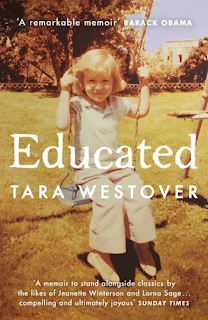
Educated


Wow. I had heard about Tara Westover's memoir, Educated, but I had no idea it was going to be such a remarkable, brutal and exhilarating ride. In clear, calm prose, Westover describes growing up in her fundamentalist Mormon family: her uncompromising, paranoid father; her volatile, violent brother; her midwife mother who begins a business supplying homeopathic remedies and essential oils; her other siblings, some of whom escape from the valley and others who choose to stay loyal.

Some of the elements of Westover's story are extreme -- her father probably lives with bipolar disorder, is convinced of the coming Apocalypse, and believes that all western medicine is literally poison; almost all her siblings at some time or other suffer serious injuries working in their father's junkyard without any safety precautions; the children are 'homeschooled' in theory but in practice are self-schooled. But the heart of the story is an all too ordinary family drama -- a domineering father figure who browbeats the rest of the family into submission, conflicted loyalties, love and anger, attempted rebellions which are sometimes successful and which sometimes backfire horrifically.

Educated is a compulsive page turner, not just in a misery-memoir, how-bad-can-this-get way, but for the determined struggle of Westover herself to break free from the shackles of her upbringing. It's also an enlightening exposure of the way a whole community of people truly believe that any government regulation or intervention in their lives can only be evil, the way they honestly value 'freedom' above all else, whatever its cost. It's terrifying but in its own way, educational.

11.3.21

Eleanor and Park


It's taken me a long time to catch up with Eleanor and Park. I enjoyed Fangirl, Rainbow Rowell's second novel, but Eleanor and Park is even better. I should say that my younger daughter had already read it and wasn't too enthusiastic -- she found Eleanor unlikeable and the ending anti-climactic -- so I was a bit wary going in; but I was completely sucked into Eleanor and Park's story, their friendship that turns to romance, and their family difficulties.

I enjoyed the fact that neither of them are conventionally gender conforming -- Eleanor is a big girl, and wears quirky men's clothing, while Park experiments with eyeliner and hair gel. But their clear appreciation of each other's physicality is delightful. I also enjoyed the mid-80s setting and music, which reflected my own adolescence. Eleanor has a frankly ghastly home life, with the sinister presence of her step-father, Richie, a catastrophe waiting to explode. Park, in contrast, has a loving and supportive family, though his father struggles with Park's seeming lack of typical masculinity.

This is a really good, moving, YA romance. I'm not surprised it's been such a hit (though not with my daughter). The cover of my copy, seen above, is not great -- there is no way that neat, slim silhouetted girl could be Eleanor! Read the bloody book, cover designer!

13.5.19

The Cricket in Times Square

My friend Pam passed this book on to me because she thought it looked like the kind of book I like, ie old. The Cricket in Times Square was a Newbery Award winner in 1961, so it's even older than I am! As I read, dim memories returned -- I think I did read this in Mt Hagen, but only once.

This is a sweet story, whose charm is enhanced by the Garth Williams illustrations (Little House on the Prairie for me will always look the way Williams drew it, just as Narnia will be forever filtered through the vision of Pauline Baynes). However, the charm is marred by a couple of chapters where Mario meets a pair of venerable Chinese gentlemen who sell him a pavilion for his cricket. The characters themselves are treated with respect by the text, but sadly there are pages and pages of dialogue where they speak in supposed Chinese accents ('Velly solly' etc) which these days reads as horribly racist. Perhaps newer editions of the book have had this dialogue altered; it would be easy enough to do, and it would make me feel much more comfortable about sharing this otherwise lovely story.

My favourite scene comes towards the end of the book, where Chester the cricket plays music which drifts up out of the subway and onto the street, and a section of the city falls still to listen. Just gorgeous.

2.5.19

Summer of My German Soldier

Summer of My German Soldier by Bette Greene is one of those classic books that I had never quite got around to reading -- perhaps because it's American, and I tend to neglect the American canon (my bad).

First published in 1973, the novel is narrated by 12 year old Patty, daughter of small town storekeepers in middle America in the middle of World War II. A group of Nazi prisoners of war is stationed nearby, and when one of them escapes, Patty makes the momentous decision to shelter him.

I expected a lot more of the book to be devoted to Patty and Anton in hiding, but in fact she only shelters him for a very short time (though with huge consequences). Much of Patty's background is autobiographical, including the loving Black housekeeper Ruth, who stands in stark contrast to Patty's cold and frankly brutal parents.

I was actually really shocked by how cruel Patty's father is to her; he regularly beats her with a leather belt to the point where she loses consciousness. The obvious parallels are drawn between the domestic brutality of Patty's father and the political cruelty of faraway Hitler. The power of love is raised to counter the horror, but with only limited results. Patty's parents never give her the love she craves, Ruth is helpless to save Patty from the consequences of her actions, and Anton's story has a tragic end.

This is a powerful, sobering story, though old-fashioned in the telling. I'm glad I finally gave it a go.

25.3.19

The Hate U Give

My elder daughter is a Tupac Shakur fan, something I've never understood. After reading this book, I can see why. Angie Thomas is a fan of Tupac, too, and the title comes from his album THUG LIFE -- The Hate U Give Little Infants F***s Everybody.

There has been a lot of buzz around The Hate U Give (a movie version was released in the US last year), and rightly so. Angie Thomas takes us inside Starr's world, a world that most white Australians would know little about. Starr is a girl from Garden Heights, a black neighborhood where gangs and drug dealing and shooting deaths are part of everyday life. She is also a student at the predominantly white, middle class school of Williamson, where she has  found a white boyfriend, Chris, and learned to 'manage' her blackness so as not to be too confronting for her classmates.

The novel begins with the shocking murder of Starr's childhood friend Khalil by a white police officer. As the only witness to the shooting, Starr is immediately in danger, and the book shows the push and pull of her conflicting loyalties in the media circus and investigation that follows. Starr wants to speak up for her friend, but she also wants to protect her family, from the warring gangs of the neighborhood and from the attentions of the police. But nothing is simple in Starr's world: her beloved uncle is also a police officer; her father spent time in jail, but as a trade-off so he could be released from gang allegiance; her boyfriend is white and rich, but he honestly tries to understand Starr's life.

I loved the way that Starr was automatically cool at school, but too daggy for the neighborhood. And I loved the way that her passion for justice slowly builds, so that by the end of the book, Starr has learned to use her own weapon: her voice. Realistically, there is no happy ending here, but there is certainly hope.

20.2.18

Hillbilly Elegy

I borrowed JD Vance's best-selling Hillbilly Elegy from a friend (thanks, Juzzy!) after seeing numerous recommendations online, and indeed the cover of the edition I read is thick with gushing praise, including the claim that it 'explains Brexit and the rise of Trump.'

That's a big call for a fairly little book, and one I don't think is entirely justified. It's also, as far as I can tell, not the intention of the writer.

JD Vance is a young writer, only about thirty, but he tells his story with clarity, insight and keen  awareness of the connections between the personal and the political. He grew up in Ohio, but from 'hillbilly' stock: fiercely loyal, resentful, a law unto themselves. JD's childhood was marred by domestic violence, parental substance abuse and instability. He was saved by the unstinting love and hard work demanded by his grandparents, which saw him eventually graduate in Law from Yale. This is a postcard from the heart of Trump's America, though as Vance is a conservative at heart, he ultimately lays blame for America's malaise on a lack of personal discipline and responsibility rather than systemic political failures.

Some parts of Vance's story were utterly foreign to my own life -- screaming parental fights, wild spending on showy consumer goods, using a pay-day lender to survive till the next pay cheque. But other parts resonated with my own experience. Vance ends up at Yale and realises he has entered another world, one where he doesn't understand the rules of the game.

He was one step ahead of me when I landed at Melbourne University Law School -- I didn't even realise there was a game. Networking, making contacts, befriending lecturers who might give you a recommendation -- I just didn't know that this was part of what university was supposed to give you. But to play the game, you have to understand that the game exists. I was totally clueless. But like Vance, I was the first member of my family to attend university; there was no one to tell me how things worked. It's not enough just to gain access to the institutions of power (interestingly, I'm also now reading about Elena's experience of the same situation in Elena Ferrante's Those Who Leave and Those Who Stay). You also need to navigate the unseen rituals, dress properly, speak properly to the right people, ingratiate yourself, submit articles to the journals that count. And nobody explains that stuff: you're supposed to just know. These are the unseen barriers that shut off opportunities to the poor, even if they scrape into the bastions of the elite.