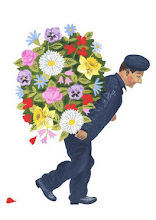
Darkest Night, Brightest Star has a tight cast of characters. Sometimes the reader is able to draw connections that Morgan is a little slower to make. Morgan makes plenty of mistakes as he goes along, but he's lucky to have a handful of people in his life who really care about him, and at the end of the day, that's all any of us can ask for. The book doesn't wrap up everything in a tidy bow, but there is hope for Morgan (maybe not for his dad, who is not a great guy -- though Jonsberg drops us some hints about he became the damaged person that he is, and how he's passed on that legacy to his elder son). I hope boys read this book and perhaps see something of themselves in Morgan. I really liked it. The only element that Jonsberg hasn't tried to deal with here is the pernicious influence of the online 'manosphere' (I wish we had a better name for it), but maybe that's too big a topic to shoehorn into a short novel.
30.3.26
Darkest Night, Brightest Star
24.3.26
He
He is not exactly an autobiography. It's composed of fragments of memory and reflection, some floating free of context, all couched in the safely distancing third person point of view. He does mention his first and second wives (Garner was number two), without naming them, and expresses admiration for Garner's writing without disclosing their relationship! In her diaries, Garner often bemoans V's refusal to admit to feeling or expressing emotion, and it would be hard to imagine a more clinical piece of autobiographical writing, in which the word 'I' never appears!
He is, however, a beautiful work, filled with evocative images and remembrance, though the meaning of each fragment and their connection to each other is left for the reader to put together. I did feel I had a bit of an advantage in understanding Bail's character after seeing him through Garner's eyes -- at first intrigued, then in love, then increasingly frustrated, and finally devastated. Reading He was an interesting exercise, and a window into a certain kind of man's perception of the world. But I'm not sure I want to spend too much time inside his head.
15.10.25
Pissants
Pissants is kind of a novel, and Jack claims that it's fiction, but it reads as more like a series of linked short stories or vignettes in which the same group of characters recur. These are the marginal playing cohort, good enough to get onto an AFL list, not quite good enough to break into the team every week, their playing lives precarious, hostage to their own and others' injuries and form. This group often find themselves at a loose end, perhaps aware that trying harder isn't going to work a miracle, frittering away their days and nights in pointless drinking games and elaborate pranks.
Getting a glimpse into their world is definitely interesting, sometimes disturbing, occasionally very dark indeed. Helen Garner puts it well in her blurb: 'Under its foul-mouthed, laughing bravado lie deep wounds, a humble and endearing loneliness that moved me.' This is the Pissants paradox; though the boy/men move in a pack and grope for identity in each others' reflected presence, ultimately they are heart-breakingly separate from one another. Terrified to show vulnerability or make a genuine trusting connection, they swear and fart and text and hunt and drink and snort and kick and run, each in his own desperate bubble.
We are always being told how problematic masculinity can be. Pissants is like an uncomfortable, entertaining textbook of how it can go so wrong.
21.8.25
28
Brandon Jack, son of rugby great Garry and brother of star AFL player Kieran, spent several years on the Sydney Swans list without ever quite breaking into the regular side. 28 refers to the number of senior games he ended up playing; often he served as an emergency, floating uncomfortably between seniors and reserves. No matter how manically he trained, how much self-punishment he meted out, he could never quite lift himself over that invisible line. For the last couple of years, he lost interest in the game, faking an injury to get out of playing seniors, leading the drinking games and mindless destruction of his fellow fringe players (I expect his recently released novel Pissants will cover these activities in more detail).
There is insight in Jack's story, and he writes with eloquence about trying to belong in a sporting team without losing his sense of self, but the largest pain here, and one he doesn't examine too closely, lies in his family. Jack and his parents were estranged for years (though I gather they have a better relationship now), but we only get glimpses of the casual brutality of his father's expectations and the effect they must have had on Jack and his two brothers. The brothers' decision to change codes from rugby to AFL was a dreadful blow to their father; not wanting to play football at all was unthinkable. But Brandon's true passions are music and writing, not sport.
28 is subtitled A Memoir of Football, Addiction, Art, Masculinity and Love. That's a lot to bite off, and perhaps it's no wonder that Jack can't fully chew the whole mouthful. Still, this is a remarkably candid and painful memoir and well worth a read.
27.8.10
Disclaimer: this post contains gross, unscientific generalisations
Watching a little of the Ben Cousins documentary last night (and I'm not going to comment on it further), I was struck by the strong relationship that evidently exists between Ben and his almost equally famous footballer father, Brian. At one point Brian described himself along the lines that he was "Ben's best friend, his mentor, his role model, his mate," and expressed the hope that Ben seeing the suffering that he was causing him, Brian, would be enough to jolt him out of his destructive behaviour.
I found this particularly interesting because I'd already been thinking about the differences between men who have a strong relationship with their fathers (whether loving or competitive, or both) and men who are more strongly attached to their mothers. Michael has often observed that he, and all his friends, are Mummy's boys - often youngest sons - who are closer to their mothers than their fathers. Traditionally, this has been true of most, if not all, of my male friends. I'm not sure that I even know any men who are close to their fathers.
Are there two types of men in the world? Russel Howcroft, the blokey, aggressive panellist on The Gruen Transfer, spoke in a recent weekend paper about the importance of his relationship with his late father; he says he thinks of him every day. Hm, I thought, he's a Dad's boy; I wonder if Todd Sampson (his "sensitive," more progressive fellow panellist) is a Mummy's boy? And lo and behold, in last week's Sunday Age, there was Todd talking about how his childhood was dominated by his strong, eccentric mother.
Sportsmen often seem to be father's sons. Many of the men I worked with in the music industry were also this type (if it is a type!) - aggressively masculine, competitive, trying to prove something. The mummy's boys, on the other hand, tend to be more comfortable in the company of women, less comfortable with conflict, and yes, some of them are gay.
So what do you think? Go on, shoot me down - please!