Showing posts with label Aboriginal history. Show all posts

4.8.26

Benang: From the Heart

I heard Bruce Pascoe talking about Kim Scott's 1999 novel, Benang From the Heart, as a book that touched him very deeply, a book about the Stolen Generations, and I immediately borrowed it from the local library. I suspect that I wasn't the only one who heard that conversation, as there are now three more reserves.

Benang is not an easy book to read. It's challenging in its structure, leaping backward and forward in time, and with a final massive twist at the end, and its story is filled with confronting pain, sorrow, grief, violence and abuse. It opens with a description of the narrator, Harley, as 'the first white man born,' the first of his family to have his Aboriginal heritage 'bred out' to the point of invisibility. However, as we discover, this is not true. Benang wrestles with questions of identity, both self-ascribed and imposed from outside -- and also, now I come to think of it, recognised by communities.

Benang From the Heart traces a complex history of several generations, and I must confess at times I got lost between characters. There are elements of magic realism, and probably also some autobiographical features: the families' names are given as 'Scat' and 'Coolman,' while Scott mentions the Coleman family in his acknowledgements. I imagine this was a hugely difficult book to write, and it's fitting that it's equally difficult to read, technically and emotionally. I'm surprised that I haven't heard of this novel before, though I'm familiar with Kim Scott's work, particularly Taboo and That Dead Man Dance, which are perhaps more approachable than Benang. A confronting, but rewarding and illuminating, reading experience. 

14.7.26

The Good Country

When I was working on Crow Country, fifteen years ago, I found it quite difficult to discover exactly what had occurred between the First Nations inhabitants and white settlers on Djadja Wurrung country, though I could assume that dispossession was swift and violent. It turns out that the true history was a little more nuanced than that.

I was alerted to the existence of Bain Attwood's The Good Country by my book group friend Cathy, who is moving to Djadja Wurrung country, and I was interested to see that it was reworked and republished at the urging of Djadja Wurrung elder Gary Murray, who was generous enough to read the manuscript of Crow Country and even wrote a foreword. The Good Country is a short book, but packed with research, and tells a story that was no doubt replicated in different areas of Victoria during the first hectic, brutal years of active colonisation. Some settlers were ruthless and cruel; others were compassionate, and understood that Aboriginal people were losing their access to food sources (one wonders why this wasn't obvious to government authorities), and that their 'theft' of food and stock was largely motivated of hunger and desperation. I was shocked to learn that one of the main causes of death among First Nations clans was due to syphilis (guess how that was spread).

I wasn't aware that one of the first experiments with 'protected' areas for First Nations people was set up in Djadja Wurrung country, primarily as a refuge from the activities of violent settlers; however, when official support dropped away, most of the remaining inhabitants were resettled at Coranderrrk, where they had ties of marriage and kin. However, some Djadja Wurrung chose to remain on Country, and some gained employment on pastoral stations or even took part in the gold rush.

The Good Country filled in a large gap in my knowledge, not just of Djadja Wurrung history, but the history of Victoria and Australia, and I'm grateful to both Bain Attwood and Cathy for it. 

28.2.26

Taboo

West Australian Noongar author Kim Scott has been on my radar for a while, but somehow I've shied away from his novels, fearing they might be too harrowing for me. But I was persuaded to pick up his 2017 book, Taboo, by my book group friend Cathy, and I'm so glad I did.

Tilly is a schoolgirl who's recently discovered the truth about her Aboriginal parentage; she finds herself caught up in a kind of cultural camp for Noongar people, returning to their Country after a long exile and horrific history which has rendered that place forbidden until now. The narrative about the adults exploring their heritage, tentatively recovering language, making traditional tools and painting, singing old songs, enveloping young Tilly in a family she's never known, is extremely moving. But there is deep darkness in the story too, not just in the form of past massacres, murder and rape, but in the present, between vulnerable Tilly and sinister Doug, who is also connected to the community.

Taboo contains both horror and humour, and a touch of magic realism that weaves First Nations spirituality through a gothic, haunted story. The book ends with the hint that eventually Tilly will make peace with both sides of her inheritance, despite all the pain that has come before.
 

21.10.25

Warra Warra Wai

Confession: I purchased this book at the Sorrento Writers' Festival because I felt like I should buy something, but my expectations honestly weren't that high, and it's languished at the bottom of my TBR pile ever since. Well, joke's on me, because it's actually really good, and has won a history prize.

Warra Warra Wai, co-written by Darren Rix and Craig Cormick, has a nice premise: it traces Captain Cook's path up the east of Australia, juxtaposing his observations with the stories of the First Peoples who watched his progress, both traditional cultural stories about Country, and stories about Endeavour and its crew. Rix, a First Nations man, did the travelling and interviewing; Cormick stayed in the archives and contributed the often disturbing history of settlement contact and conflict.

I think because it's divided into bite-sized chunks with each new tribal Country that Cook passed, this is not an overwhelming read; it becomes a fascinating travelogue as well as a history, with glimpses into each local language and Dreaming stories. It would make a wonderful companion to a leisurely road trip from Victoria up to Cape York, insightful and packed with history which too often whitefellas just don't know. 


22.5.25

Unsettled

Kate Grenville's non-fiction meditation, Unsettled, is one of the best books I've read this year. Grenville is well-known for her novels based on her family's history: The Secret River, Sarah Thornhill, Restless Dolly Maunder. She's also written Searching for the Secret River, which is an account of the research process she went through while writing the first of those novels. Unsettled is a different kind of journey, though she often refers to that research and ancestral history. But this time, she's looking at the bigger picture -- not just the individuals of her family and the choices they made, but how those choices fitted into a broader colonial narrative.

Grenville takes a simple but effective structure, retracing various ancestors' movements, from that first settlement on the Hawkesbury, further and further out from Sydney, finishing with the farm where her own mother was brought up. Along the way, she reflects on the way 'settlement,' or more bluntly, stealing land from First Nations people, must have felt for both the colonists and the dispossessed. She brilliantly examines the way our language serves to obscure the reality of what happened -- how we speak of settlers 'taking up land', when we really mean 'taking land.' Squatters 'got' land, women 'were never left without a gun.' What horrors are those bland words hiding?

There are plenty of challenging ideas here, but Grenville leads us through the landscape and her own thoughts gently but firmly, never allowing us to turn away completely, while acknowledging the strong urge to hide from the truth that has gripped our nation from its beginnings. She ends on a hopeful note, visiting the memorial to the Myall Creek massacre, the only occasion when white men were hanged for the murder of Aboriginal people -- a memorial that was constructed after local inhabitants, Black and white, sat down together to commemorate their shared, painful history.

Unsettled would be a perfect book to give to someone just learning about Australian history, or someone who grew up when we weren't taught the truth. It is confronting, but it's not sanctimonious or preachy, and it's engagingly easy to read; we travel beside Grenville as she works through her own feelings and thoughts. Yes, it's written from a white person's point of view, but as a first hand struggle with accepting and sitting with our shameful past, it's intimate, valuable and powerful.
 

1.5.25

Always Was, Always Will Be


I was lucky enough to see Thomas Mayo speak at the recent Sorrento Writers Festival. In person, he is a calm, strong, gentle presence, the very embodiment of healthy masculinity. Always Was, Always Will Be was written in the aftermath of the unsuccessful Voice referendum which had such a disappointing result and seems to have virtually shut down any further discussion of First Nations issues since. It wasn't until some far-right dickheads disrupted the Anzac Day Welcome to Country speech that any politicians even mentioned Aboriginal issues in the current election campaign.

But Always Was, Always Will Be begins and ends with a message of hope and optimism. It's subtitled 'the campaign for justice and recognition continues,' and it contains numerous practical ideas for allies to take the fight forward. As Mayo points out, every other step toward equality and justice has at first been met with opposition and hostility, and yet slowly the cause has crept in the right direction.

The book is less than two hundred pages, but it neatly summarises the history of First Nations peoples since colonisation, a history of oppression and pain that even in 2025, many Australians would prefer to deny or forget, or are simply ignorant about. Without this basic historical understanding, there will never be justice. Always Was, Always Will Be is engaging and simply written, without bitterness or blame, and I hope it will provide a perfect starting place for anyone who is curious about First Nations issues.

15.10.24

Dirrayawadha

Anita Heiss is a best selling, award winning Australian author. She also happens to be a Wiradyuri woman, and in Dirrayawadha (Rise Up) she explores the troubled, tragic history of colonisation around the Bathurst area, Wiradyuri country.

Dirrayawadha centres on a love story between a Wiradyuri woman, Miinaa, and an Irish convict, Dan O'Dwyer. But Dan and Miina work for a pair of white settlers, and Miinaa's brother is the famous warrior Windradyne, who led the First Nations resistance in the eighteenth century. Love, joy and loyalty are inextricably intertwined with brutality, loss and tragedy.

This is an important story, and we need more stories about colonised Australia that centre the First Nations point of view. Heiss also draws an interesting parallel between First Nations dispossession and  the history of Ireland, also violently colonised by the British. I'm not aware of any Irish political prisoners, like Dan, who could clearly see the comparison between the two, but it's a fascinating idea that gave me food for thought. Like Melissa Lukashenko's Edenglassie, this book also includes many First Nations words.

In some ways, Dirrayawadha adopts a modern sensibility, perhaps intentionally, which might help a wider readership more easily relate to the power dynamics of the historical situation. Expressions like hyped-up, maintaining autonomy, racism, culture, self-worth, and you don't get it might be anachronistic, but if they gain this novel more readers, I'll swallow it.

9.9.24

First Knowledges: Innovation

I've enjoyed reading all the volumes in the First Knowledges series (this is the seventh title, and there are at least four more scheduled), but Innovation: Knowledge and Ingenuity, by the husband and wife team of Ian McNiven and Lynette Russell, is one of the best. It serves as a brief, digestible history of Australian First Nations peoples and the adaptations and inventions they have made over their long 65,000 year occupation of this continent.

There has long been a notion that First Nations people lived in a static, changeless world, stuck in a 'Stone Age' lifestyle. In fact, they were quick to adapt and change as their environment changed, willing to develop new methods of hunting and trapping (like the ancient, massive fish traps at Budj Bim), adopting some foreign inventions (like using Reckitt's Blue laundry powder for painting, or glass and ceramic for spearheads) and rejecting others. Even when missionaries attempted to introduce Christianity to First Nations communities, it was usually added to their existing spiritual beliefs, rather than replacing them.

It's impossible to read this book and not come away with a profound admiration for the resilience and ingenuity of First Nations people, both before and after colonisation.

15.3.24

Blood on the Wattle

I can't believe it's taken me this long to read Blood on the Wattle, Bruce Elder's book about Aboriginal massacres and mistreatment which was first published as far back as 1988. There really is no excuse for saying 'we didn't know;' Elder collects together previously published material into one numbingly awful litany of slaughter.

Bruce Elder is not an academic, but a journalist, and he suggests that this might be the reason why he and this book were largely spared the attacks that the so-called 'black armband' historians received in the 1990s. There is a chapter included in this edition where Elder explains why the objections of the anti-black armband crew don't stand up; it beggars belief that all these stories, passed down through oral history in First Nations communities, should be invented or exaggerated, especially when there is plenty of other proof to be found, as David Marr's Killing For Country demonstrates.

There is no real central thesis or narrative here, it is a painful list of events which do start to almost blur together. Blood on the Wattle is not as beautifully written as Killing For Country, and Elder makes no attempt to pretend he is being 'objective' -- he is sickened and ashamed, and rightly so. Blood on the Wattle has been used as a school text for decades, and yet it does seem that the average white Australian is still ignorant of this basic history, or worse, knows about it and doesn't care.

Feeling depressed.

14.2.24

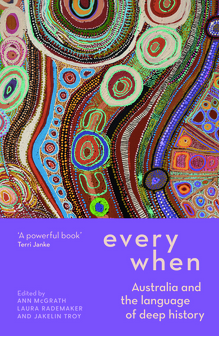
Everywhen

I pounced on this book from my new favourite place in the world, the Atheneaum Library, on the strength of the title alone: Everywhen: Australia and the language of deep history. When I give school talks on Crow Country, I try to convey something of the pre-invasion First Nations world view -- the deep interconnectedness of Country, the importance of secrecy and accuracy of knowledge in an oral culture, and their different attitude to time. In the simplest possible terms, while Western cultures tend to conceptualise time like an arrow, or a conveyor belt, moving inexorably from the past into the future, First Nations cultures have a much more cyclical experience of time, tied to the movement of seasons and stars, and a sense of the on-going events of the Dreaming as existing in a kind of living, eternal present, rather than in a distant, far removed past. My understanding is pretty shallow, but the authors of this collection bring a more nuanced and sophisticated approach to this idea.

Honestly, if I'd realised just how scholarly Everywhen was going to be, I might have thought twice about borrowing it, but I'm so glad I persevered. Some of the essays are deeply personal, like Jakelin Troy's account of standing between the snowy mountains of her ancestors and the sky, or Shannon Foster's reflections on being locked away from rock engravings around Sydney, on D'harawal land, in order to 'keep them safe.' There are pieces here that examine the role of music and song, that outline the way performance of ancient songs and stories helps to bring the deep past into the present moment, or the challenge for linguistics of trying to recover the languages lost since white settlement.

After the shock and despair of reading Killing For Country, it was heartening to explore these essays and to realise that there are so many people working so earnestly to preserve, to recover and to engage with the oldest living culture in the world, and hopefully to share a new perspective on what it means to live on and with our fragile planet.

12.2.24

Killing For Country

Killing For Country is a remarkable, scorching book. Journalist David Marr was digging through his family history at the behest of a relative when he stumbled across a photograph of his two-times great-grandfather dressed in the uniform of the Native Police, a notoriously brutal group who specialised in 'dispersing' (ie slaughtering) Aboriginal tribes in Queensland in the latter part of the nineteenth century.

Marr forensically lays out the records, from official correspondence, newspaper reports, private diaries and letters, which bulge with proof of large-scale massacres and individual killings on the frontier -- a history we never learned or even suspected at school, a history that was silenced, covered up and ignored for far too long. There are no more excuses for ignorance. This land was brutally stolen, its inhabitants murdered.

David Marr says he doesn't feel guilt for the actions of his ancestor, but he does feel shame. And so should we all. The detail of this clear, intelligent account is incontrovertible. Many times while reading Killing For Country, I had to lay down the book to catch my breath in disbelief and horror. Anyone who still believes that the history of white settlement has suffered from a false 'black armband' view should be made to read Killing For Country.
 

22.12.23

Manganinnie

I've developed a fascination with old Australian children's books that address the issue of Aboriginal people and their place in the nation. Unfortunately many of them take the attitude that First Nations people are facing an inevitable decline, tragic as that may be -- and extraordinarily, that is true even of Manganinnie, which was published as late as 1979. Bizarrely, it was translated into French and Japanese, and won the French children's book of the year in 1986. It was also made into a film, which to my astonishment was easily found on SBS (I watched a few minutes but the technicolour costumes gave me a headache).

I cannot imagine a contemporary child reading this book. On one level, it's quite a lovely story, following old Manganinnie as she moves through the year and the landscape, searching for her vanished
 people after the 'Black Drive' of 1830. Along the way, from loneliness and fear of all her knowledge being lost, she kidnaps a white toddler who stays with her for three years. There are some narrow escapes for the outlaw pair, and encounters with various animals, but on the whole it's quite an uneventful journey, lyrically described, but shot through with the sorrow and desolation of Manganinnie, alone in the wilderness and with the white settlers always drawing closer.

There is an air of tragic inevitability to Manganinnie's experience, and while she is sympathetically portrayed (by the white author) and many words of language are sprinkled through the narrative, there is never any doubt that these are the old woman's final days. I suspect this attitude still survives in pockets of this country; even though some people may draw the line at the physical extermination or dying out of First Nations people, they certainly see no place for their culture or beliefs in a modern Australia. For that reason, I'm glad that Manganinnie is no longer on the shelf of the op shop where some unsuspecting young person might actually read it.

27.9.23

First Knowledges: Law

As an outspoken supporter of the Yes case for the upcoming Voice referendum, Marcia Langton has copped a heap of abuse. At recent appearances, she looks exhausted, and fed up, as well she might. You get the impression that Marcia Langton doesn't suffer fools gladly, and that she comes across a lot of fools.

The latest installment of the First Knowledges series, Law: The Way of the Ancestors, is co-written by Langton and Aaron Corn, and it lays out in basic, approachable terms the foundations of traditional (and continuing) First Nations law. Obviously in a slim volume like this, the reader can be given only a simple understanding of an extremely complex body of knowledge, but Langton and Corn succeed in explaining some simple concepts and illustrating them clearly, often with the use of graphics and traditional design. Their explanation of Michael Nelson Jagamarra's beautiful mosaic in the forecourt of Parliament House, Possum and Wallaby Dreaming, is a particular delight.

The tracks of Possum and Wallaby slowly and humbly approach the meeting place, a great white-hot fire, around which radiate the ceremonial colours, each of which is associated with a different Warlpiri group, each of whom in turn is responsible for a particular group of ceremonies and ritual, all interdependent on the others. There are more layers of meaning and relationship which are too complex to repeat here and which leave me breathless with wonder and awe at the intricate web of story and tradition which bind communities together. 

The emphasis throughout is on the maintenance of balance and stability, never allowing one individual or group to become more powerful or dominant over the rest. Patterns of familial responsibility and marriage ties ensure that everyone has a deep stake in the preservation of land and lore. It's a system that worked brilliantly for over 60,000 years, yet was flexible enough to allow for adaptation and innovation -- until the catastrophe of invasion.

The First Knowledges series is such a fantastic introduction to First Nations ideas and practices, and I'm thrilled to see that the series, originally intended to comprise six volumes, has been extended to include further titles on Innovation, Medicine and Seasons. I can't wait to read them.


26.9.23

The Lamb Enters the Dreaming

I have taken a long time over reading Robert Kenny's award-winning The Lamb Enters the Dreaming, partly because the complexity of the subject matter required careful concentration, and partly because I wanted to savour it and let it sink in.

Kenny examines the story of Nathanael Pepper, one of the first Aboriginal converts to Christianity in the Western District of Victoria; but as well as thinking about the point of view of the missionaries and their joy at recruiting a local Australian (who seemed largely impervious to the message of Jesus), Kenny also looks at what might have been gained for Pepper himself, and how he might have found sense and meaning in integrating the Christian story with his own traditional culture and also the catastrophic impact of invasion.

One really interesting point that Kenny makes is that it was probably the animals that the invaders brought with them, rather than the humans, that were the most shocking intrusion into the Aboriginal cosmology. First Nations people were used to large two-legged beasts -- emus, kangaroos -- and suddenly these big, alien four-legged animals appeared from nowhere: cows, sheep, and most alarmingly, horses. How were they to make sense of these shocking new life-forms? Men on horseback must have seemed like some bizarre hybrid species. As Kenny says, it must have seemed as if the Martians had landed. And were the white humans there to serve the animals, or the other way round?

The Lamb Enters the Dreaming is deeply thought-provoking and fascinating stuff. Not light reading, but very rewarding.
 

30.12.22

First Knowledges


What a fantastic initiative the First Knowledges series of books has been! I've now read all six that have been published so far, and I'm looking forward to reading the next volumes on Law and Plants when they become available. Possibly I'm the ideal reader for these books -- someone who is (mostly) uninformed but interested, and eager to find out more about Indigenous knowledge and practice. These volumes are not too long or too academic to be daunting, but I've learned so much from them.

Design: Building on Country by Alison Page and Paul Memmott explores both the history of Aboriginal building practices, and an approach to building and architecture in Australia that is highly responsive to the landscape -- the flow of air and sunlight, an interplay between outside and inside, and a recognition and respect for cultural requirements that allows for gathering spaces and spaces for separate withdrawal. I must admit I hadn't given much thought to Aboriginal structures (colonial baggage!) but of course there is a very long history of temporary building -- from windbreaks by a fire for a single night's camping, to semi-permanent stone footings with seasonal roofing, like those seen at the Brewarrina and Budj Bim fish traps, where food was abundantly available for long stretches of the year. I love the idea of these impermanent structures and the way they sit so lightly in the landscape, so different from the concept of a permanent house and home that I am personally so attached to -- it really challenged my ideas of what a home means. Of course, for First Nations people, their Country is home.

Astronomy: Sky Country by young female Indigenous astronomers Karlie Noon and Krystal De Napoli opens with personal, sobering accounts of how they developed their interest in the stars and the challenges they each faced in accessing schooling and further education. It introduced me to the idea that Country comprises the sky as well as the land, and warns of the danger to star observation posed by light pollution everywhere. In one of those weird coincidences that seem to dog my reading journey, on the very day that I finished this book, I turned on the radio and found Noon and De Napoli discussing their work with Phillip Adams on Late Night Live!

24.6.22

The Memory Code

This utterly fascinating book was lent to me by my friend Chris Kelly (no relation). I'd previously read Lynne Kelly's book in the First Knowledges series, Songlines, co-authored with Margo Neale, and I'm looking forward to reading Memory Craft, which I gather is more of a practical guide to putting Kelly's insights into practice.

Lynne Kelly's key revelation in The Memory Code is that many, if not all, ancient monuments are actually what she calls 'memory spaces.' Extrapolating from the idea of Australian Indigenous songlines, in which landscape and story are sung together as a way of preserving knowledge (practical survival knowledge as well as sacred stories), she imagines the transitional time in human history between living as hunter-gatherers and becoming settled food producers. She reasons, very plausibly, that the intimate hunter-gatherer knowledge would still be highly valued -- but how to preserve that oral knowledge when walking the landscape was no longer a permanent way of living? She theorises that structures like Stonehenge, the animal shapes traced in the desert at Nasca, the immense statues on Rapa Nui and others, were constructed as memory devices, to be walked or observed as an aid to calling up elaborate images or stories that embed vast amounts of remembered information.

Kelly gives an exhilarating account of her own experience of using her own neighbourhood to absorb and recall more information than she would have thought possible, and gives some hints of the way different streams of knowledge begin to intertwine and inform each other, enriching the whole way she looks at the world -- this is why I'm looking forward to finding out more in Memory Craft. Her theory seems to me totally plausible and hugely important, showing us how Indigeous knowledges can help us to understand other civilizations, and also a key to perhaps deepening our own relationship to our precious world.