Showing posts with label Australian history. Show all posts

9.11.26

A Room Made of Leaves


Attentive followers will have noticed that I've been on a bit of a Kate Grenville binge lately -- I intended to have a break after Restless Dolly Maunder, but then I came across this beautiful hardcover copy of A Room Made of Leaves in Savers, and it was too much of a bargain to ignore.

A Room Made of Leaves sees Grenville return to the early years of Australian settlement, this time through the eyes of Elizabeth Macarthur, and to one of her favourite subjects, the hidden history of women's experience. In Grenville's telling (historically plausible), Elizabeth is an intelligent, sensitive woman, shackled to an overbearing, quarrelsome and selfish husband who needs to be carefully managed. Grenville quotes from Elizabeth's actual letters, but puts her own ironic spin on the words, and she also softens Elizabeth's attitude to the First Nations people her successful sheep farm displaced. 

I really enjoyed A Room Made of Leaves. It's beautifully readable and vivid, and the portraits of John and Elizabeth Macarthur are compelling. Grenville allows herself to show a secret side to William Dawes, who was the subject of her earlier novel The Lieutenant -- not supported by historical evidence!

23.10.26

Alice's Dreaming

Alice's dreaming was an unexpected, lovely and bittersweet book, a chapter of the long and painful history of interactions between Australian First Nations people and colonisers which for once left me with a feeling of hope. Distinguished historian Tom Griffiths tells the story of Alice Duncan-Kemp, brought up on an outback station on south Queensland's Channel Country in the early years of last century. As a child, she had an extraordinary education from the original inhabitants -- 'the landlords' as her father called them -- and shared in (some) cultural and environmental knowledge, which she drew on in later life when writing memoirs of her childhood and the history of the region.

Alice felt a deep connection to the country and its people, and ironically her books, diaries and papers have proved an invaluable record of cultural practices, stories and even language that might otherwise have been lost. However, charges of plaigarism tarnished her legacy -- I actually groaned aloud when I came to this section of the book -- and her books, though lauded at the time, have fallen into obscurity. Griffiths delicately explores questions of authenticity, memory, and multi-sided truth as he looks at Alice's history in parallel with the life of an Aboriginal boy of the same age in the same area, Bill Gorringe.

At the end of Alice's dreaming, Alice's descendants and First Nations people come together to assess and share the mass of material left behind by Alice and members of the Gorringe family, and share a ceremony on Country. It's such a beautiful moment, and sadly an unusual collaboration. But it opens a window to other possible close relationships between First Nations people and the invaders who also came to love the land -- I really hope that there are other stories like this waiting to be told.
 

16.9.26

The Model Murder

I am really enjoying Amanda Hampson's series of Tea Ladies mysteries. This latest installment, The Model Murder, is set in 1968 and times are changing. Protests against the war in Vietnam are in the streets, pop art frocks are on the way in, but Hazel and her friends are once again drawn into a shadowy world of crime and corruption, brothels and bookies.

The Model Murder is a clever title, as we're not sure until almost the end of the novel whether the missing model in question is a victim or the perpetrator of the killing. This book abounds with deceptions, lies and fake identities. Stern, self-righteous Merl has been hiding a secret for thirty years, and when the reason for it is finally revealed, it expands the tea ladies' universe a little more. Betty gets caught up in an avant-garde theatre group, whose members are not all they seem, and whose workshops are painfully funny for any student theatre victim-survivors. Irene finds herself a new weapon, which will no doubt feature in future volumes. And I hope there are future volumes. The Tea Ladies are undemanding but highly enjoyable company.
 

8.9.26

Restless Dolly Maunder


After the success of Kate Grenville's exploration of her mother's story in One Life, Grenville went back another generation to explore her maternal grandmother's life in Restless Dolly Maunder. Dolly appears in One Life as a difficult, sometimes cold and demanding woman; in Restless, she comes fully into focus as an energetic, thwarted character who could have achieved so much more if she'd been allowed the same freedoms and opportunities as a man.

Interestingly, while One Life was classed as a biography, Restless Dolly Maunder is published as a novel. I guess Grenville felt that the gaps she had to fill with imagination and speculation were that much larger for her grandmother than for her mother. In some ways, I didn't serve Dolly Maunder well by reading her book straight after One Life, because it covers much of the same ground and I didn't feel I was encountering a new person, though Dolly's story is much more fleshed out and she is more sympathetic than her portrayal in One Life.

I enjoyed Restless Dolly Maunder for the same reasons that I loved One Life: it's a window into a life that would have otherwise gone unremarked and uncelebrated, a life of a courageous, smart, determined woman who did her best with the hand she was dealt, sometimes at the cost of her closest personal relationships. (Her husband's infidelities also played a role, to be fair.) Kate Grenville has mined her family's history to great effect, I could read any number of these stories, but I guess she might have run out of material by now.

22.8.26

One Life: My Mother's Story

I enjoyed Kate Grenville's One Life so much -- more than I expected to. She is just such a readable writer, even when handling material that by her own admission, might seem very ordinary. It's a biography of Grenville's mother, Nance, but it reads like a novel, and I kept eagerly turning the pages.

Mind you, Nance was not really such an ordinary woman. One her friends described her as 'remarkable,' and in many ways she was exceptional, despite living all her life in sleepy Australian towns and suburbs. But even the most ordinary lives contain their own drama and pathos. Nance was the child of an unhappy marriage, of pub owners Dolly and Bert (Grenville has also written about her grandmother in Restless Dolly Maunder, which I might check out next). (The pub owning background was also interesting on the heels of reading Australian Gospel.) Nance trains as a pharmacist at a time when it was unusual for woman to gain professional qualifications, but once she's attained her apprenticeship, she's qualified herself out of a job. She marries Kenneth, a closet Trotskyist, and their partnership has its ups and downs -- he's proud of her for working, but is clueless about taking up the domestic burden. Time and again Nance is thwarted by lack of childcare in her community.

One Life is a loving, clear-eyed tribute to a woman whose story becomes extraordinary in Grenville's hands, and a kind of first hand history of the middle decades of Australia, covering the Great Depression and the wars. I loved it.
 

4.8.26

Benang: From the Heart

I heard Bruce Pascoe talking about Kim Scott's 1999 novel, Benang From the Heart, as a book that touched him very deeply, a book about the Stolen Generations, and I immediately borrowed it from the local library. I suspect that I wasn't the only one who heard that conversation, as there are now three more reserves.

Benang is not an easy book to read. It's challenging in its structure, leaping backward and forward in time, and with a final massive twist at the end, and its story is filled with confronting pain, sorrow, grief, violence and abuse. It opens with a description of the narrator, Harley, as 'the first white man born,' the first of his family to have his Aboriginal heritage 'bred out' to the point of invisibility. However, as we discover, this is not true. Benang wrestles with questions of identity, both self-ascribed and imposed from outside -- and also, now I come to think of it, recognised by communities.

Benang From the Heart traces a complex history of several generations, and I must confess at times I got lost between characters. There are elements of magic realism, and probably also some autobiographical features: the families' names are given as 'Scat' and 'Coolman,' while Scott mentions the Coleman family in his acknowledgements. I imagine this was a hugely difficult book to write, and it's fitting that it's equally difficult to read, technically and emotionally. I'm surprised that I haven't heard of this novel before, though I'm familiar with Kim Scott's work, particularly Taboo and That Dead Man Dance, which are perhaps more approachable than Benang. A confronting, but rewarding and illuminating, reading experience. 

14.7.26

The Good Country

When I was working on Crow Country, fifteen years ago, I found it quite difficult to discover exactly what had occurred between the First Nations inhabitants and white settlers on Djadja Wurrung country, though I could assume that dispossession was swift and violent. It turns out that the true history was a little more nuanced than that.

I was alerted to the existence of Bain Attwood's The Good Country by my book group friend Cathy, who is moving to Djadja Wurrung country, and I was interested to see that it was reworked and republished at the urging of Djadja Wurrung elder Gary Murray, who was generous enough to read the manuscript of Crow Country and even wrote a foreword. The Good Country is a short book, but packed with research, and tells a story that was no doubt replicated in different areas of Victoria during the first hectic, brutal years of active colonisation. Some settlers were ruthless and cruel; others were compassionate, and understood that Aboriginal people were losing their access to food sources (one wonders why this wasn't obvious to government authorities), and that their 'theft' of food and stock was largely motivated of hunger and desperation. I was shocked to learn that one of the main causes of death among First Nations clans was due to syphilis (guess how that was spread).

I wasn't aware that one of the first experiments with 'protected' areas for First Nations people was set up in Djadja Wurrung country, primarily as a refuge from the activities of violent settlers; however, when official support dropped away, most of the remaining inhabitants were resettled at Coranderrrk, where they had ties of marriage and kin. However, some Djadja Wurrung chose to remain on Country, and some gained employment on pastoral stations or even took part in the gold rush.

The Good Country filled in a large gap in my knowledge, not just of Djadja Wurrung history, but the history of Victoria and Australia, and I'm grateful to both Bain Attwood and Cathy for it. 

16.3.26

Mr & Mrs Gould

Grantlee Kieza is a prolific author of Australian history and biographies. My younger daughter gave me Mr & Mrs Gould for Christmas, because she figured the combination of Australian history and birds would be a winner, and she was mostly right. It's a shame that Mr Gould himself wasn't a more attractive character, which took the shine off his story a little bit.

John and Elizabeth Gould arrived in Australia in 1838, already established as pre-eminent naturalists and producers of wildlife books; The Birds of Australia would make Gould more famous and very rich. John organised and carried out the collection of specimens, while Elizabeth, who at the time of their Australian trip was into her seventh pregnancy (at 34 -- when I was just getting started! Gulp), was responsible for the extraordinary illustrations, many of which are reproduced in this book. Kieza has done his research thoroughly, and provides all kinds of social and scientific background; it appears that it was humble John Gould who first suggested to Charles Darwin the possibility of natural evolution.

John Gould was a hard taskmaster and a relentless worker who didn't treat his subordinates very well, and he was a bit rough round the edges in a world people largely by gentlemen amateurs. However, he does seem to have been genuinely loving to his wife and grieved her deeply when she died, though Elizabeth never received her full credit for his commercial success. Mr & Mrs Gould is a readable and engaging popular history which taught me a lot about early colonial Australia and its abundant ornithological wonders. And the pictures are gorgeous.
 

24.2.26

The Middle of Nowhere

I like Geraldine McCaughrean's books. I loved The White Darkness, and she's written 170 books and won numerous awards, so she's clearly doing a lot right. The Middle of Nowhere is a pacy, often frightening, high stakes drama set in the Australian Outback in the late nineteenth century. Comity's father is a telegraph operator on a remote repeater station; her mother has just died from snakebite. Comity is comforted by her friend Fred, an Aboriginal boy. But when the new assistant, Quartz Hogg arrives, he has brutal schemes up his sleeve...

As an historical adventure story, I enjoyed The Middle of Nowhere. But I did have a few problems, starting with the cover of my edition, which unlike the one shown here, features a silhouette of an Aboriginal figure in a stereotypical pose, standing on one leg and braced by a spear. I appreciated Fred's use of language throughout the book, but his ostracism from his mob didn't quite ring true -- I just couldn't believe it when Comity told her father, 'Fred has no people.' (This shunning was sort of explained in the text, but I didn't buy it.) There were other small weird moments, like when Comity's father gives her dollar coins, or when Horse suddenly changes gender for part of a chapter. I'm sure McCaughrean took pains to achieve historical and cultural accuracy, but small slips kept pulling me out of the story. Would I have noticed or cared if the novel had been set in, say, Venezuela? Absolutely not, and I'm sure I've brushed past the same kinds of errors in Eva Ibbotson's books that would have driven me crazy if I were actually Venezuelan.

On the other hand, McCaughrean doesn't flinch from showing the racism and cruelty of settler society (though Comity's family are almost too progressive to be true). So a mixed review from me. 

21.10.25

Warra Warra Wai

Confession: I purchased this book at the Sorrento Writers' Festival because I felt like I should buy something, but my expectations honestly weren't that high, and it's languished at the bottom of my TBR pile ever since. Well, joke's on me, because it's actually really good, and has won a history prize.

Warra Warra Wai, co-written by Darren Rix and Craig Cormick, has a nice premise: it traces Captain Cook's path up the east of Australia, juxtaposing his observations with the stories of the First Peoples who watched his progress, both traditional cultural stories about Country, and stories about Endeavour and its crew. Rix, a First Nations man, did the travelling and interviewing; Cormick stayed in the archives and contributed the often disturbing history of settlement contact and conflict.

I think because it's divided into bite-sized chunks with each new tribal Country that Cook passed, this is not an overwhelming read; it becomes a fascinating travelogue as well as a history, with glimpses into each local language and Dreaming stories. It would make a wonderful companion to a leisurely road trip from Victoria up to Cape York, insightful and packed with history which too often whitefellas just don't know. 


13.10.25

A House Divided

I enjoyed Clare Hallifax's middle grade novel, A House Divided, immensely. I guess it would be classed as historical fiction, as it's set in 1975, the year of the Whitlam dismissal. My family was in PNG in the mid-70s, so I don't remember anything contemporary from this time; I didn't become aware of (and horrified by) these political events until a few years later. 

In A House Divided, grade 6 student Juliet's dad works in the heart of the Whitlam government, and journalists, public servants and politicians, even Gough himself, are familiar figures in her home. But Juliet's grandmother is much more conservative, and her new friend Robbie's parents are alos public servants, but lean more to the right. It's not all politics, though; this is also a story about tensions in a friendship, and just about growing up in the Australia of the 70's -- watching Countdown and Dr Who, the excitement of colour TV, riding bikes and swimming unsupervised, boring food, European migration, the loosening of divorce laws, no smart phones for easy contact, Norman Gunston.

A House Divided was a really fun and engaging read, and I hope that kids find it and enjoy it for its own sake, and not for the nostalgia that undoubtedly coloured my own experience. (PS What a gorgeous cover!) 

22.9.25

The Deadly Dispute

We are now up to number three in Amanda Hampson's Tea Ladies mysteries. The Deadly Dispute takes us up to 1967 and modernity is definitely encroaching on the tea ladies' world. Replaced by a coffee machine, Hazel has been unemployed for eighteen months when she's offered a job with a trade union; Irene has given up serving tea altogether and is now a cleaner at a brothel. Naive Betty is exposed to free love, drugs and feminism when she makes friends with a young woman at her clothing factory. Fourth member of the gang, Merl, is somewhat sidelined in this story after she takes offence at the decisions of the Tea Lady association.

But the real action is down at the docks, where Hazel soon finds herself up to her neck in trouble and smuggled Krugerrands. I was reminded that these novels take place in the same locale as Ruth Park's Harp in the South books, albeit somewhat later. Hampson does an excellent job of evoking 1960s Sydney and the social and political currents of the time, as well as an engaging crime story which proves that middle aged ladies can be effective action heroines -- Betty has no need to mourn for her wasted youth.

I'm really enjoying this series and while I'm not sure if there are further adventures in store for the intrepid tea ladies, I certainly hope that they don't hang up their pinnies any time soon.
 

22.8.25

The Harp in the South

I was inspired to go back to Ruth Park's Harp in the South novels after reading her autobiographies. I read the final volume, Poor Man's Orange, years ago for school, but I wasn't even aware that Park had written a prequel, Missus, in the 1980s. So I pounced on this omnibus edition when I found it at the Athenaeum.

Well, I tried Missus, but it wasn't for me. Somehow I couldn't connect with the characters and the story seemed forced. But once I plunged into The Harp in the South, all was forgiven. Mumma and Hughie, Dolour and Roie, leapt off the page in their brave struggles with poverty and bad luck. I can see why The Harp in the South caused such controversy when it was first published, with people protesting that such scenes of deprivation couldn't be true. But Park and her husband had themselves lived in the streets of Surry Hills and witnessed the lives of people like the Darcys firsthand. 

There is much humour and joy in this novel, but Park doesn't shy away from either the everyday sufferings like bedbugs, rats, ragged clothes and shared beds, or the grimmer realities of alcoholism, violence, and back street abortion. (The latter was probably the true source of the outrage at the time.) I remember being very confused by Roie's name when I first encountered it -- was it a fancy way of spelling Roy? Eventually I realised it was short for Rowena. I'd also forgotten, or never realised, that Charlie, Roie's eventual husband, has Aboriginal heritage, though he is disconnected from his people. It'll be interesting to see how much of Poor Man's Orange, if anything, has stuck since Year 9 English!
 

3.7.25

Searching for the Secret River

Having read Kate Grenville's brilliant Unsettled not long ago, it seemed like fate when Searching for the Secret River popped up on Brotherhood Books. It made a very interesting companion read, because it covers some of the same ground, but from quite a different angle. As a writer, it was fascinating to follow Grenville through the process of writing this big, important, successful novel, from the first scratch of interest in her family history and the stories handed down, all the way to the final edit, and the multitude of decisions along the way. In Unsettled, the emphasis is squarely on her awareness and assumptions about First Peoples, and interrogating the family stories with fresh knowledge. One of the very first prompts for rethinking came early on, when a First Nations writer helped Grenville to query what 'taking up land' really meant -- it meant 'taking.'

This is a story Grenville also tells in Unsettled; it was clearly a formative moment. Despite its wide success, The Secret River was not an uncontroversial novel. It was criticised for not including the voices of its Aboriginal characters; Grenville reveals that was a deliberate, and in its own way, respectful choice. Inga Clendinnen fiercely argued that Grenville confused history and fiction; I'm not sure that's true. The project of fiction is not the same as the project of history, and Grenville is aware of that all the way through.

I'm so glad I read this book, though it might not be as totally fascinating for everyone. It got me through a long night in the emergency department of our local hospital, if nothing else!
 

22.5.25

Unsettled

Kate Grenville's non-fiction meditation, Unsettled, is one of the best books I've read this year. Grenville is well-known for her novels based on her family's history: The Secret River, Sarah Thornhill, Restless Dolly Maunder. She's also written Searching for the Secret River, which is an account of the research process she went through while writing the first of those novels. Unsettled is a different kind of journey, though she often refers to that research and ancestral history. But this time, she's looking at the bigger picture -- not just the individuals of her family and the choices they made, but how those choices fitted into a broader colonial narrative.

Grenville takes a simple but effective structure, retracing various ancestors' movements, from that first settlement on the Hawkesbury, further and further out from Sydney, finishing with the farm where her own mother was brought up. Along the way, she reflects on the way 'settlement,' or more bluntly, stealing land from First Nations people, must have felt for both the colonists and the dispossessed. She brilliantly examines the way our language serves to obscure the reality of what happened -- how we speak of settlers 'taking up land', when we really mean 'taking land.' Squatters 'got' land, women 'were never left without a gun.' What horrors are those bland words hiding?

There are plenty of challenging ideas here, but Grenville leads us through the landscape and her own thoughts gently but firmly, never allowing us to turn away completely, while acknowledging the strong urge to hide from the truth that has gripped our nation from its beginnings. She ends on a hopeful note, visiting the memorial to the Myall Creek massacre, the only occasion when white men were hanged for the murder of Aboriginal people -- a memorial that was constructed after local inhabitants, Black and white, sat down together to commemorate their shared, painful history.

Unsettled would be a perfect book to give to someone just learning about Australian history, or someone who grew up when we weren't taught the truth. It is confronting, but it's not sanctimonious or preachy, and it's engagingly easy to read; we travel beside Grenville as she works through her own feelings and thoughts. Yes, it's written from a white person's point of view, but as a first hand struggle with accepting and sitting with our shameful past, it's intimate, valuable and powerful.
 

13.5.25

Weevils in the Flour

The Great Depression was almost a hundred years ago. My mother was born during it, and I remember my grandmother saying that their family managed all right because her parents had helped them buy their house. My grandfather worked as a clerk at Dunlop during the war, and I assume he might have had the same job while the depression was on. So my family was pretty lucky, though I'm sure that living in the lower-middle class and working suburbs of Preston and Thornbury, they saw plenty of poverty and suffering.

Wendy Lowenstein's oral history of the 1930s, Weevils in the Flour, is a confronting read. It's not a short book, and I admit I skimmed through some of the chapters, especially the ones about long-ago politicians and strike actions, but I was riveted by the stories of how families coped (or didn't) -- evicted onto the streets, making clothes out of flour sacks, the men waiting for hours on the off chance of some casual labour, toiling on road works for sustenance relief (and expected to perform hard physical labour despite being badly malnourished), children not attending school because they didn't have shoes, people living on wild-caught rabbits and home-grown vegetables. 

There were stirring stories of how the left wing organisations, particularly the unions, fought for fairness: when a family was evicted for not paying the rent, a group might rush to the house and start to tear it apart -- after a few such occasions, the landlords stopped evicting their tenants! There were unions for unemployed workers who agitated for greater support. The most frightening aspect of the times is that no one seemed to really understand what was happening or how to deal with it -- politicians just kept bleating that 'there was plenty of work.' It's hard to imagine how cruel this must have sounded to the people who knew damn well that it wasn't true. And then the war came along and fixed it all...

Lowenstein admits there are omissions in these accounts -- not enough women, not enough from the self-employed. I would add that there is not a single First Nations voice in this book, and not many non-Anglo stories either.

A knowledge of this history helps to put our current economic woes into perspective. Our current standard of living is so insanely high -- everyone seems to expect multiple yearly overseas holidays, regularly renovated bathrooms, new cars every couple of years, constant new clothes and furniture as a matter of right. And this high consumption lifestyle is burning our planet out from under us. It's sobering but weirdly reassuring to read about a time when expectations were so low and that people (mostly) managed to survive.
 

6.1.25

Mean Streak

When the robodebt Royal Commission was running in 2022-3, my husband and I became a bit obsessed with following the livestream of the proceedings. Often we didn't fully understand exactly who a particular witness was, or what part they'd played in setting up or perpetuating the scheme; sometimes we found the counsel's line of questioning hard to follow, or had trouble disentangling the self-justifications, half-lies and fudges produced by the witnesses.

We weren't directly affected by robodebt, though my sister receives Centrelink payments and my husband works for the public service (the Tax Office was tangentially involved in the saga, as the source of the data that the department of Human Services relied on to produce their 'debt' figures, and it was possible at one time that my husband's boss might be called to give evidence). I guess we had just enough skin in the game to be appalled and fascinated. During the sittings, I relied on Rick Morton's tweets to decipher what was going on and explain the broader context, and now he has produced Mean Streak, which sorts out all the confusions of the out-of-order evidence and sets out a brutally clear chronological account of how robodebt evolved, its cruel consequences, and the persistence of a few activists and lawyers that finally brought it crashing down.

Mean Streak is not an easy read, though Morton does his best to leaven the material with personal interviews, wry asides and even the odd joke. But he is furious, and exhausted, and it shows. A few individuals (given a right of reply at the end of the book) emerge as merciless architects of a scheme that targeted the most vulnerable in our society, though they all deny any wrong-doing, and I suppose most of them actually believe that they were doing the right thing -- stopping 'fraud' (though welfare fraud is actually vanishingly small), clawing back 'overpayments' from undeserving bludgers to be returned to 'honest taxpayers' (hm, I have another whole set of views about that categorisation...) But people died. And still no one has been held accountable.

Robodebt was a horrific, shameful episode of Australian public life, and I applaud Rick Morton for his tireless, unflinching examination of the story, and his faithful chronicling of it. He says working on this story has made him sick, literally, and I'm not surprised. But there are still shining moments among the dishonesty and lack of compassion -- a lowly worker who tried to draw her superior's attention to the unfairness of the scheme, an online activist drawn into protest almost against their will. There is still hope, and there still are decent people doing their best, people who care.
 

4.1.25

Craft for a Dry Lake

Kim Mahood's first book, Craft For a Dry Lake, was much awarded when it was published in 2000, but somehow it passed me by. I came to Mahood's writing via her other books, Position Doubtful and Wandering With Intent, but Craft For a Dry Lake really sets the foundation for the later books and fills in much of the detail of Mahood's early life that has led her to where she is now.

The influence of Mahood's late father, Joe, looms large over these pages. Kim was raised in the Tanami Desert, though her family later moved to Queensland, and the struggle she has returned to the desert to face is rooted deep in her childhood. This land belonged to her family, but it's not their land (the cattle station has been returned to Aboriginal ownership). All her life, she has worn her unusual childhood with both pride and otherness -- yet returning here after many years, she is unsure how to integrate her memories, her sense of self, with the intellectual knowledge that this place was never really hers. She is pulled back to the familiar places, and yet deeply conscious of how alien is her presence there.

It was particularly interesting to read about this inner conflict, because I was aware from the later writing how she has resolved it -- she spends part of the year in the desert, living and making art with the First Nations community, and part of it back in the city, where she can live out the other part of her identity. Mahood has a nuanced, complex understanding of the intensely complicated relations between white and Black Australia, between history and present and future, between personal experience and the weight of the past, and I hope she keeps writing about it. I'm hungry for more.
 

15.3.24

Blood on the Wattle

I can't believe it's taken me this long to read Blood on the Wattle, Bruce Elder's book about Aboriginal massacres and mistreatment which was first published as far back as 1988. There really is no excuse for saying 'we didn't know;' Elder collects together previously published material into one numbingly awful litany of slaughter.

Bruce Elder is not an academic, but a journalist, and he suggests that this might be the reason why he and this book were largely spared the attacks that the so-called 'black armband' historians received in the 1990s. There is a chapter included in this edition where Elder explains why the objections of the anti-black armband crew don't stand up; it beggars belief that all these stories, passed down through oral history in First Nations communities, should be invented or exaggerated, especially when there is plenty of other proof to be found, as David Marr's Killing For Country demonstrates.

There is no real central thesis or narrative here, it is a painful list of events which do start to almost blur together. Blood on the Wattle is not as beautifully written as Killing For Country, and Elder makes no attempt to pretend he is being 'objective' -- he is sickened and ashamed, and rightly so. Blood on the Wattle has been used as a school text for decades, and yet it does seem that the average white Australian is still ignorant of this basic history, or worse, knows about it and doesn't care.

Feeling depressed.

14.2.24

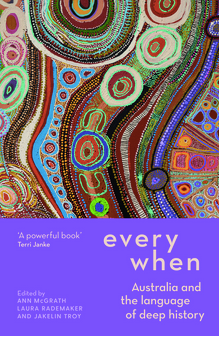
Everywhen

I pounced on this book from my new favourite place in the world, the Atheneaum Library, on the strength of the title alone: Everywhen: Australia and the language of deep history. When I give school talks on Crow Country, I try to convey something of the pre-invasion First Nations world view -- the deep interconnectedness of Country, the importance of secrecy and accuracy of knowledge in an oral culture, and their different attitude to time. In the simplest possible terms, while Western cultures tend to conceptualise time like an arrow, or a conveyor belt, moving inexorably from the past into the future, First Nations cultures have a much more cyclical experience of time, tied to the movement of seasons and stars, and a sense of the on-going events of the Dreaming as existing in a kind of living, eternal present, rather than in a distant, far removed past. My understanding is pretty shallow, but the authors of this collection bring a more nuanced and sophisticated approach to this idea.

Honestly, if I'd realised just how scholarly Everywhen was going to be, I might have thought twice about borrowing it, but I'm so glad I persevered. Some of the essays are deeply personal, like Jakelin Troy's account of standing between the snowy mountains of her ancestors and the sky, or Shannon Foster's reflections on being locked away from rock engravings around Sydney, on D'harawal land, in order to 'keep them safe.' There are pieces here that examine the role of music and song, that outline the way performance of ancient songs and stories helps to bring the deep past into the present moment, or the challenge for linguistics of trying to recover the languages lost since white settlement.

After the shock and despair of reading Killing For Country, it was heartening to explore these essays and to realise that there are so many people working so earnestly to preserve, to recover and to engage with the oldest living culture in the world, and hopefully to share a new perspective on what it means to live on and with our fragile planet.