Showing posts with label Antonia Forest. Show all posts

8.10.25

The Player's Boy and The Players and the Rebels

Here is a real treat! I read these two books of historical fiction together, as Antonia Forest originally intended them to be just one volume; they were split into two by her publisher, Faber. I managed to get hold of the Girls Gone By edition of second part, The Players and the Rebels, a few years ago, but they've only just reissued part one. So I was able to read The Player's Boy for the first time since I left my high school library behind, decades ago. Woo-hoo!

The eponymous player's boy is Nicholas Marlow, an Elizabethan ancestor of the Marlow family of Forest's other books, who runs away from home and ends up joining Will Shakespere's theatre company. As the expert forewords to both volumes make clear, while Forest did lots of research and used the best resources available at the time (the books were published in 1970 and 1971 respectively), Shakespeare scholarship has moved on since her time and some of her conclusions and characters might not agree exactly with current thinking (for example, there is no way that yeoman's son Nicholas and high-born page Humfrey would ever be friends). Still, Forest excels at evoking everyday Elizabethan life and the fascinating detail of the player's life -- some things don't seem to have changed at all. As ever, she is so skilful at showing us rivalry between players, conflicting loyalties, political subtleties, and the real perils of Elizabethan life, from plague to knife fights to execution for heresy.

There are loads of echoes for Marlow fans, or should that be foreshadowing? Nicholas's personality is very similar to modern Nicola's. They are both beautiful but unself-conscious singers and spend time with falcons, though Nicholas's acting skills are more of a nod to Lawrie than her twin. Nicholas and Nicola are both afraid of ghosts and are drawn to the sea. Nicholas hero-worships Sir Walter Ralegh just as Nicola adores Nelson. And there are other references to Forest's other books, like gentle Humfrey who worries about his own lack of courage, just like Peter Marlow. One thing that did pass completely over my head when I read these books at school was the subtle gay content, though it seemed a little implausible that Nicholas, who is 17 or 18 by the end of the story, seems not to be bothered by any sexual yearnings at all!  

I did vividly remember the poignant character of Will Kemp, the company's clown, who finds his improv skills crowded out by increasingly strict scripts. In fact, Kemp seems more like a modern stand-up, creating his own material and responsive to the mood of the crowd. He ends up leaving the troupe, his job pretty much obsolete.

The Rebel part of the story doesn't really come into properly until the last third of the second book, though it's ably set up by what comes before. I think fans of the Elizabethans and of Shakespeare would find a lot to enjoy here, and Will in particular is a most attractive character, kind, dry, level-headed and intelligent, with a hidden melancholy but also wry humour. I really relished making my reacquaintance with these books, and they will join my other Forest volumes in the frequently re-read stack. 

12.9.24

The Last of the Marlows


The last four books of Antonia Forest's Marlow series are a mixed bag: two 'holiday' books and two set at Kingscote, two of my absolute favourites and two at the bottom of my 'liking list,' as Nicola would say.

The Ready-Made Family is a lovely read, introducing the Dodd children (bookish Rose, chirpy Chas and ponderous Fob) and their dismal father Edwin, who unexpectedly marries nineteen year old Karen, thus bringing her Oxford studies to an abrupt halt. It's always perplexed me that everyone just assumes that Karen has to give up her studies after marriage, but perhaps there was some kind of university rule about it? The theme of this book is 'nearly a nasty accident,' from the naughty boys throwing stones on the railway tracks in the opening chapter, all the way up to Rose and Nicola's terrifying near-miss encounter with a very nasty man in Oxford at the end. It could be argued that Karen and Edwin's marriage actually is a nasty accident; I'm less lenient toward him and his (not always suppressed) violent streak than Nicola is.

The Cricket Term ties with End of Term as my teenage favourites -- two perfect school stories. It's been pointed out that this novel feels like it could be the end of the series, neatly tying up Nicola's long-standing enmity with the dastardly Lois Sanger, a happy, summery atmosphere, and a cracking cricket match as its climax. Forest writes about cricket as well as anyone I know, so well that she's won converts to the game among American readers who otherwise wouldn't have a clue. And there's a fabulous plot twist involving my pet Lawrie, which delights and outrages me every time.

The Attic Term skips over the summer holidays and brings us back to school. This is my least favourite of the Kingscote stories, mostly because it revolves around Ginty, my second least favourite Marlow sibling, and her tedious romance with boy-next-door Patrick. And I could well do without Patrick's pontifications on the recent changes in the Catholic Church, which make him so unhappy at his own school that I honestly can't understand why his parents don't move him. This time the theme seems to be 'the coughing bear' -- a minor breach of rules/laws that results in terrible damage, most immediately Nicola's first illicit phone call from the school office which paves the way for Ginty's later wrongdoing. I think Forest is suggesting that the changes of Vatican II also opened the door for catastrophe to follow? I don't know enough church history to comment on that point of view!

Run Away Home is another patchy book, like The Thuggery Affair (though I prefer Thuggery). This one features my first least favourite Marlow, oldest brother Giles, who is sexist, pompous and insufferable, though clearly intended to be dashing, bold and tremendous good fun. I'm irritated by the plot of the runaway boy, in which the rights and wrongs are less obvious to me than they are to the Marlows. I'm furious on behalf of poor Ann, who is treated with utter contempt by everyone, teased, lied to and denigrated at every turn; I'm inclined to agree with her take on the Edward situation and I think her family treat her abominably. There's a half-formed problem with Nicola accepting the gift of Miranda's dress, which again, I find baffling -- who cares? Miranda would have thrown it away if Nick hadn't taken it! However, the final few chapters, with Giles and Peter in trouble at sea and Patrick holding vigil, are almost worth the annoyances at the start.

It was interesting to read all ten novels from beginning to end. It was much easier to follow little bits of continuity, like the endless pony swaps and Peter's splinter, as well as the presence of the Dodds, which I never understood as a young reader, having missed Ready-Made Family. Taken as a single work, they are certainly uneven, but there are far more moments of brilliance than there are moments when I grit my teeth. As Patrick says to sexy au pair Claudie, 'Might we do that again some time?'

16.8.24

More Marlows

The next batch of Antonia Forest's Marlow books includes two of my very favourites, End of Term (the Christmas play one) and Peter's Room (Gondalling). I've also become quite attached to The Thuggery Affair, usually described as flawed but interesting -- but as time's gone on, I find I can overlook the flaws (the complicated Ted-talk, the inherent implausibility of the plot) in favour of enjoying the novel's strengths (adroit characterisation, Lawrie's chicklet adventure, the philosophical discussions between Jukie and Patrick on the run).

Objectively. End of Term is probably the best of the bunch, with lots to enjoy, mostly the shifting friendships between Lawrie and Tim, Nicola and Miranda, and of course the utter wormishness of Lois Sanger, Nicola's nemesis. I always love the last few chapters, where we see the Christmas play unfold through the eyes of Patrick Merrick, and the still silent snowy beauty of the Cathedral before the gigantic blood-for-breakfast row to come.

Peter's Room will always hold a special place in my heart. I actually enjoy the Gondal sections (skipped over by many readers) though only in the light of the real world happenings through which they're interleaved -- I certainly couldn't take a whole book of them. And when will someone take the firearms away from Peter? So far he's shot a Nazi, a hawk and now nearly Patrick (nearly Rowan, too). Though technically it's Patrick holding the gun this time, it's still Peter's carelessness that left the pistol loaded.

Up to this point, the Marlow novels could all be set vaguely 'after the war,' but with Thuggery, we land in the 1960s with a definite bang. Partly this is because we're interacting with the world outside school and Trennels, with cafe bars, cinemas, pop music on radios, and driving through the night, makeup and clothes are important, and the very presence of the Thuggery boys, a particular brand of juvenile delinquents, situate us firmly in one possible decade only.

Coming into the home strait now with only four novels to go. The next two are excellent but unfortunately the last two are my least favourite of the series. Oh well, I'm committed now.
 

15.7.24

Antonia Forest Again

It's been a few years since I last read Antonia Forest's Marlow books, and I'm not sure that I've ever had the opportunity to read them straight through, as a series, back to back. It's difficult to come to them fresh, being so familiar with the later volumes and all the fan canon, but I still think Forest does a masterful job of juggling multiple complex characters, giving us insight especially into Nicola's mind, and handling engaging (if occasionally implausible) plots. But character is her real strength, and it's a testament to her talent that she presents us with three strong stories in three quite different genres, with pretty much the same cast: Autumn Term is a school story, The Marlows and the Traitor is a spy thriller, and Falconer's Lure is a country holiday story, complete with ponies and a local performing arts festival to showcase everyone's various gifts. However, in each book there is a twist of difference -- instead of succeeding at school accomplishments (netball, Guides, academia) as they'd planned, the twins find an entirely new way to shine (the play). The Traitor turns out to be someone the children find appealing, sometimes kind, and even worthy of pity. And the emphasis in Falconer's Lure is really on the hawks rather than the ponies.

Some themes definitely begin to emerge as the characters are fleshed out. Quirky, self-absorbed Lawrie; poor selfless Ann, despised by all; Peter, perpetually battling his own perceived cowardice and realising that it's just going to be 'one paper hoop after another' for his whole life; brusque, sensible Rowan; and perhaps most poignantly of all, pretty Ginty, who coasts through life but tends to fail at any real test. It's a bit harsh when her father, at the start of FL, says 'she should have got over it by now,' when in the previous book, she's been kidnapped at gunpoint, locked up in a lighthouse, very nearly drowned, and faced the prospect, as a claustrophobic, of being forced into a Nazi submarine... and then forbidden to discuss any of it! The stiff upper lip required by this class, at this time, and particularly in this family, is a constant refrain in these books, and the examination of how that affects each of these young people differently is what really sets these books apart from conventional YA.

6.3.22

The Thuggery Affair


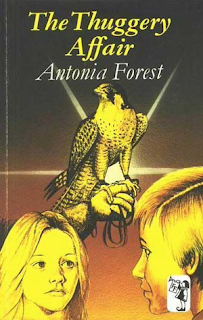
The Thuggery Affair is a deeply odd book, one I didn't read until I was well and truly an adult. It's not a favourite among Antonia Forest fans, largely because it doesn't feature our usual protagonist Nicola at all, but it does have some moments of superb writing and moments of high, cinematic drama, despite its flaws.

This re-read was prompted by a read-through by the most excellent Ann Philips on the Antonia Forest Facebook group, and as usual it was hugely enjoyable. It is so much fun to read a book collectively, different people pointing out things you've never noticed before, drawing links and highlighting references that have passed you by. I always enjoy The Thuggery Affair because, though Nicola is missing, her twin Lawrie, my favourite character, is very much part of the action, and I enjoy seeing Lawrie in action and also glimpsing inside her head. Probably the main reason why Thuggery isn't as loved as Forest's other books is because the gang of youths, the 'thugs' of the title, speak in a heightened, elaborate slang, which can be fun to decode, but is also a bit of a drag on the action.

'Suppose I switch this ring to a flutter that's an also-ran, then it's the also-ran's ring I hand Maudie. 'N if I tell Maudie this was a flutter as was strictly the clipped-wing-world-without-end, due to be culled -- you reading me? So Maudie's the squarest. Maudie digs the integrity racket like she's crazy for it. If Maudie's told he's a clipped-wing, Maudie won't claim.'

Oh, did I mention that the gang is smuggling drugs via pigeons? (Apparently this isn't as far-fetched as it sounds.) All the action takes place over a single twenty-four day, something that didn't register with me until my second reading, and some chapters read like breathless, Technicolour film scenes. I would actually love to see this as a movie... But a movie of an overlooked, obscure 1960s young adult crime thriller? That's never going to happen.

3.2.22

The Marlows and the Traitor


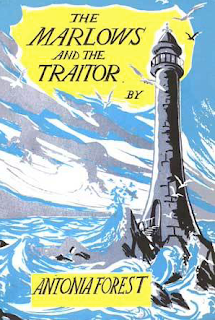
I discover to my (slightly horrified) amazement that this is the FOURTH time I have recorded reading Antonia Forest's The Marlows and the Traitor on this blog. I was prompted to revisit it by a most excellent read-through by Ann Phillips on the Antonia Forest Facebook group -- and I found enough extra material to add my own random thoughts to the discussion.

This time I was particularly struck by the moral ambiguity of Forest's universe. The 'villain' is kind and charming, but also brutal, cold and self-serving. His counterpart, the adult helper/'hero,' is definitely on the side of good, but nonetheless steals a boat, threatens a minor with a knife, is prepared to risk the death of a colleague from appendicitis, and tells numerous lies. No wonder the children at the heart of the story struggle with their own choices as well as battling their personal fears.

Anyway, I won't bang on about this book again. Gee, it is a terrific read though!

3.1.18

End of Term

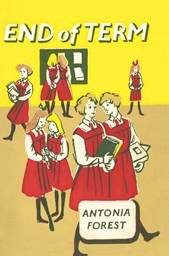
Is it terrible of me to confess that I own not one, not two, but three copies of Antonia Forest's End of Term? I bought the first, a Puffin edition, in 1991, in an op shop in Scotland, and it reminded me just how wonderful Antonia Forest's books were (I had discovered some, but not all of them, in my school library). The second copy, pictured above with a very ugly cover, was ordered from Girls Gone By last year. And then I found another, less battered Puffin edition in my local secondhand shop -- probably discarded by someone who had also upgraded to a GGB edition!

But I don't care, because I love this book. I didn't re-read it when my GGB copy arrived, but waited for Michelle Cooper's read-through on Memoranda. I've read it so many times that I almost didn't need to refresh my memory, but revisiting it was a pure pleasure.

In this fourth Marlow book, and the second of the school stories, the action twists between two plot strands -- the netball team, which Nicola is inexplicably left out of (thanks to the machinations of her nemesis, Lois Sanger) -- and the Christmas play, which Lawrie, the fabulous actress, is inexplicably left out of (thanks to the dubious judgement of the headmistress, Miss Keith, who has her own ideas about casting this particular piece and feels that reverence and religious feeling should be more important than talent). These twin disappointments are the backdrop against which various friendship dramas play out (see what I did there?), with Nicola finding herself isolated from her sister and her former bestie, Tim, and making two new friends in spiky Miranda and shy Esther.

There is another strand woven skilfully and unusually through this book, which is religion. Miranda is Jewish, therefore also excluded from the play. And Nicola's friend from home, Patrick, is Catholic, and a sincere believer, who still feels passionately grieved about the Reformation and the martyrdoms of 500 years ago. Nicola is a puzzled agnostic, who tends to think that people used to believe 'properly' in the distant past, but that 'science changed everything.' And her twin Lawrie is a cheerful and unabashed heathen who thinks the whole Christian story is completely imaginary (and there are plenty of readers who would agree with her!) Their various viewpoints are inserted subtly into the story -- much more subtly and entertainingly than in later books (I'm looking at you, Attic Term).

Antonia Forest is at the peak of her powers in this, and the next few books in the series. An absolute delight.


6.9.17

Falconer's Lure

It's only a year since I talked about Falconer's Lure, so I won't rabbit on about it again at any length. It's not my favourite Antonia Forest book, but it provides so much background to the books that follow that it's essential reading. It's a summer holiday book, with falconry instead of ponies -- well, actually there are ponies, too!

The reason I've been re-reading it is because Michelle Cooper has been doing a wonderful read-through on Memoranda. Highly recommended!

And I'll take any excuse to read Antonia Forest. I can't wait till Michelle tackles End of Term, which is where the Marlow series really takes off.

13.4.17

The Marlows and the Traitor (again)

Over on Memoranda, Michelle Cooper has been conducting a fabulous read-through of The Marlows and the Traitor, which has given me the opportunity to read it again, too. And I think I've enjoyed it even more this time; it really is a cracking story, despite the holes in the plot, the poor behaviour of most of the adults involved and the stiff upper lips all round. Forest uses multiple viewpoints and clever pacing to masterfully control the tension of the narrative. In many ways this is a very adult book. We are told, 'The children are expendable' -- you wouldn't get that in Enid Blyton!

In other news, I had to do something absurdly upsetting this week -- get rid of my childhood books. I'm in the process of clearing out my childhood home -- I'm very fortunate that my parents have lived in the same house for nearly fifty years, and the books I read as a four and five year old have all been tucked away in a spare bedroom, to be read by my younger sister and then by my own children. I've saved my special favourites, but I couldn't keep them all, and most of them were so tatty (and had my name scribbled in them!) that they couldn't be passed on. So into the recycling bin they had to go. How ridiculous that this, more than anything other aspect of the business, reduced me to tears! I had to go home, too upset to do any more clearing out that day.

When I got up next morning, I discovered that my lovely husband had fished the books out of the bin and brought them home. 'They don't take up much room,' he said. 'We can keep them.' Bless him.

4.9.16

Brat Farrar

Oh dear, I'm so easily distracted... I bought this on impulse on the Kindle -- too hurriedly as it turns out, because if I'd investigated further I could have found an even cheaper version -- oh, well, serves me right for being impatient I guess!

My interest was piqued because I'd seen Brat Farrar mentioned in Antonia Forest (Ginty picks it up as 'an easy re-read', and I have a feeling it turns up somewhere else as well, but for the moment I can't think where... have to look out for it next time I read the Marlows books...). Published in 1949, it's a classic thriller -- a stranger arrives at the old country estate of Latchetts, claiming to be Patrick Ashby, the long-lost, presumed-dead-from-suicide twin of eldest son Simon. Certainly the two young men look very much alike. But Simon is not convinced -- and he has a very good reason not to believe 'Patrick's story... Can you guess what it might be?

I absolutely raced through this and thoroughly enjoyed it. It's a good old-fashioned thriller with a fabulous set-up. But what gave me the most fun was finding all the echoes of Forest's own books -- clearly this novel was on her mind when she wrote Falconer's Lure! The setting is very similar: there are two neighbouring estates, one solidly yeoman (ie Trennels), one more aristocratic (Mariot Chase). There are horses galore, and a set-piece local horse show toward the end of the book where villainy is exposed. One of the main characters is called Patrick. And there are animals called Regina and Buster (though in Falconer's Lure, Regina is a falcon, rather than a horse...)

I must admit I've been guilty of putting in little 'homages' of my own in the books I write, so it was rather lovely to see that Antonia Forest had done the same!

23.8.16

Re-read: Run Away Home

This morning I looked up the post where I wrote about my first reading of Antonia Forest's Run Away Home. I had completely forgotten that I'd written that post on 26th March last year, and seeing that date sent a peculiar shiver down my spine.

Why? Because that was the last day Before; the last day when life was normal. Run Away Home was the last book I read before the day my father had a massive stroke, and all our lives turned upside down. On March 27th, 2015, my father almost died. He was in hospital for a month, and went from there straight into an aged care home. My mother moved in with us. Dad has not been back to his own home since the day he left in an ambulance. These days he gets around in a wheelchair, or, tremblingly, shuffling, with a cane. He can't use his right hand or arm at all. And since that day, he cannot speak.

Our lives have changed so utterly that it's weird to look back and realise that it's only been a year and a half. We're working toward getting Dad to move in with us, too, into the granny flat that we've built for Mum. We think we'll be able to manage it (unhelpful bureaucracy notwithstanding!). And that will be another massive change.

It's odd to reflect that this is one of the recurring themes that Antonia Forest's novels explore: how swiftly life can alter, from one moment to the next; how freely we toss around terms like 'tomorrow' and 'the rest of our lives', without thinking how conditional our futures are, how lucky we are when we do manage to string together our tomorrows.

17.8.16

Re-reading: The Cricket Term

Still re-reading my Antonia Forest collection, and The Cricket Term is one of my favourites of the lot, and one I re-read most often when I was in high school myself. Someone elsewhere has described it as a summery, joyous book, and that is certainly true. In some ways, it seems rambling and episodic, the term punctuated by the usual small dramas (Lawrie's difficulty in finding a way to play Ariel in The Tempest, Nicola's determination to win the Cricket Cup), along with some more serious matters (Nicola finds out that due to lack of family funds, she might have to leave Kingscote; there is a wholly unexpected death). Yet the overall atmosphere of the book is happy and triumphant, with several storylines that have played out over previous books being satisfactorily brought to conclusion. The Cricket Term almost reads like the last of the series -- except that there are two more books to come, the jarringly 'with-it' The Attic Term, in which Ginty features largely (not my favourite Marlow sister!), and the disappointing Run Away Home.

Even though I've read The Cricket Term so many times before, I was forcibly struck this time by the degree to which this novel is about luck. There are many references to superstitions, rituals, and bargains with the gods. Stuff Happens, for no apparent reason, and with no apparent bearing on the overall plot: Nicola hurts her hand, but it doesn't stop her playing in the all-important final match; the person who dies has been off-screen for the whole book, and we readers have forgotten about them such as much as the characters have. Ginty relies on her lucky clover for success in the Diving Cup, but it doesn't work. Nicola's team seem to have lucky breaks in the cricket matches -- flukey catches, unlikely run-outs -- but in fact, luck is with them because Nicola has trained them relentlessly to fly for every chance. And the final awarding of the scholarship is similarly flukey and surprising, the winners and losers unexpected yet somehow right.

And there is a striking contrast drawn between Nicola's hard-won stoicism, which enables her to handle her troubles and disappointments with grace and dignity, and the reactions of her arch-enemy, Games Captain Lois Sanger, whose self-deceiving, fundamentally dishonest approach to life leaves her ill-equipped to face the future that awaits her after school, as she steps out of the pages of this book and the series. It's a subtle lesson, but a valuable one.

I'm considering making this pleasurable re-read an annual event -- a treat for August, perhaps, which is always such a hectic, stressful month. Something to look forward to!

14.8.16

In Praise of the Indulgent Re-read

Image courtesy of bookkunkiesanonymous.blogspot.com

Remember when you were young, and you used to read your favourite books over and over? There were even books that I used to re-borrow from the library and sleep with under my pillow, not bothering to open them because I knew them so well -- I just craved the totem of their physical presence. I had read them so many times that I knew them almost by heart.

These days I don't re-read so much, and when I do, it tends to be those same childhood favourites that wormed their way into my heart all those years ago. (The exception is the Harry Potter books, which have been re-read aloud many times because my children insisted on it.)

But I do allow myself one indulgence, which is Antonia Forest. When I recently filled a gap in my Forest collection with Falconer's Lure, I decided to continue with a re-read of the whole Marlow series. This is a prospect of pure delight; in the last week, I've powered through Falconer's Lure, End of Term, Peter's Room, The Thuggery Affair, and I'm now in the midst of The Ready-Made Family.

My Marlows experience has been immeasurably enhanced by reading the books in tandem with a Livejournal read-through from a couple of years ago, which comprises an expert chapter-by-chapter commentary, followed by a lively and thorough discussion, unpacking resonances between the books, pinpointing obscure literary references, debating time-lines and possible future developments, character consistencies and inconsistencies, and sharing favourite lines.

This is my only experience of such a read-through and I don't know if it's a common phenomenon, but I can't imagine another series that would benefit so well from this kind of close attention... except, now that I come to think of it, Harry Potter!

There's a scene in The Thuggery Affair where the character of Jukie declares his belief in an after-life that fits whatever the individual believes: if that's true, I'd like my heaven to be an endless supply of Antonia Forest novels, please.

4.8.16

Falconer's Lure

I pre-ordered my reprint of Antonia Forest's third volume in her Marlow series, Falconer's Lure, back in February and it FINALLY arrived two days ago -- I had been checking the letterbox several times a day! (This is not a crack at Girls Gone By Publishers or Australia Post, just a comment on my own impatience...)

Falconer's Lure was the last missing link in my collection of Marlow books. My high school library had a copy and I could dimly remember reading it, but I hadn't got my hands on a copy for a good thirty years. I awarded myself a day off yesterday and read it straight through in a single sitting. Would it stand up to expectations? Reader, it did.

Here were characters who have now become familiar, introduced for the first time (Patrick Merrick, Sprog the merlin). Here was Trennels, the Marlow ancestral home, where all the subsequent 'home' books are set. Here is a children's book which meditates on loss and grief, while being ostensibly concerned with the events of a traditional summer holiday - gymkhana, regatta, singing competition - and the less conventional activity of falconry.

There is also some of the most beautiful, restrained writing I've encountered. Here is a favourite passage:

The sun came down in slanting lines through the trees, and made a fishnet of light on the bed of the stream. It was doing that when Nicola and Peter first met. It was still doing so, five minutes later. But by then Peter had managed to tell her that Cousin Jon had been killed when the plane crashed, and that made everything look quite different.

6.4.16

The Marlows and the Traitor


It's not even a year since I last read Antonia Forest's The Marlows and the Traitor! And yet I enjoyed it just as much, if not more, the second time around. There are many books that I would never even contemplate re-reading, however much I relished them. I once tried to re-read AS Byatt's Possession, a wonderful, rich novel that I adored. But trying to swallow it again, even a decade after the first time around, was just too much. I felt simultaneously daunted and bored. I could remember what was coming next just well enough to be put off continuing... and there were so many pages... I gave up.

Luckily The Marlows and the Traitor is a very different beast, though equally wonderful in its own way (much less ambitious, obviously). I read it with breaks between each chapter, during which I would scurry across to Trennels at LiveJournal, a forum for Antonia Forest fans, to follow the commentary from their MATT read-through from a couple of years ago. To be able to consume a book in the company, so to speak, of a group of witty, erudite, thoughtful and attentive fellow-readers, who mostly know all the Marlows books back to front and have a multitude of opinions, observations and personal head-canon to share, is one of the most blissful benefits of the internet age. I just dive in and wallow, luxuriously, like a hippo.

All this in preparation for the arrival, next month, of Falconer's Lure, the third volume in the series. I feel as excited as if an old and dear friend were coming to visit. So much catching up to do!


18.3.16

Autumn Term

Girls Gone By Publishing recently announced that they would be reprinting Falconer's Lure, the third volume of Antonia Forest's Marlows series, in May this year. Approximately thirty seconds passed between me becoming aware of this and placing my order, and now I'm counting the days until it arrives. But more of that later...

To prepare myself for Falconer's Lure's arrival (and also because there is a Facebook Antonia Forest read-through going on), I decided to re-read the first two volumes in the series. Autumn Term was published in 1948, and in some ways it is a very old-fashioned children's novel.

Twelve year old twins Nicola and Lawrie are joining their older sisters for the first time at their boarding school, Kingscote. Determined not to disgrace the family honour, they resolve to star at everything -- coming top in exams, winning the Form Shield for IIIA, captaining the netball team, excelling at Guides, and anything else they can get their hands on. Of course nothing turns out the way they planned. Instead of going into the 'top' form, the way all the other Marlows did, they end up in Third Remove with the other 'backward, delicate or just plain stupid(s)' who require extra help. They aren't even allowed to play netball. All that's left to them is Guides, but even that goes horribly wrong. But when Third Remove rebel and decide to put on a play, perhaps the twins will get a chance to redeem themselves after all...

This summary makes the book sound like the most conventional of school stories. But it's so much better than that. Antonia Forest peoples her school with a cast of complex, realistic and not always likeable characters. Even our heroes, Nick, Lawrie and their new friend Tim (Thalia, the Headmistress's Niece), have their flaws. Nicola can be almost irritatingly stoic, but she is also impulsive (in the very first chapter, she stops the train to rescue her new pen-knife). Lawrie is sometimes babyish and self-absorbed, and Tim, clever and amusing, can also be coolly manipulative. The form mistresses can be unjust, the lofty older girls can be self-deceiving and have feuds of their own.

At every turn, Forest turns the reader's expectations upside down. And she subtly contrasts the stereotypes of school narratives with the reality the twins face. 'Don't pretend you're the tomboy of the Fourth Remove,' says one of their sisters to another. Nicola spins herself a fantasy of running away to sea, and when she actually does break bounds to visit her older brother Giles, the episode ends badly, not because she's discovered and punished, but because Giles himself is furious and disapproving when she appears. There is a constant dialogue in all the books between reality and fiction, and Autumn Term sets up this tension beautifully.

But the absolute triumph of Tim and the twins when they pull off their play of 'The Prince and the Pauper' at the end of term, is nonetheless perfectly satisfying, if somewhat unlikely. At least they realistically fail all their exams because they've put all their efforts into the play! These are some very accomplished and knowledgeable twelve year olds -- something I found inspiring rather than daunting, as a teen reader.

I just love these books and it was a joy to re-visit Autumn Term again, even though it's not actually one of my favourite Forests -- it might just sneak into my top five of the ten books in the series. I'm already looking forward to the next one.

4.11.13

Historical Reading

My lovely friend Suzanne from book group recently did something wonderful: she lent me almost the whole set of Drina books (there's one book missing). Nine gorgeous old-fashioned ballet books to lose myself in! So far I've read two -- I'm rationing myself -- and can't wait to get stuck into the rest.

I was asking myself this morning exactly why these kinds of books hold such an appeal for me, and I think part of the reason I enjoy them so much is because I find the incidental historical and sociological details embedded in the stories so fascinating. I love reading Agatha Christie and Noel Streatfeild for the same reason.

It's the throwaway details that are so endlessly interesting: the clothes, the meals, the minutiae of daily middle-class life. Drina's friend telephones and they have three minutes to cram in their conversation before the pips sound. A stack of newspapers arrive, each one containing a critic's review, the morning after Drina's play debuts. Noel Streatfeild's youngest children have supper on a tray -- fruit and cereal just before bed (they have to explain this to a mystified cook when they go to live in America). Antonia Forest's Marlow family have 'Mrs Bertie' from the village in to do 'the rough' -- meaning the hard physical household labour, like scrubbing floors and toilets. Drina has a cloak (!) as part of her school uniform -- admittedly, it's a ballet school!

And of course there's the dialogue, the slang, the codes of behaviour. Drina's grandmother is horrified when Drina, aged 12, breaks down while they're out shopping: 'You're much too old to cry in public!' There is the casual racism, the cautious attitude to anything 'foreign' -- Drina's fragile emotional state, her temperament, is wisely sheeted home to her half-Italian heritage.

And of course there are assumptions about gender and sexuality, often unspoken. Drina declares that she will never give up dancing. Her friend Jenny points out that of course she will have to, when she gets married -- but Drina says, no, not even then... The very fact that they feel the need to have this conversation, aged twelve or thirteen, is interesting in itself.

Someone once asked me for tips on researching a historical period, and I said, read some books written at the time. Especially books like this, where all the details are taken for granted, mere background to the plot. It's amazing how much you can pick up, little clues that the author let drop, without even intending to.

8.5.12

The Thrill of the Hunt

Earlier this year, I wrote a guest post on Michael Pryor's blog about one of my favourite books, Peter's Room by Antonia Forest. I mentioned the thrill of finding this rare book on the shelf of a Spanish restaurant in Collingwood, and actually being able to buy it for three dollars.

There is something very special about hunting down your favourite books -- not on eBay or Amazon, but out in the real world of second hand book shops and op shops. For years I dedicated myself to tracking down every book Iris Murdoch had ever written, which was no mean feat, as she wrote twenty-six novels in her long career. (The only one I'm missing is The Italian Girl, which I lent to someone years ago and never saw again.)

I found most of the Green Knowe books second hand; last year I picked up a volume of Joan Aiken short stories I had been searching for ever since I left Mt Hagen. But Antonia Forest is the toughest challenge. Most of her books have been out of print for years and are hideously difficult to find, even on the internet, where they regularly fetch prices of a hundred pounds or more.

Alas, I've only managed to acquire a few of her books. I found End Of Term in a charity shop in Oban, Scotland, in the 1990s. Peter's Room, as I said, surfaced miraculously in a Collingwood cafe a couple of years later. I succumbed and bought Autumn Term in a reprint edition and also The Ready Made Family, which I had never even read, for an exorbitant price online.

And then, just last weekend, I was browsing in a tiny second hand bookshop in Bacchus Marsh when I saw the magic words: Attic Term, Antonia Forest. I thought I was hallucinating. I clutched the book to my breast, scanning the bare two shelves of teenage books for any more, but that was it. Two dollars, people. Two dollars!

I've been exalting ever since. Now if only I could find Cricket Term...