Showing posts with label nature. Show all posts

24.5.26

Nest

I am a huge fan of Inga Simpson's writing (her novel Willowman and memoir Understory are just so beautiful), but for whatever reason, her second novel Nest didn't quite do the trick for me. Perhaps this quiet, reflective, observational novel suffered from being read simultaneously with big, blustery King Sorrow; perhaps it was my state of mind, where I was looking for distraction rather than meditation. Perhaps even the very short chapters, which is something I usually enjoy, meant that it took a long time to make my way through the story, to the point where I'd sometimes forgotten characters or events by the time they were referred back to (did I mention my concentration is not great at the moment?)

The actual writing and the nature observations were as usual absolutely gorgeous, in fact I think I would have enjoyed Nest more if it has been presented as a piece of nature writing or memoir rather than a novel. There is hardly any plot, and what there is, moves slowly and quietly. There is a missing child, harking back to a missing friend of Jen's own childhood; an absent father, an unsatisfactory ex. But these are elements that hover around inside Jen's head as memories and speculations, rather than playing out on the canvas of the novel. Gradually, very gradually, tense loner Jen starts to unfreeze, through her close relationship with the trees and birds on her land, tending to her house and garden, and her tentative friendships with the townsfolk and neighbours, and her drawing pupil Henry. The novel ends in quiet hope, but anyone looking for high stakes drama will not find it here. 

I think I would have loved this book more if I'd been in a different frame of mind! I have another Inga Simpson novel on my pile, but I might wait a while before I open it; I want to meet it in the right spirit.

30.4.26

Helm

I feel like there's been a bit of a buzz around Sarah Hall's novel Helm, which is centred around the only named wind in the UK (I must admit I hadn't heard of Helm and didn't realise that it was a real thing: a unique, powerful, occasional force). It's such a cool concept for a novel and Hall has constructed a rich narrative of interweaving strands through the history of human interactions with the wind. Hall has given Helm a wild, poetic voice, and it has motivations and desires of its own, which adds a distinctive flavour to the novel.

For me, some of the narrative strands were more successful than others, though Hall has obviously expended a lot of effort in creating authentic and researched stories for each time period. Most of the narratives are focused on attempts by humans to tame or measure Helm: a medieval churchman who sees Helm as a demonic force; a Victorian scientist who wants to set up an elaborate machine to dye the air flow; a modern climate scientist who becomes paranoid in isolation; a Bronze Age wise woman who sees a sacred stone in a vision and dedicates her life to finding and erecting it. Often the protagonists are women who develop a special relationship with the wind, like Janni, a victim of 50s psychiatric treatment who is eventually reclaimed by Helm as Helm's own.

I especially loved the Janni story and the Bronze Age narrative, perhaps because they both came to a satisfying conclusion. Some of the other plotlines petered out or ended anti-climactically, but there is more than enough meat here to compensate, and the actual prose is rich and wild and gorgeous.
 

16.3.26

Mr & Mrs Gould

Grantlee Kieza is a prolific author of Australian history and biographies. My younger daughter gave me Mr & Mrs Gould for Christmas, because she figured the combination of Australian history and birds would be a winner, and she was mostly right. It's a shame that Mr Gould himself wasn't a more attractive character, which took the shine off his story a little bit.

John and Elizabeth Gould arrived in Australia in 1838, already established as pre-eminent naturalists and producers of wildlife books; The Birds of Australia would make Gould more famous and very rich. John organised and carried out the collection of specimens, while Elizabeth, who at the time of their Australian trip was into her seventh pregnancy (at 34 -- when I was just getting started! Gulp), was responsible for the extraordinary illustrations, many of which are reproduced in this book. Kieza has done his research thoroughly, and provides all kinds of social and scientific background; it appears that it was humble John Gould who first suggested to Charles Darwin the possibility of natural evolution.

John Gould was a hard taskmaster and a relentless worker who didn't treat his subordinates very well, and he was a bit rough round the edges in a world people largely by gentlemen amateurs. However, he does seem to have been genuinely loving to his wife and grieved her deeply when she died, though Elizabeth never received her full credit for his commercial success. Mr & Mrs Gould is a readable and engaging popular history which taught me a lot about early colonial Australia and its abundant ornithological wonders. And the pictures are gorgeous.
 

17.12.25

Wild Hares and Hummingbirds

I have to confess, I bought Stephen Moss's Wild Hares and Hummingbirds purely on the strength of this lovely cover art (by Hannah Firmin). It's subtitled The Natural History of an English Village, and it's a simple but pleasing concept: Moss recounts the comings and goings of seasonal birds, animals, insects (the 'hummingbirds' of the title are actually hummingbird moths) and plants within a small parish in Somerset. The book is divided into twelve chapters, one for each month, beginning and ending in deep winter.

Wild Hares made a perfect companion read to James Rebanks' more serious English Pastoral. Because I'd already read the latter, observations about the extinction of local birds and wildlife hit home harder. I knew what Moss was talking about when he outlined the consequences of silage replacing hay for cattle feed. Moss is careful to avoid an overtly political stance, but the shadow of climate change falls darkly even over this 2011 book. There are floods in the village, birds and insects respond too early to the change of seasons and find themselves without the proper food, certain butterflies arrive at the wrong time. Not every species is a loser in this shakeup of the natural world, but there are more losers than winners.

But mostly Wild Hares is a celebration of close observation and involvement in the natural world, delighting in the small events in Moss's backyard or familiar lanes and fields. This is a lovely book. Let's hope it's not completely irrelevant in another twenty years. 

3.11.25

The Place of Tides

James Rebanks was burnt out. A Cumbrian farmer and author (from the same neck of the woods as Rory Stewart), he had spent too many years as a rural activist, not taking enough time with his family, with frustration and anger building building inside. He remembered an old woman he'd met in Norway, on an isolated island, and felt that she could offer him solace; she invited him to come and stay with her.

Anna was a 'duck woman,' a dying breed, who travel to the remote islands where eider ducks nest. They build safe nesting places for them, protect them from predators, and watch over them until the eggs hatch and the ducklings are taken out to sea. Rebanks, Anna and Ingrid, a younger friend of Anna's, spent ten weeks on this island, working hard to tend to the nests, observing the ducks, waiting and watching and quietly spending time together. At first Rebanks felt restless, until he eventually settled into the rhythm of the life and recognised that yes, this was exactly what he needed. But to his surprise, though he'd thought it was solitary time that he was craving, he came to realise that in fact Anna was deeply enmeshed in community, and it was the time spent with Anna and Ingrid that achieved the real healing.

The Place of Tides was only published last year, and I discovered it by accident on Brotherhood Books. It fits perfectly into a category of books my friend Chris calls people and animals -- books like H is for Hawk, or The Company of Wolves. It's nature writing, but it's also a meditation on life, connection and spirituality. The Place of Tides is an absolutely beautiful book, simple but profound, and it took me into another world.
 

2.9.24

The Hidden Life of Trees

Peter Wohlleben's instant classic, The Hidden Life of Trees, has been around for a while now (published in 2015) and he's followed it up with several other books exploring the world of nature. What made this first volume so electrifying was his portrait of trees as sentient, communicative beings, living not singly but in splendid communities, cooperating and helping each other through chemical communication and widespread underground networks of mycelia.

Wohlleben unapologetically anthropomorphises trees throughout, referring to mother and child trees, cries of anguish, bleeding wounds, migration (of species, not individuals), trees 'stuffing themselves with sugary treats,' happy and unhappy trees. I suspect it's this unashamed attempt to make trees relatable that led to the huge success of Wohlleben's work. And it is genuinely remarkable to discover that trees send nutrients to each other when they're in trouble, that they can count (warm days in a row to discover spring has come) and that still no one really knows exactly how trees draw up moisture from their roots all the way to the tips of their leaves.

As a German forester, Wohlleben naturally focuses on European species: oak, beech, ash, spruce and pine. I don't know if there's an equivalent volume that discusses southern hemisphere and non-deciduous trees, but if there is, I'd love to read it.
 

4.8.24

An Immense World

A couple of weeks ago, watching TV one evening, I was startled by a huge bang at our back window. We're used to birds flying into the glass during the day, but it's never happened at night before. Flicking on the outdoor light, I was surprised to see a flying fox, seemingly stunned, lying on the ground. As I watched, it dragged itself across the ground to a nearby tree and began to crawl, rather creepily, up the trunk. When I last looked, it was hanging from a branch, presumably recovering; then it disappeared, so I suppose it was all right. 

Such a thing had never happened at our house before, but it turns out that bats flying into windows is not uncommon. Sheets of flat glass, non existent in nature, send back the same sonar signal as clear air, so the bats crash straight into them. It's just one of the myriad ways that we humans make life difficult for the animals with whom we share this world.

An Immense World is a fascinating, very readable exploration of animal senses and how they extend and differ from our own, something we rarely take into account. Birds and insects can see colours we can't see (charmingly, Yong christens these 'grurple' and 'yurple.') Animals can hear sounds that we can't hear, either above or below our normal range, and smell odours that we can't pick up. and they have senses that we find it difficult to imagine, like detecting electric fields or the Earth's magnetic compass.

Yong reminds us that other living creatures exist in a sensory world very different from our own, bounded by different parameters and consisting of an altogether different experience. Yet we are increasing shaping the environment for our own convenience, filling it with light and noise and pollution that is destroying the Umwelt (roughly, lived experience) of the planet's other inhabitants. I think An Immense World came from the same recommendation list that included Wilding, and similarly, it has given me much information and food for thought.

29.7.24

Understory


Inga Simpson's Understory is an irresistible mix of personal memoir and nature writing. She begins the narrative with an account of finding a property on the inland Sunshine Coast with her partner. At first all goes well. The family discover the local wildlife, adjust to their leaky, creaky home, and make their home. Each chapter begins with a description of a species of local tree, which ties into the memories which follow. But a growing sense of dread begins to pervade the pages, as Simpson and her partner, N, 'begin to make some bad decisions,' buying the property next door, starting a business, and realising their property is under threat from a proposed powerline development.

The tension in this book builds like a thriller, which makes an unusual contrast with the more meditative style of most nature writing. I actually had to flip to the end to make sure everyone was going to be okay (I don't do well with suspense). There are also flights backward in time to Simpson's childhood, and earlier stages of her life (not among trees) which cast light on her reactions. I had previously read and loved Simpson's novel, Willowman, not coincidentally featuring woodwork and cricket, but Understory made me appreciate that novel even more.

Ultimately Understory is a moving, sometimes devastating personal story intertwined with beautiful vignettes of connection with the forest, as well as with individual trees and animals, as well as Simpson's own writing and publication journey. I loved it all the more for being so thoroughly Australian.

10.6.24

Wilding

Wilding was recommended in a list of uplifting books in the Guardian, and it definitely lived up to the description. Isabella Tree recounts the story of how she and her husband Charlie made the difficult decision to stop intensive agriculture on his family's ancestral estate (yes, they are very posh) and return the land to wilderness. It was in some ways a hard-headed financial choice, and the wilding project was made possible with EU funding, which I assume would no longer be an option since Brexit.

At first their neighbours were appalled as fields were ploughed up, a canal returned to a messy, shallow river channel, and deer and cattle were allowed to roam free on the property. A thistle outbreak led to howls of outrage and cries that Charlie's ancestors would be ashamed of him. Why were they 'wasting' perfectly good land in this way?

And yet within a very short time, the results were extraordinary. Birds thought lost to the local landscape, like nightingales and turtle doves, returned to breed. Clouds of rare butterflies descended (and ate up all the thistles). Torrential rains, which resulted in horrendous floods all over the country, were avoided at Knepp, and the natural flood plain sopped up excess water. Insect life and soil health flourished. It really demonstrates the importance of preserving, not single species in isolation, but whole ecosystems, allowing balance and richness to return to the land.

There are obvious parallels here with First Nations management of Country -- careful observation, a holistic approach, respect for nature, and a light touch with interference. The land at Knepp was not really allowed to 'run wild' but was carefully and thoughtfully watched. The introduction of hardy cattle and pigs resulted in the unexpected creation of 'woodland pasture,' which Tree argues was the most likely landscape in pre-human Britain, in contrast to the dense forest which is often assumed to have covered the island.

This was such a fascinating and heartening story, and I'm thrilled to see that a documentary of the same name is about to be released in the UK, and as part of the Sydney Film Festival. I hope I get to see it soon.

8.5.24

Black Duck

When I was a baby writer, and Bruce Pascoe edited Australian Short Stories, I sent him a few of my attempts. He rejected them all, but sometimes he'd write a kind note on the rejection slip which was almost as good as an acceptance. In latter years I have become a big fan of his, for his revelatory work on Dark Emu and for his dignity and patience in dealing with the sometimes vicious and deeply personal criticism that the book has attracted.

Black Duck is a very different book from Dark Emu. It's subtitled A Year at Yumburra, Pascoe's Gippsland farm where he is putting some of the discoveries from Dark Emu into practice, growing and harvesting native grains and making delicious flour from them. I love the loose diary format of this book, divided into seasons, and I marvel at the amount of labour that Pascoe undertakes at a time of life when most of us would be planning rest and retirement. It's not just the heavy work of farming and managing a rural property (fencing, clearing, cool burning, chopping wood, mending, building, caring for animals), but the endless demands on his time from the media and from interested visitors. Some are just breezing through, some are more deeply committed, but Pascoe takes the time to show them around and explain his work. He's also deeply involved in the local First Nations community; though he doesn't go into details, there was clearly some conflict to sort out during this particular year, which also takes up time and energy.

What I loved most about this reflective, generous book was the model Pascoe presents on how to live in harmony with Country -- grateful for its bounty, tending it with care, sensitive to the presence of birds and animals and vegetation, always aware of its stories. It's a glimpse of an approach to life which holds the possibility of so much richness and nourishment for us all, just as the native grains might teach us to appreciate the flavours of our own place instead of food imported from the colonisers. The shadow of death, infirmity, the disastrous Mallacoota fires, and petty back-biting falls over Black Duck, but at its heart this is a joyous and celebratory book.
 

22.1.24

The Salt Path

The Salt Path was a bestseller in the UK for many months, and is currently being made into a film. It's a hard and beautiful book, told in clear and concise prose. Perhaps the most difficult chapters to read are at the beginning, when Raynor Winn calmly but devastatingly recounts the events that ended with herself and her husband, Moth, taking to the South West coastal path that winds around Somerset, Devon, Cornwall and Dorset. Thanks to an unwise investment, the couple lost their beloved farm, home and business; if this wasn't catastrophic enough, Moth is diagnosed with a fatal condition and given only 6-8 years to live. With literally nothing, no money and no home, Ray and Moth spend their last pounds on sleeping bags and a tent and start to walk.

At first numb with grief, Winn and her husband move through fury at their fate, slow exaltation at the gradual realisation that the constant hard exercise of walking, carrying and camping is actually helping Moth's symptoms, despair, misery and joy, to acceptance of taking every day of life and freedom as a gift. 

There are many funny moments and also upsetting ones, particularly when Winn notes the difference in reactions when they tell people they've 'sold' their home (oh, wow, you're so lucky, have a great time) as opposed to honestly admitting that they've 'lost' everything and are homeless (cheerful chit-chat ceases and people back away hastily). It's not an easy walk; their lack of money means surviving on noodles, they can't afford campsites with bathrooms so they stink, they get sunburn and blisters.  But they survive.

Issues of class arose starkly in all the books I was reading at this time: The Salt Path, Prima Facie and The Wild Hunt of Hagworthy. Was it a coincidence that all three were written in the UK? I suspect not.

17.11.23

Braiding Sweetgrass

What an extraordinary, beautiful, enlightening book. I'm so grateful for the recommendation from my book group friend Cathy. Robin Wall Kimmerer is a Native American botanist and writer who braids these three strands into a generous, glorious whole. I'm really struck by the parallels between Native American spirituality, and First Nations Australian philosophy -- it shouldn't be surprising that first peoples share a similar attitude to caring for and gratitude toward the environment. Braiding Sweetgrass also emphasises an idea that I saw recently expressed in The Monthly magazine, that while it's tempting to think that 'wilderness' should be untouched by human involvement and left strictly alone, in fact these 'wild' areas thrive with judicious human management -- selective harvesting, selective burning actually helps the environment to flourish, and this light-handed tending is precisely where first peoples have thousands of years of experience.

Kimmerer is expert at explaining the science behind how plants work; her writing is never dry or difficult, and she marries the science with traditional stories and anecdotes from her own teaching and personal life to spark up her narrative. It's really a collection of discrete essays that build to a compelling whole. It's easy to despair at the state of our world and the terror of climate change, but Kimmerer holds onto hope, despite her clear-eyed recognition of the damage we have done. And her writing is just exquisite -- right up there with Robert McFarlane and Helen McDonald, my two favourite nature writers.

Braiding Sweetgrass is definitely one of my books of the year.

12.7.23

Plants: Past, Present and Future

Plants: Past, Present and Future is the most recent publication in the First Knowledges series, this one by Zena Cumpston, Michael-Shawn Fletcher and Lesley Head. I am a big fan of this series, which presents short, manageable texts on various subjects, by First Nations experts. They're like tasters on the First Nations knowledge of astronomy, design, management of Country -- perfect for the layperson. They are often quite political, but appropriately so. For example, Plants is vocal on the topic of 'bush foods' and the way they are being appropriated by non-Indigenous businesses, sprinkled on top of 'normal food' like a garnish (sometimes literally), rather than being seen for what they truly are, nutritious and complete diets in their own right.

There are various chapters on different native plants -- spinifex, quandong, yams -- but I think my favourite section was 'Abundance' by Zena Cumpston, in which she forensically examines a photo of three people camped on Country, taken in the late nineteenth century, and picks out all the different plant-based items visible in the picture. There are nets made from bulrush fibre, digging sticks, coolamons, thatch on the hut, a grindstone, spears and boomerangs, bunches of leaves used as medicine, and more. This photograph illustrates with immediate clarity and force the degree of reliance of traditional peoples on plants; what it doesn't show is the reverse relationship, the degree to which First Nations peoples managed and curated Country to ensure that the plants and animals thrived and flourished, with the careful use of fire and practices like replacing yam-tops so the tuber would regrow. As Cumpston reminds us, Country is still here, even when it's hidden under urban sprawl, and we can still learn to care for and respond to it, even in our cities and suburbs.

I'm looking forward to reading the next volume in the series, Law, co-written by the formidable Marcia Langton, and I hope there will be many more volumes to come.

31.1.23

White Beech


Another book about trees. I hadn't heard anything about this book but when I saw it on Brotherhood Books (last year, before the Great Warehouse Flood), I pounced on White Beech, Germaine Greer's account of rehabilitating a patch of rainforest on the NSW/Queensland border.

I really enjoyed some parts of White Beech, as when Greer writes about her long search for a patch of land (initially she intended to buy a piece of desert) to protect and revive -- not just put a fence around it, but remove weed species and allow native plants and wildlife to reclaim the place, and also searching out the likely original species and replanting them herself. She wasn't looking for rainforest, and almost walked away, but an encounter with a little bird changed her mind. Greer has this streak of spiritual openness which is surprising in someone who presents as so hard-headed! I also loved her other encounters with animals and birds on the land and in her house (she describes antechius flattening themselves until they are like 'a credit card with a leg at each corner'), and her determination to restore this small patch of the planet to the way it was before white settlers trampled all over it, poisoned it, cut down the trees, filled it with weeds and feral beasts, and generally ruined it.

However, Greer has taken it upon herself to educate herself extensively about Australia botany. Which is great, but she insists on sharing every shred of detail she's learned with us, the readers, and we are not all necessarily as fascinated by the ins and outs of botanical history and the minute differences between different genera, species, pentioles and venation, as she is... I must admit I skimmed some of these pages, and they could have been edited quite severely without harming the book. Greer is very confident that she knows better than everyone else about pretty much everything, but my confidence in her expertise wavered when she corrected our mistaken belief that Skippy the Bush Kangaroo was a male -- something that I'm sure no-one ever believed, except possibly Greer herself.

2.8.22

The Old Ways


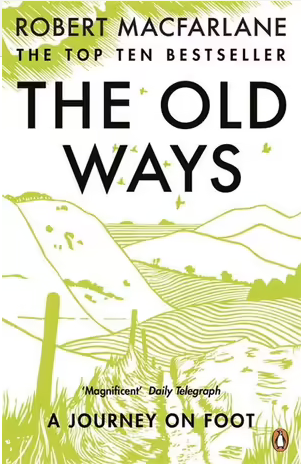
I've been looking out for a copy of Robert Macfarlane's The Old Ways for a long time, and I was thrilled when it popped up on Brotherhood Books. Macfarlane's books are ones I want to own, not just borrow. They are to be sipped and savoured, not raced through, and I managed to stretch out The Old Ways for over a month. 

Macfarlane's prose is dense, thoughtful, evocative, considered. He mixes personal memories with nature observations, philosophical musings with provovative conversations with the people he meets on his travels. The Old Ways is subtitled A Journey on Foot, but one section consists of a sea voyage in a small boat through wild Scottish waters. Most of his walks occur in the British Isles, but he also walks in Israel, Tibet and Spain. Inevitably my mind was drawn to the songlines and Dreaming tracks of Australia, and Lynne Kelly's account of memory paths, and I held that awareness as I was reading, which gave Macfarlane's beautiful words an extra layer of resonance.

Is it weird that for me reading nature writing like this becomes akin to a mediation in itself, almost a spiritual practice? Lee Kofman quoted Robert Macfarlane in The Writer Laid Bare. I'm already looking forward to a time when I can pull one of his books from my shelf and immerse myself in re-reading.

1.2.22

Vesper Flights


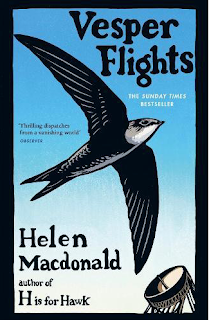
Helen McDonald's memoir H is for Hawk, about her goshawk, Mabel, was one of my personal books of the year. Vesper Flights, a collection of her essays, doesn't pack quite the same emotional punch, but is still a beautiful, meditative and moving read.

The essays are mostly grounded in nature, but range over a multitude of topics: loss and grief, refugees, climate change, freedom, headaches, mushrooms. Pre-pandemic, she writes of how observing urban falcons can transport us 'away' -- in this case, from personal grief; but as members of the 367 Collins St falcon-watching community can attest, observing our own peregrine family was also a welcome distraction from the monotony of Melbourne's Covid lockdown. 

Again and again, McDonald returns to the themes of close, thoughtful observation and what it can teach us, and to the uses of imagination. She urges us not to be seduced into thinking that animals are just like us, nor to believe that we can be just like animals, but to try to grasp and appreciate them in their own unique strangeness, and above all to recognise that the natural world is there with us, but not FOR us, to try to resist centring their lives on ourselves.

17.9.21

A Million Wild Acres

I bought Eric Rolls' classic history of the NSW Pilliga Forest, A Million Wild Acres, after seeing it lauded in Wildwood by Roger Deakin -- the only chapter in the book devoted to an Australian author. A Million Wild Acres is certainly an impressive achievement: an exhaustive history of the area's exploration and settlement, forestry and agriculture, and detailed description of the local flora and fauna, the book runs to over 450 pages and I must admit it has taken me a long time to work my way through it.

This may have been partly because I don't know the Pilliga area at all and so found it difficult to picture the landscape Rolls describes in such loving and forensic detail. I did enjoy his respectful attention to the original First Nations inhabitants of the land, and the foreshadowing of Bill Gammage and Bruce Pascoe's later work in describing how this fertile territory resembled 'an English parkland' when first seen by explorers, ie lightly wooded, with low grass, for easy grazing and hunting of kangaroo and other game. It was the settlers who dramatically changed the character of the landscape by clearing the trees and then tearing up the fragile soil with the hard hoofs of cattle and sheep, which led to the scrub running wild and thick forest taking over.

First published in 1981, A Million Wild Acres is clearly a labour of love and must have taken decades of painstaking work to assemble. Rolls sets out the back and forth of land ownership over generations, recounts numerous anecdotes of bushrangers and wild cattlemen (including the tragic story of the Aboriginal outlaw Jimmy Governor -- the basis for Tom Kenneally's The Chant of Jimmy Blacksmith -- though Rolls describes Governor's life oddly as 'a sinister comedy'), and includes his own observations of flowering gums, bushfires, and wild creatures, birds and insects.

An admirable work, and I take my hat off to him, but I must admit I felt slightly exhausted by the end of it!

6.9.21

Imaginative Possession


 I bought Imaginative Possession: Learning to live in the Antipodes after hearing Belinda Probert speak on the radio. As an immigrant from England, she found adjusting to the shape and meaning of the Australian landscape a difficult leap; not just the heat and the bright light, the wide horizons, but the look of the trees, the sound of the birds and the shape of the hills and fields. Eventually she bought a country property in the Victorian Otways, to create a garden as a way of making herself more at home, and she admits the this was not a wholly successful experiment.

The project of Imaginative Possession caught my attention because it raises some of the same issues I was grappling with in Crow Country -- how can strangers to this land, especially those of us brought up on European stories, myths and meanings, adjust ourselves to and learn to love this very different place, without trying to apply the more familiar language of the Northern Hemisphere that has shaped out imaginations? The obvious answer is to ask the original inhabitants, but this is a route that European immigrants have been sadly reluctant to adopt. At last we are learning to listen and to see with the eyes of those who know this place so much more intimately than we do.

Imaginative Possession is filled with enticing titbits of information. Australian birds tend to screech and squawk rather than sing, because birds (not bees) are the main pollinators in our flowering forests, and have evolved to scare off rivals to the blossom harvest. The poet Dante Gabriel Rossetti owned a pair of wombats and mourned them when they died.

Probert (like me) is the kind of person who tends to turn to books for enlightenment, and she quotes many other writers in her quest. Some I was familiar with: Billy Griffiths, Bruce Pascoe, Bill Gammage, Judith Brett. Others, like Kim Mahood, I don't know, but I'm looking forward to discovering. Part memoir, part rumination, Imaginative Possession perhaps ends up raising more fruitful questions than it answers.

10.5.21

The Serpentine Cave Revisited

 Just a quick note to say that anyone interested in the artists of St Ives, especially Alfred Wallis (as discussed in my previous post on Jill Paton Walsh's The Serpentine Cave), should check out episode 2, season 1 of Tate Britain's Great British Walks, which sees host Gus Casely-Hayford and guest Miriam Margolyes visit the town and its landscapes, and discuss Wallis's art and his legacy. Available on ABC iView now!


How do you like that for synchronicity?


Wintering


I love this cover, I would happily hang it on my wall. Katherine May's Wintering is another recommendation from Susan Green. We don't often disagree on books and Wintering is no exception. It's true, not all of us are in a position to be able to retreat and hunker down when times are tough, but it's also true that often that is exactly what we need. I think of all those antique novels where the protagonists are sent away to "rest" in the country (usually at the farmhouse of some elderly former nanny or a distant relative) or to "recover" by the seaside. Long walks, fresh air, plenty of fresh food usually does the trick and our sufferer is back to their old selves.

I liked the descriptions of northerly winters with their snowy landscapes and cosy firesides, though seasons in our hemisphere don't follow that stark course (thank goodness -- I remember my sole Scottish winter when the sky seemed to press on the top of my head like a leaden lid and daylight only lasted about four hours, I couldn't stand it and had to run home to Aussie summer). I liked the account of restorative winter swimming, which is apparently extremely beneficial for both physical and emotional health, and something I heard recommended a couple of years ago by Wim Hof devotees at a mind-body-spirit festival. I'm not brave enough to take the plunge, though I am trying feebly to at least briefly douse myself in cold water under the shower most days.

I even liked that Katherine May ended the book by admitting that she hadn't managed to include everything she'd planned -- she didn't travel as far or interview as many people as she intended. But adjusting our expectations of ourselves is part of "wintering" too, something that many of us experienced during last year's lockdown. (And I'm very aware that having a "good lockdown" is also a highly privileged experience.) But maybe it's time to see that slowing down, just hanging out at home rather than rushing in all directions, finding time for slow activities like cooking and knitting and jigsaws, can be healthy, rather than lazy and self-indulgent. I'm all for wintering.