Showing posts with label science. Show all posts

18.8.26

Brain Rules for Ageing Well

John Medina has written several of these Brain Rules books -- about music, about babies, about work, about teenagers -- and Brain Rules for Ageing Well offers advice (current in 2017) about how to preserve or even improve our brain function as we get older. It's written in a light, friendly style with enough science to be convincing but not enough to overwhelm the reader.

Most of Medina's advice is just sensible: stay connected to friends and family, learn new things, exercise, eat properly, lower your stress (easier said than done). He does devote part of one chapter to the theory of so-called Blue Zones, which unfortunately was recently pretty comprehensively debunked -- for a few years, there was a lot of hype around certain areas of the world, like Sardinia and Okinawa, where people seemed to live well beyond the expected age limit. People got very excited by the supposed lifestyles adopted by these Blue Zone inhabitants -- but it turned out that most of the zones were actually quite poor areas where welfare fraud was common, and the people who were apparently living to 110 had often died years before... Oh,well, back to the drawing board.

One finding in Brain Rules for Ageing Well that initially surprised me was the beneficial effect of marinating in nostalgia. Our brains lay down their most vivid memories during our late teens and early twenties, so reliving those years makes us feel more alive. I can certainly testify that listening to the upbeat music of my youth during my morning walks puts a pep in my step, and when my husband was preparing for a high school reunion last year, the mood rush lasted several weeks as old friends reconnected over group chats and shared memories. So maybe there's something in that -- though I won't be revisiting 80s fashions or hairstyles any time soon.
 

13.6.26

Big Sky: when the emu left the earth

I heard astrophysicist Professor Ray Norris (born in the UK, now living in Australia) and beloved and controversial First Nations elder Bruce Pascoe talking on Radio National about their collaboration, Big Sky: when the emu left the earth, and immediately reserved it from the library. As anyone who's read The January Stars will know, I'm a sucker for astronomy and space (Duane Hamacher, who was the consultant on January Stars, is quoted often in this book).

I was a little disappointed by the astronomy volume of the otherwise excellent First Knowledges series, and Big Sky fills in some of the gaps. It really is remarkable to think that some sky stories, like the Seven Sisters myth, which carries extraordinary similarities all over the globe, may have travelled with the first humans out of Africa. There are other stories from parts of Australia that might recall celestial events like supernovae, comets and meteor strikes, that occurred tens of thousands of years ago. Star maps can act as mnemonics, along with stories, to guide land journeys. The Emu of the title of course refers to the Dark Emu figure visible in the dark patches of the Milky Way.

I was particularly struck by the different explanations of solar and lunar eclipses, often described as Sun-woman and Moon-man having sex, but showing an understanding of who is on top of whom! Some of Norris and Pascoe's examples show that Aboriginal cultures had a more sophisticated understanding of the skies than Renaissance scientists.

I'm not sure that books are the best way to pass on First Nations knowledges; the ideal way is to have an elder explain to you what you're ready to understand. But in the absence of that firsthand experience, books like Big Sky are the next best alternative. 

14.1.26

In My Time of Dying

Those of you who have been following my reading journey will realise that there is no way I could ignore a book with this title. In My Time of Dying: How I Came Face to Face with the Idea of an Afterlife is not written by a would-be medium or someone claiming psychic powers or the ability to commune with spirits. Sebastian Junger is a hard-nosed journalist, a war correspondent, who has had many encounters with death and near-death, his own and other people's. But the incident that inspired this book was a medical emergency, an abdominal aneurysm that very nearly killed him.

During the moments when Junger was hovering on the border between life and death, he saw something totally unexpected: his dead father, who was a rational, logical scientist and if anything even more hard-nosed than his son. Junger's blow-by-blow account of his medical experience is utterly gripping, and takes up the first half of the book. The second half is devoted to his struggle to understand why he might have seen his father, and takes him into the arcane reaches of quantum theory, the definition of consciousness, and others' accounts of their own near-death experiences, to conclude that perhaps consciousness is woven into the very fabric of the universe, and that we really do rejoin something larger than ourselves when we die. It's a controversial, but (to me) very appealing proposition. I'm certain there is more to reality than our puny brains can comprehend, and it's always seemed the height of arrogance to assume that we could.

Weirdly, just after reading In My Time of Dying, I read Paul Jennings' life story, Untwisted, in which he recounts his own near-death experience, when he saw a cavern filled with people eating and laughing and enjoying themselves, and was drawn to a tunnel that exuded feelings of bliss and tranquillity. He says he hopes when his time does come, that tunnel is still there. Jennings' mother also saw a vision of her sister at the moment of her death, half a world away. Junger argues that there might be biological reasons for many near-death phenomena, but the one that is most difficult to explain is these visions of the dead. I do wonder what is going on; maybe one day I'll find out.
 

8.12.25

Why Are We Like This?

Another recommendation via the Radio National book countdown -- Robin Williams, the long time host of The Science Show, which I've been listening to on a Saturday morning for as long as I can remember, suggested Why Are We Like This? by Zoe Kean, who has worked as a science journalist with the ABC, so there might be a touch of nepotism here! I do enjoy a spot of popular science, and Kean writes in a clear, lively style that meant that I understood almost all the science she was explaining.

Why Are We Like This? poses some big questions about human behaviour and genetic heritage: why do we have sex? Why do we sleep? Why do we age? and more, and takes an evolutionary approach to nutting out the answers. Not all these questions are solved, and Kean does a great job of setting out the various scientific debates, as well as honestly letting us know her own opinion. It shows science as an area of energetic but respectful conflict, motivated by curiosity and the advance of knowledge, which is something unspeakably valuable in these times where science is being ruthlessly devalued and misunderstood. We need many more books like these and many more writers like Zoe Kean who can help dumdums like me grope towards a rough comprehension of what science does, as well as its hard-won conclusions.
 

2.9.24

The Hidden Life of Trees

Peter Wohlleben's instant classic, The Hidden Life of Trees, has been around for a while now (published in 2015) and he's followed it up with several other books exploring the world of nature. What made this first volume so electrifying was his portrait of trees as sentient, communicative beings, living not singly but in splendid communities, cooperating and helping each other through chemical communication and widespread underground networks of mycelia.

Wohlleben unapologetically anthropomorphises trees throughout, referring to mother and child trees, cries of anguish, bleeding wounds, migration (of species, not individuals), trees 'stuffing themselves with sugary treats,' happy and unhappy trees. I suspect it's this unashamed attempt to make trees relatable that led to the huge success of Wohlleben's work. And it is genuinely remarkable to discover that trees send nutrients to each other when they're in trouble, that they can count (warm days in a row to discover spring has come) and that still no one really knows exactly how trees draw up moisture from their roots all the way to the tips of their leaves.

As a German forester, Wohlleben naturally focuses on European species: oak, beech, ash, spruce and pine. I don't know if there's an equivalent volume that discusses southern hemisphere and non-deciduous trees, but if there is, I'd love to read it.
 

4.8.24

An Immense World

A couple of weeks ago, watching TV one evening, I was startled by a huge bang at our back window. We're used to birds flying into the glass during the day, but it's never happened at night before. Flicking on the outdoor light, I was surprised to see a flying fox, seemingly stunned, lying on the ground. As I watched, it dragged itself across the ground to a nearby tree and began to crawl, rather creepily, up the trunk. When I last looked, it was hanging from a branch, presumably recovering; then it disappeared, so I suppose it was all right. 

Such a thing had never happened at our house before, but it turns out that bats flying into windows is not uncommon. Sheets of flat glass, non existent in nature, send back the same sonar signal as clear air, so the bats crash straight into them. It's just one of the myriad ways that we humans make life difficult for the animals with whom we share this world.

An Immense World is a fascinating, very readable exploration of animal senses and how they extend and differ from our own, something we rarely take into account. Birds and insects can see colours we can't see (charmingly, Yong christens these 'grurple' and 'yurple.') Animals can hear sounds that we can't hear, either above or below our normal range, and smell odours that we can't pick up. and they have senses that we find it difficult to imagine, like detecting electric fields or the Earth's magnetic compass.

Yong reminds us that other living creatures exist in a sensory world very different from our own, bounded by different parameters and consisting of an altogether different experience. Yet we are increasing shaping the environment for our own convenience, filling it with light and noise and pollution that is destroying the Umwelt (roughly, lived experience) of the planet's other inhabitants. I think An Immense World came from the same recommendation list that included Wilding, and similarly, it has given me much information and food for thought.

8.1.24

Stolen Focus

Johann Hari is an extremely readable writer. Coming from a background in journalism, that's not really surprising. I don't always agree with everything he says, but when he claims that the world is suffering from a global crisis of attention, it's hard to argue.

In Stolen Focus, Hari doesn't just blame screens and social media for our inability to focus; poor diet and pollution also play a role, along with general exhaustion and poor sleep. He also points out that it's not just personal weakness that makes us vulnerable to eternal scrolling and constant phone-checking; these technologies are being specifically designed to be addictive. I think Hari is being optimistic in calling for an end to 'surveillance captialism.' There is just too much money tied up in advertising, and though he admits that any solution will rely on government regulation, I honestly can't see that happening either, which is a bit depressing.

Hari also takes a couple of chapters to reflect on the way we are robbing our children of the chance for mind-wandering (my own childhood was basically reading and mind-wandering), by scheduling every minute of activity and removing free play from our education systems. As far as I know, things haven't gone quite so far here in Australia as they have in the US and UK, but we are certainly heading down the same road with a focus on competitive testing and a move away from unsupervised play.

Stolen Focus is a sobering read, but I was relieved to note that I'm already following a lot of Hari's advice. I make a lot of time for reading (books!), I don't spend much time mired in social media, I strive to achieve a 'flow state' while I'm working, I let my mind wander. But as he points out, individual efforts aren't enough to solve this social crisis, in a time when we need more deep thinking and imaginative solutions than ever before. I'm afraid it might be too late to go back.

17.11.23

Braiding Sweetgrass

What an extraordinary, beautiful, enlightening book. I'm so grateful for the recommendation from my book group friend Cathy. Robin Wall Kimmerer is a Native American botanist and writer who braids these three strands into a generous, glorious whole. I'm really struck by the parallels between Native American spirituality, and First Nations Australian philosophy -- it shouldn't be surprising that first peoples share a similar attitude to caring for and gratitude toward the environment. Braiding Sweetgrass also emphasises an idea that I saw recently expressed in The Monthly magazine, that while it's tempting to think that 'wilderness' should be untouched by human involvement and left strictly alone, in fact these 'wild' areas thrive with judicious human management -- selective harvesting, selective burning actually helps the environment to flourish, and this light-handed tending is precisely where first peoples have thousands of years of experience.

Kimmerer is expert at explaining the science behind how plants work; her writing is never dry or difficult, and she marries the science with traditional stories and anecdotes from her own teaching and personal life to spark up her narrative. It's really a collection of discrete essays that build to a compelling whole. It's easy to despair at the state of our world and the terror of climate change, but Kimmerer holds onto hope, despite her clear-eyed recognition of the damage we have done. And her writing is just exquisite -- right up there with Robert McFarlane and Helen McDonald, my two favourite nature writers.

Braiding Sweetgrass is definitely one of my books of the year.

25.10.23

Rise of the Rocket Girls

Nathalia Holt's Rise of the Rocket Girls was a loan from my younger daughter, who is a bit obsessed with the space race. This is a corner of history that I know almost nothing about (except through her!) and this book gives a fascinating glimpse into a bygone world. I didn't know that before microprocessors, humans doing the complicated maths required to calculate rocket and satellite trajectories were known as 'computers.' And at Jet Propulsion Laboratories, all the computers were women.

A couple of remarkable women at JPL made it a policy to hire only women as computers (nearly all the engineers were men) and they created a harmonious, relatively family-friendly workplace that was fun and exciting. Of course as time went on, the electronic computers replaced the humans. It strikes me that it seems to be mostly women's jobs that are eliminated by the march of technology -- switchboard operators, typists, computers. Is this because the women's work was seen as expendable, or because women were shunted into the boring, repetitive work that was easy for machines to pick up? I suppose robots have also replaced mostly men on the factory floor, so perhaps it's not a gender issue!

E and I are going to watch Hidden Figures soon, which tells the same story from a different angle. I'm looking forward to it.

12.6.23

The Making of the British Landscape


Francis Pryor is familiar to me from Time Team, which has always been a family favourite show. The Making of the British Landscape is a hefty tome, more than 700 pages, as Pryor takes us on a whirlwind journey through British history and pre-history, examining the way that humans have shaped and given meaning to the landscape. It's inevitable that some sections of the journey seem too rushed for comfort, while others feel a little plodding (the parts I'm less interested in!)

I found the early parts of the book, dealing with the time before the arrival of the Romans in 43CE, the most fascinating, probably because this period is Pryor's own area of archaeological expertise. He argues convincingly that these early inhabitants viewed themselves as deeply embedded in a landscape soaked in sacred meaning and sustained by ritual (similarly to First Nations culture here in Australia before white invasion). Though there are areas of Britain that can seem untouched and wild, like the Highlands of Scotland, it's probably true that no corner of the landmass has been unaffected by human intervention, whether through farming, hunting, enclosure, building, mining or industry.

Pryor is at his most compelling when he takes a personal view, arguing passionately for the preservation of important sites, or for local freedom to manage and maintain local quirkiness and distinctiveness. He is a knowledgeable and entertaining companion on a long and complicated journey.

12.5.23

Catch Up


Okay, I'm not sure how this happened, but I've got terribly behind in my posting. So I'm going to lump together a whole lot of books in one hit.

Sorrow and Bliss by Meg Mason -- borrowed from one of my book group ladies (I'm not actually sure who it belongs to, it's been passed around!). This is such a marvellous novel, a funny and dry story about mental illness -- not just what it's like to suffer from it, but what it's like for the support crew of the sufferer. Brilliantly written, moving, sad, clever but also often laugh out loud funny. Ooh, I've just discovered that despite this book being set in the UK, Mason is an Australian author. Yay! I need to read more of her work.

The Five Love Languages by Gary Chapman -- as you know, I am a sucker for pop psych nonsense like this, but in this case (I always say this) I believe there is a grain of truth to the idea behind it. It's another weirdly Christian self-help book for couples with the emphasis on sticking it out no matter what, which I found very uncomfortable in one chapter in particular where the wife (why is it always the wife??) is advised to basically love-bomb her unresponsive and unpleasant husband in his preferred 'love language' until his 'love tank' fills up and he begins to reciprocate. She has to do this for six months before she has permission to give up! Apparently it worked, but it left a sour taste in my mouth. Having said that, I do think that people express and receive love in different ways and it's just as well to be aware of whether those in your life prefer 'acts of service,' 'words of affirmation,' 'physical touch.' 'quality time' or 'receiving gifts.' I know I am definitely NOT in the last category.

The Cloudspotter's Guide by Gavin Pretor-Pinney. I bought this funny little book for my Dad who is a cloudspotter from way back. Written by the founder of the Cloud Appreciation Society (don't laugh, it has over 50,000 members in 120 countries), this is a clear and simple guide to the basic cloud types, explaining the science behind their formation and including plenty of whimsical trivia along the way. The best chapter is the last, in which the author travels to remote outback Queensland to experience the Morning Glory, a truly magnificent cloud phenomenon which glider pilots can surf like a breaker. Look it up.

Knight's Castle by Edward Eager -- it occurred to me that this book, by one of my old favourite children's authors, might have some King Arthur content. Alas, it was more Ivanhoe-centred than King Arthur. Not one of Eager's strongest titles, I'm not surprised I couldn't remember much, or indeed anything, about it, and it owes a huge, and acknowledged, debt to E. Nesbit's The Magic City.

The Year of Reading Dangerously by Andy Miller -- another category of book I have a weakness for, the reading diary, reading self-help book, reading memoir, call it what you will, but this one was better than I expected (my edition has a particularly dull cover). Miller was in a stagnant period of his life when he decided to use his work commute for reading rather than Sodoku, resolving to knock over those classic novels he always claimed to have read but never had. Achieving this goal kicked off an examination of his whole life, with diversions into his reading childhood, his career, his marriage, a bizarre passionate rant about an obscure book on German rock which captures the peculiar euphoria of the book written for you. A strong example of the genre.

Amongst Our Weapons by Ben Aaronovitch -- the most recent installment of the Rivers of London series. I have given up trying to keep track of continuity in this series, and Aaronovitch seems compelled to add more new characters with each volume, which means less and less screen time for the old favourites. Personally I would be quite happy with a story that featured only Peter, Nightingale and Beverly, but hey, it's not my world. I raced through Amongst Our Weapons and thoroughly enjoyed it.

Goldengrove Unleaving by Jill Paton Walsh -- a somewhat problematic book by my new favourite writer. Tracking down this volume (in fact two companion novels) has been my quest for some time and I was so thrilled to find it, both books in one volume. Originally published as young adult, I think they are properly adult novels, though they centre on teenagers. Clearly Paton Walsh felt a strong attachment to the St Ives area in Cornwall, because these books are also set there (like The Serpentine Cave) and her descriptions of the sea and the coast are beautiful. I did wonder, in the second book, just how so many bodies could be crammed, with apparent ease, into this one old house! And I had a massive problem with the way the character of Molly, a young girl with Down Syndrome, was portrayed, to the point where it interfered with my enjoyment of the book. I suspect this element might be the reason why a book described by the New York Times Book Review as 'a beautiful novel and an enduring one' has been so difficult to find. There was a lot of philosophical debate in Unleaving, which reminded me of Knowledge of Angels, written twenty years later. I'm left with mixed feelings.

2.4.23

Lessons in Chemistry


I'd seen a lot of rave reviews of Lessons in Chemistry by Bonnie Garmus, so my expectations were high when I finally seized it from the reservations shelf at the library. Even one of my friends, a bio-medicine academic, told me that she loved it and thought it was all too accurate.

Well, I liked it but I didn't fall in love -- this book's message is far from subtle and it ticks every single box of male discrimination, pig-headedness, harassment and abuse. I take my hat off to Garmus for managing to write a comedy about sexual discrimination (the book is pretty funny) -- no mean feat! But as I read, I found myself wincing at its obviousness in parts. Once I decided to treat it as a fairy tale, I relaxed and enjoyed it much more. It also seemed to be inspired somewhat by the story of Julia Child, as our heroine ends up hosting an improbably successful cooking show in the early days of television. There were some wildly unlikely plot turns, some people adore the character of the super-intelligent dog, and I must admit I did enjoy the idea of a TV cook becoming a feminist inspiration and a huge success because she takes women's intelligence seriously.

I think I'll give it three stars out of five -- maybe the sciencey flavour of the story just didn't push my buttons!

22.8.22

The Gardener and the Carpenter


 I borrowed The Gardener and the Carpenter by Alison Gopnik from the library after reading Susan Green's review. I agreed with everything Susan said, so check out her opinion and I'll put ditto marks underneath it!

Like Sue and Alison Gopnik, I also chafe against the pressure of 'parenting,' as if there's only one correct way to do it and we're all striving to produce one kind of child at the end of the process (as if there is an end -- hah!) I really appreciated Gopnik's attitude that, rather than trying to shoehorn child-raising and education into the mould of other jobs or industries, we should try to use the model of the parent-child relationship to improve other caring relationships in society, notably looking after the aged. Just imagine what the world would look like if we prioritised caring for the most vulnerable instead of always thinking of the economic bottom line!

The Gardener and the Carpenter is full of practical good sense as well as carefully researched science. A rare combination!

27.7.22

Thinking in Pictures

Isn't this a terrible cover? There was a 2010 telemovie biopic about Temple Grandin, which apparently used to be on Netflix, but isn't anymore (I looked it up). I'm not sure I would have chosen Claire Danes to play Temple, and this cover image has a very peculiar vibe, but it's the content that matters, right?

Temple Grandin's book, Thinking in Pictures, was, as far as I know, the first first-person account of living with autism. Grandin is well-known as a designer of humane equipment for handling cattle; about a third of slaughterhouses and cattle facilities in the US use her designs. She has a gift for imagining situations and seeing them as a cow would; she knows what startles and frightens them, and her designs eliminate things like dark shadows, sudden colour contrasts, and slippery ramps. She knows that cows are calmer when they can touch each other, and that they will follow peacefully a curved walkway where they can't see too far ahead. Grandin loves animals and has an intense fellow-feeling for cattle, and she sees it as her mission to make the experience of slaughter as compassionate and serene as possible.

Grandin's account of the way she sees the world and the way she thinks  -- not in words, but in associations of images -- is absolutely fascinating. I'm not sure that the medical research she cites is totally up to date anymore, but she is very thorough in wanting to understand her own neurological differences and brings the vividness of lived experience. The chapters do jump around in a disconnected way, but that only adds to the authenticity of her account. A really interesting and enlightening read.

16.5.22

My Age of Anxiety


I have anxiety. My mother has anxiety. My grandfather (almost certainly) had anxiety. One of my daughters has anxiety. But I don't think any of us have suffered the extreme torments that have tortured Scott Stossel from his earliest childhood, through adolescence and into an apparently successful adulthood.

It was quite harrowing to read Stossel's struggles with various phobias, particularly his terror of vomiting, which I didn't even know was a thing, but has more victims than fear of flying. He intersperses his personal account of trying to deal with crippling, lifelong dread (psychotherapy, medication, one particularly distressing attempt at exposure treatment) with the latest brain science that attempts to tease out where anxiety comes from, how it serves us, and how we can try to overcome it.

My Age of Anxiety is a very readable and intelligent examination of mental health and a memoir of pain and dread. Stossel is optimistic and nuanced in his approach, recognising the tension in his concern that Americans might be over-medicated, with his own long-term dependence on that same medication. This is not an easy topic but it is very timely and a great summary of the current science.

11.4.22

The First Astronomers

I was so excited to get my hands on this beautiful and enlightening book. I was lucky enough to get help from Duane Haumacher when I was looking for some Indigenous star lore for The January Stars, and he promptly supplied the perfect information. Duane is a practising astro-physicist, but The First Astronomers was written in collaboration with First Nations elders and knowledge holders, and all proceeds from the book are going toward Indigenous science education programs.

The First Astronomers is divided into chapters dealing with the nearest star (ie the sun), the twinkling stars, the variable stars, the navigation stars etc, and combines Indigenous stories with Western scientific observation and theory to show just how well First Peoples understood and used the movements of the stars to predict the seasons, weather and navigation. It's absolutely fascinating, and shows just how sophisticated Indigenous scientific knowledge was and is. Of course when you are living in deep synchronicity with the natural world, intimate observation and memory is essential.

There is also a deep spiritual dimension to this knowledge, and Duane tells a wonderful anecdote about one night observing a couple of meteors flash across the sky. The Indigenous guides he was with made a brief observation that in their tradition, meteors signify death in the community, then continued with their discussion. The next morning when Duane arrived for a scheduled information session, he was told it had been cancelled because two elders had died the previous night... He says the hairs stood up on the back of his neck.

I couldn't hope to ever master the degree of traditional knowledge shown by Duane's informers in this book, but I especially enjoyed the way that narrative and story-telling so elegantly and engagingly encode this information. Only the most simple level of these sacred stories is shared here, but it's still enough to hint at the incredible depth of traditional learning that was dismissed and ridiculed for so long.

8.3.22

Country: Future Fire, Future Farming


Another volume in this important series of First Knowledges, which includes books on design, astronomy, plants and songlines. Country: Future Fire, Future Farming is written two of the most prominent voices on pre-settler land use in Australia, Bruce Gammage (The Biggest Estate on Earth) and Bruce Pascoe (Dark Emu). While these two venerable experts take slightly different views of Indigenous land management, they are united in their insistence that we must look to the Aboriginal past to better manage our future.

Bruce Pascoe uses his chapters partly as a rebuttal to Keryn Walsh and Peter Sutton's Farmers or Hunter-Gatherers? which I discussed a while ago, coming back to his conviction that pre-colonisation Aboriginal peoples were on the road to agriculture. It's inspiring to read his account of farming native fruits, grains and greens on his own land, and to wonder why we aren't making better use of the plants and animals that evolved here, rather than insisting on importing foreign foods and wasting resources on trying to make them grow. 

But the most urgent argument the book presents centres on the use of fire to manage country. Pre-1788 people skilfully and constantly used cool, controlled fire to precisely and deliberately manage different types of landscape and vegetation, never allowing the tremendous build-up of material that has lead to repeated catastrophic bushfires that we have experienced over and over since colonisation. Before 1788, people balanced fire-tolerant, fire-sensitive and fire-dependent vegetation, encouraging new growth for animal and human food, and leaving patches unburnt to shelter animals. We must recover and re-learn such detailed and sophisticated local knowledge that kept the land in balance for tens of thousands of years. It's almost unbelievable, and so tragic, that in a mere 250 years we Europeans have managed to stuff things up so thoroughly and disastrously.

Country: Future Fire, Future Farming is an urgent and essential book, not just for understanding our past, but for planning any kind of sustainable future.

4.3.22

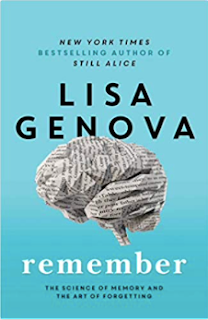
Remember


I heard Lisa Genova speaking on the radio about memory and forgetting, I can't remember (ha!) which programme it was on now, but I do know I was in the car. But I was so interested I made a point of checking for her book and reserving it at the library.

Neuroscientist Lisa Genova is perhaps best known for writing the novel, Still Alice, which became the basis of an Oscar-winning film starring Julianne Moore. Genova said that after the success of the film, she was so often asked questions about Alzheimers, memory loss and how memory works, that she decided to write a book to address all those issues.

Remember is an engaging, easy to read guide to memory. Clearly written for an American audience, it opens by asking the reading to picture a US penny, something I'm obviously incapable of (mind you, thanks to the pandemic I struggle to remember what Australian coins look like, too). Genova's point is that we don't remember what we don't need to remember, like things we see and do every day. She has several reassuring points to make about the particular difficulty of remembering people's names (nothing to hook the memory to) and how poor humans are at remembering things prospectively, ie things we have to do in the future. She is not at all worried about the use of lists and reminders to assist us. This was an interesting, informative read about a subject that is relevant to us all.

My only niggle was the total American-centricity of the examples Genova uses -- not just the coin, but things like picturing your last Thanksgiving dinner, or George Washington being the first president. This tactic would work perfectly on her lecture circuit but it doesn't translate so well for an international audience.

10.1.22

The Signature of All Things

Unfortunately this was another much-lauded novel that, for me, failed to live up to high expectations (see Where the Crawdads Sing, below). I've seen many glowing recommendations for Elizabeth Gilbert's The Signature of All Things and it has over 100,000 reviews on Goodreads (crikey) so I'm clearly in a minority here, but I wasn't as enthralled as I wanted to be.

There were plenty of reasons to expect good things. I've read most of Elizabeth Gilbert's non-fiction and find her an engaging writer. I love history and historical fiction; I like plants, and I was primed to discover more about eighteenth century botany after being bewitched by The Paper Garden. A plain, scholarly heroine always appeals, as does the fact that most of the story takes place either in Alma's childhood or after her middle age -- entirely skipping over the youthful, fertile years which are usually the focus of fiction about women. 

I must say that the final third of the novel (contrary to normal practice!) fairly sang -- once the story shifted to Tahiti I found myself gripped much more tightly by the story. But the first third was a bit of a drag. The backstory of Alma's father went on too long for me, and it wasn't till Alma met the ethereal Ambrose, about halfway through, that the gears of the plot began to move. I can see why other readers have been captivated by this novel, but I just couldn't quite shift myself onto its wavelength.
 

30.9.21

The Martian


Andy Weir's The Martian is not a book that I would have picked up ordinarily, but it was strongly recommended by the younger daughter, who requested it a while ago and then lent it to me. And then after I'd finished it, we watched the movie.

The Martian oddly reminded me of Arthur Ransome's Swallows and Amazons books, which I adored as a child. There was a similar emphasis on describing practical problem-solving (which is what appealed to the YD), except that instead of pitching tents or catching fish, stranded astronaut Mark Watney has to figure out how to create water, grow food and communicate with Earth. There is a LOT of science, all of which is apparently accurate, especially in the early pages, but there is also a lot of drama. It reminds me of those writing exercises that demand you throw increasingly horrendous problems at your protagonist: just when you think Watney's going to be okay, he blows up some vital piece of equipment, or crashes his rover, or breaks his spacesuit.

The scenes on Mars are intercut with chapters set on Earth, as NASA discovers that Watney is still alive and then develops a rescue plan. The film version lost some of the detail of the problems Watney had to solve, but made up for it with the spectacular visuals of the surface of Mars (the movie was partly shot in Jordan) and gorgeous scenes on a very luxurious space station. As YD remarked, if she'd seen this when she was younger, it would definitely have made her want to be an astronaut.

I think there is a part of all of us that secretly wants to be an astronaut; however, reading The Martian convinced me that I wouldn't last a day!