Showing posts with label biography. Show all posts

22.8.26

One Life: My Mother's Story

I enjoyed Kate Grenville's One Life so much -- more than I expected to. She is just such a readable writer, even when handling material that by her own admission, might seem very ordinary. It's a biography of Grenville's mother, Nance, but it reads like a novel, and I kept eagerly turning the pages.

Mind you, Nance was not really such an ordinary woman. One her friends described her as 'remarkable,' and in many ways she was exceptional, despite living all her life in sleepy Australian towns and suburbs. But even the most ordinary lives contain their own drama and pathos. Nance was the child of an unhappy marriage, of pub owners Dolly and Bert (Grenville has also written about her grandmother in Restless Dolly Maunder, which I might check out next). (The pub owning background was also interesting on the heels of reading Australian Gospel.) Nance trains as a pharmacist at a time when it was unusual for woman to gain professional qualifications, but once she's attained her apprenticeship, she's qualified herself out of a job. She marries Kenneth, a closet Trotskyist, and their partnership has its ups and downs -- he's proud of her for working, but is clueless about taking up the domestic burden. Time and again Nance is thwarted by lack of childcare in her community.

One Life is a loving, clear-eyed tribute to a woman whose story becomes extraordinary in Grenville's hands, and a kind of first hand history of the middle decades of Australia, covering the Great Depression and the wars. I loved it.
 

5.7.26

Hitchhiker


I was a bit taken aback when I read the foreword to M.J. Simpson's biography of Douglas Adams, Hitchhiker. The foreword was written by John Lloyd, now best known as the creator of QI, but at one time Adams' closest friend, and he describes Hitchhiker as 'painstakingly researched and ineffably sad,' and describes Simpson as 'an honest man who has done his level best to present a balanced picture of what can hardly be described as a balanced life,' which at first seemed mystifyingly like damning with faint praise.

However, having now read the biography and gone back to re-read the foreword, it seemed less mean-spirited and closer to the simple truth. Douglas Adams was evidently a gifted and difficult man, and the huge success of The Hitchhiker's Guide to the Galaxy delivered him wealth, fame and opportunities, and simultaneously dragged like a millstone round his neck. He was a fountain of ideas, fired up when he was collaborating with other people, a natural extrovert, but loathed the isolation and discipline of sitting at a desk and doing the lonely work of actually writing, hence his notorious inability to meet a deadline. (Perhaps his most famous quote was, 'I love deadlines, I like the whooshing noise they make as they fly past.')

Adams' was widely loved, but he burned many bridges. He brimmed over with ideas but was hardly ever able to see them through to a finished product. At one point his publisher had to lock him up in a hotel room and physically sit glowering at him until he had finished writing the book he was contracted for. He was a master of distraction and procrastination (it's not considered in this book, which was published in 2003, but I wonder if he had ADHD). Adams died far too young, of a heart attack at 49, when his daughter was only seven years old. That's not the only reason why this biography seems so sad, but also the unfulfilled promise of a huge brain and often lonely heart. 

25.6.26

Agatha Christie: A Very Elusive Woman

Lucy Worsley is a well known English historian who has presented many television and podcast series and written several books of historical fiction and non-fiction. I must admit that in the media I sometimes find her 'isn't this thrilling' presentation a bit much, but I must also admit that I found her biography of Agatha Christie utterly beguiling and illuminating. Worsley has a knack for intertwining Christie's personal history with social movements of the time which makes for fascinating reading.

Naturally the hinge of the book lies with the mysterious events of 1926, when Christie disappeared for several days, after her husband had told her he was leaving her for another woman. Her car was found abandoned and foul play or suicide was suspected. She was eventually discovered in a Yorkshire hotel, and the official story was that she had lost her memory. The whole episode was a press sensation, and it didn't take long before nasty aspersions were cast: was it a publicity stunt? A hoax to cast suspicions of murder on her husband? Or an elaborate scheme to lure him back? Worsley takes the view, informed by modern psychological knowledge, that Christie was acting in a genuine fugue state, a recognised psychological condition which is not exactly amnesia but certainly involves acute mental distress and delusion. It seems highly unlikely that Agatha Christie, who fiercely guarded her privacy all her life, would have deliberately staged such an attention-seeking stunt.

Worsley points out that the notion of Agatha Christie stories as cosy and nostalgic has largely arisen from the TV and movie adaptations of her work; the actual books were often acutely modern (for their time) as well as technically adventurous. Though she lost her grip as she grew older (Worsley suggests that perhaps dementia was setting in in her later years), at her peak she was a sharp psychological observer as well as a fiendish mystery plotter. I'm quite tempted to go back and revisit her classics -- I acquired loads of Christie collected volumes from various library sales, but I think they are all in storage with my daughter's stuff...
 

2.5.26

Wild Swans

I am extremely late to the party on Jung Chang's international bestseller from 1991, Wild Swans. If you've been living under a rock for the last thirty years, Wild Swans is the story of three generations of women living in China through the tumultuous decades of the twentieth century. Jung Chang's grandmother was a warlord's concubine; her mother was a dedicated Communist Party official; and Jung herself eventually studied English and emigrated to the UK.

Wild Swans has been a school text almost from the moment it was published. My younger daughter used it in studying Revolutions and the copy I've been reading is hers. My ignorance of China's history is shamefully almost total, and Wild Swans filled in quite a few blanks for me. I vaguely knew about the Cultural Revolution, but not quite what a horrific period it was, nor the extent of the arbitrary violence and cruelty it unleashed. The tides of being in and out of favour washed Chang's family to and fro; sometimes they enjoyed quite a lot of privilege, sometimes things were absolutely desperate.

For me, Wild Swans started slowly and it took me a while to become captured by the story. The book really came alive for me when Jung Chang herself appeared, and I sometimes found the parts about the internal machinations of the Communist Party head-spinning. However, I was excited when simultaneously reading Mark Colvin's autobiography, Light and Shadow, to come across a section when Colvin was travelling through China in the early 1970s and he was told about the death of important general Lin Biao -- a very deliberate piece of information-planting whose significance young Colvin completely failed to recognise! Thanks to Wild Swans, I already knew the background story of Lin Biao, so this story meant much more than it would have otherwise.


17.2.26

Dorothy L. Sayers: Her Life and Soul

I have a feeling I might have read this biography of Dorothy L. Sayers before -- I think I borrowed it from the Stockbridge Library in Edinburgh in 1991, I'm sure I remember reading it in Jo and Alyson's flat in East Claremont St. Anyway, I had forgotten almost everything except the rather astonishing fact that she had a son in 1924, out of wedlock, telling no one. Fortunately she was able to foster the baby with her discreet cousin Ivy, who did this for a living, and was able to keep in contact with her son and support him for his entire childhood, until she 'adopted' him at the age of about eleven. He suspected that she was his biological mother but was not able to confirm this until after her death. (Also, apparently adoption as we know it was not legal in the UK until 1926! How extraordinary.)

Barbara Reynolds focuses a lot on Sayers' religious work and spiritual philosophy, which is of less interest to me than her detective fiction, so I skimmed over the last section of this book fairly quickly. I am intrigued to find her radio plays, The Man Born to Be King, which at the time were a revelation in their realistic presentation of Jesus' life. Something I'd forgotten was that Sayers pronounced her name 'Sairs' and strongly disliked the pronounciation SAY-ers, which is of course how I've said it my whole life. Whoops. Sorry, Dorothy. 

I don't think Dorothy Sayers and I would have agreed on much, but she had a brave, rich and resourceful life and I celebrate her.

19.2.24

The Narnian

Another gem from the shelves of the Athenaeum Library. I have read quite a lot about C. S. Lewis but I'd never come across The Narnian. It's not an exhaustive biography, because Alan Jacobs focuses above all on the development and expression of Lewis's inner life -- his ideas and imagination. As a Professor of English and university director of Faith and Learning, Jacobs is particularly interested in Lewis's Christianity, which was of course the central foundation of his work. 

I have to confess I've never read any of Lewis's apologetics or even his adult novels (though I have a dim memory of attempting The Screwtape Letters in high school), but Jacobs does a good job of outlining his arguments. I think Jacobs is right when he says that Lewis's great strength was not actually in debate or philosophy (even though 'no one could best him'), but in depiction -- he shows us a world where goodness and virtue become rich and delightful, and makes us want to live in that world. Could there be a better description of Narnia? Jacobs emphasises Lewis's 'willingness to be enchanted,' for which I am prepared to forgive his dated attitudes.

One aspect of Lewis's personal life which struck me particularly after reading Wifedom was his long devotion to Mrs Moore, his friend's mother, about which Lewis's brother Warnie was apoplectic with fury, seeing his busy, gifted brother running around filling hot water bottles, taking out the dog et etc instead of getting on with his work. For a start, it seems clear that Lewis and Mrs Moore at least at one time were sexual partners, and no one would bat an eyelid if the gender roles were reversed, and a younger wife were caring with equal tenderness to an older, demanding husband, no matter how creatively gifted she might be, and how much her work suffered in consequence -- not that that would be an ideal situation, either, but part of Warnie's horror surely stems from the perceived 'unnaturalness' of Lewis's position. Anyway, it doesn't seem that Lewis's work actually did suffer all that much, and as Jacobs points out, this experience probably taught him much about suffering, and patience, and love, and duty, which helped him toward greater depth of wisdom and compassion in the long run.
 

13.6.22

Scribbles, Sorrows and Russet Leather Boots


Liz Rosenberg's Scribbles, Sorrows, and Russet Leather Boots is that rarest of beasts: a young adult biography, charmingly illustrated by Dian Sudyka. It's the life story of Louisa May Alcott, who wrote a version of her own autobiography in her best-known and deeply beloved novel, Little Women. 

However, as Scribbles, Sorrows makes clear, Little Women is a look at Louisa's youth through rose-tinted glasses. She did have three sisters, who conformed more or less to the images of the March sisters as we know them, and the family did live in Concord and did enjoy a life that combined good deeds, hard work and the freedom of picnics, boating, and amateur theatricals. But Louisa's real life was much harder and more bitter than the version she created for Little Women.

Mr Alcott was not exactly the wise, benign pastor we met in Mr March -- he was a man of high principles but little practical sense of responsibility. He started schools (all of which failed) and gave philosophical lectures, but refused to enter paid employment, which he regarded as a kind of slavery, despite the fact that this decision plunged his wife and children into utter poverty. He enjoyed the big book-lined study, which Louisa, the one who actually earned money with her writing, was forced to scribble at a cramped desk in the corner of her bedroom.

All the weight of responsibility for the family landed on Louisa's shoulders. The illness of Lizzie (Beth), the early death of Anna's (Meg's) husband, her parents' increasing frailty, May's (Amy's) artistic education, and eventually the raising of May's daughter -- all fell to Louisa to deal with, supporting the whole family with her writing. Tragically, her own health took a downward slide after a stint nursing during the Civil War. Louisa fell ill with typhoid pneumonia and was generously treated with calomel, then regarded as a wonder drug, but now exposed as toxic. Louisa suffered for the rest of her life with mercury poisoning, which eventually killed her.

Rosenberg attempts to paint Alcott's life as ultimately fulfilling and positive, but reading the details of her daily struggles, it's difficult to take such a rosy view. I've also read a Twitter theory that Alcott was trans, regarding herself as male, and certainly Louisa, or Louie, did take on much of the traditional masculine role of family breadwinner and guardian. However I think ultimately, without access to Alcott's private papers, I'm more comfortable with Greta Gerwig's interpretation of Jo and Laurie as blurring gender roles, with Jo leaning to the masculine and Laurie to the feminine. Rosenberg also seems inclined to this view.

Scribbles, Sorrows and Russet Leather Boots was lent to me by my friend Sian -- thank you!

14.1.22

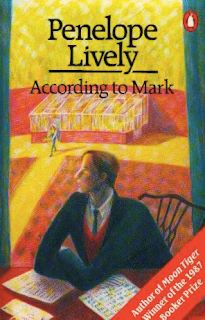
According to Mark


I really love Penelope Lively's books for children but I'm less keen on her adult fiction. According to Mark seemed like a pretty minor novel to me and I was surprised to learn that it was shortlisted for the 1984 Booker Prize (Lively won the Booker three years later with Moon Tiger). It reminded me strongly of A. S. Byatt's blockbuster Possession which appeared a few years later and tackled head-on topics that According to Mark brushes past more lightly -- the relationship between biographer and subject, the dance between biography, fiction and truth, the gaps in the record of a life, which might be deliberate or accidental.

According to Mark does deal with a literary mystery similar to the one central to Possession, but it's principally the story of the biographer Mark and his mid-life crisis infatuation with the grand-daughter of his subject. Carrie's reluctance to plunge into an affair -- she goes along with Mark out of politeness more than anything -- makes uncomfortable reading in a post-Me Too world, though it's played for comedy here. By three quarters of the way through I was becoming impatient for the revelation of the secret life of Gilbert Strong which Possession had conditioned me to expect, and its final arrival was a satisfying relief.

According to Mark is a pleasant, diverting novel but for my money, it doesn't compare to The Ghost of Thomas Kempe!


24.9.21

The Paper Garden


Molly Peacock's The Paper Garden is a biography of the remarkable Mary Delany, born in 1700, who at the age of 72 picked up scissors and paper and embarked on an extraordinary project, inventing a new kind of art form in the process. She made collages of flowers, mostly from paper, occasionally incorporating real botanical samples or touches of paint, and before her death in 1788, created almost a thousand of these 'mosaicks.'  

Just look at these amazing pictures!

Each tendril cut out by hand, from hand-dyed papers! Mrs Delany ordered her own pigments, dissected specimens to ensure the accuracy of her portraits, pasted them (probably with flour and water glue), brought them out to show King George III and Queen Charlotte, and they are still preserved to this day.

Molly Peacock's day job is as a poet, and she allows herself plenty of latitude in tracing Mrs Delany's life story in parallel with her own obsession with the collages and possible correspondences between each life stage and a flower portrait. This technique builds up layers of story and meaning in much the same way as Mrs Delany's creations. It was fascinating to learn about the skills that prepared Mary Delany for this superb body of work: gardening, shell craft, silhouettes, embroidery and fabric design, each of which contributed to her powers of observation and dexterity of hand.

Mary Delany also left behind hundreds of letters, which provide an insight into her life story, two marriages, and close friendships, all in her own words.

The Paper Garden is a beautifully produced book, with lovely glossy reproductions of the 'mosaics', thick paper, and a chunky feel in the hand. Deeply satisfying!

26.8.21

The Vetting of Wisdom


 Full disclosure: I was a student at PLC during the events discussed in this book. Joan Montgomery was my headmistress; she left the school the year after I did. Kim Rubenstein, the author of The Vetting of Wisdom: Joan Montgomery and the Fight for PLC, is also a former student. She was my school captain in 1982, a couple of years older than me.

The Vetting of Wisdom is an unashamedly partial account of the furore that enveloped the school in the 1980s, after PLC was awarded to the Continuing Presbyterian church (after the split in the Presbyterians that followed the formation of the Uniting Church) and a campaign began to oust Joan Montgomery as Head. Despite the support of staff, parents, students, Old Collegians and the educational establishment as a whole, a stubborn rump of Continuing Presbyterian men were determined to get rid of 'Monty' and ultimately succeeded.

I was absolutely riveted by this book. It's astonishing to me how little I knew about the controversy that unfolded while I was a student at the school. My parents weren't involved in school affairs and Miss Montgomery and the staff succeeded in shielding the students from the fuss to a remarkable degree. I was aware that Joan Montgomery was going to leave at the end of 1985, but I didn't understand why. I was vaguely outraged when it was announced that she was to be replaced by a man, and not even an Australian man, but did I realise why it was happening? I don't think I did. I certainly didn't appreciate the degree to which a stacked School Council had been hijacked by conservative, narrowly religious forces hostile to the ideals that Joan Montgomery represented -- a liberal, expansive, humane education for young women, equal in quality to that available to boys. These men wanted to see a more 'Bible-centred' approach to education, and they were deeply agitated about courses like Liberal Studies or Human Relations (the course I did in Year 10). They wanted to send representatives to sit in on the Human Relations classes -- I can only imagine the chilling effect that observers would have had on classes about sex and relationships filled with 16 year old girls who were all embarrassed enough as it was! Luckily that idea was scotched.

'Monty' was a wonderful principal. She's been described as 'a woman who embodies an exceptional combination of intelligence, perception, energy, loyalty and common sense.' I would add compassion, dignity and humour to that list. We all revered Miss Montgomery -- we respected her more than the Queen, and she moved through the school with an air of unassailable grace and serenity. But at the same time, she was never intimidating. If she spoke to you, you'd be awed but not overwhelmed. She turned up at my last school reunion to our absolute delight, and she is still going strong at 97. What an incredible waste of talent, and what a terrible shame for the young women of PLC, that she was forced to retire at the young age of 60, instead of having her term extended at least until she was 65.

I accept that for someone who doesn't know the setting or the characters involved, this book's detailed account of school meetings and political intrigue might be drier reading than it was for me, but I found it utterly compelling, outrageous and shocking. To see this remarkable educator torn down, despite a massive outcry of protest, is thoroughly dispiriting. It's almost a 'Me Too' story, albeit without the sexual element, but it is still an account of a gifted, respected women brought down by a conspiracy of men, and there's no other way to spin it.

What a waste. The deepest irony of all is that the Presbyterians were convinced that Joan Montgomery was neglecting the religious education of the girls under her care. In fact, her thoughtful addresses at daily assemblies sank deep, certainly into my consciousness, and probably did more to awaken my spirituality than any other influence in my life. We were encouraged to question, to doubt, to think for ourselves, to pray, to reflect, to sing, to be grateful, to consider how we could help others. It might have taken years for that gentle encouragement to bear fruit, but I know that ultimately it did.

23.1.21

Stravinsky's Lunch


I have read Drusilla's Modjeska's Stravinsky's Lunch before, but not for many years. I wrote above (below, actually!) about the anecdote which sparked her thinking around this subject, at a dinner with Helen Garner and other friends, mostly writers. Stravinsky's Lunch is a biography of two Australian women artists, but it is also a mediation on the clashes between the demands of any creative practice, love, family and the world that women artists experience particularly acutely. (Rachel Power's The Divided Heart is another excellent book on this topic.)

Naturally this is a subject close to my own heart, as I try daily to juggle writing with the multiple needs of family, domestic responsibilities and self-care. The two artists Modjeska writes about, Stella Bowen and Grace Cossington Smith, took very different approaches to the compromises and conflicts they both endured for their art. Bowen left Australia to pursue her artistic studies, but ended up sacrificing her own work for many years after falling in love with the much older writer, Ford Madox Ford, who was supportive of her work (up to a point) but took it for granted that his writing should come first, barely conscious that a quiet house, regular food, and the pleasures of domestic comfort (including children) require work by someone (not him). Eventually they separated and she enjoyed late success as a war artist, but she died relatively young and under-appreciated.

Grace Cossington Smith never married, and in fact, never left her parents' home. Her middle class family supported her financially through the ups and down of artistic recognition, though again she didn't receive the accolades she deserved until late in her long life. Cossington Smith doggedly followed her instincts, painting mostly in isolation and suffering the derision of male critics, and eventually amassed an incredible body of work. But again, her independence was bought at a cost -- in this case, her sister Madge, who kept house and cared for their ageing parents, and then for Grace herself. Modjeska is careful to acknowledge Madge's presence and sacrifice which made Grace's achievements possible.

Annabel Crabb's The Wife Drought makes the same point -- any individual who wants to combine a demanding career (in any field) and a fulfilling personal life (family, children, love) needs a WIFE to do the endless, tedious, draining, time-devouring work behind the scenes. Or a Madge, or a faithful servant, or a partner who is willing to sacrifice a bit of their own time or success or leisure to share the load. Only some us are lucky enough to score one of those.

4.1.21

Beyond the Vicarage


This was a sneaky last minute Christmas present for myself, and I enjoyed it so much! Noel Streatfeild wrote three volumes of fictionalised autobiography: A Vicarage Family was one of my very favourite books as a child; Away From the Vicarage covers the years of her acting career (including a tour of Australia in the late 1920s!); and Beyond the Vicarage (1971) describes the war years and Streatfeild's writing career. I still need to get hold of Away From the Vicarage, but Beyond the Vicarage was a huge treat.

I knew that Streatfeild had written novels for adults as well as her huge output for children, but I hadn't realised how many she'd written. Several of her adult titles were lost when her publisher's warehouse was bombed during the war and the printing plates were destroyed, so I guess we'll never know exactly what they were like. It surprised me that Streatfeild was rather dismayed by the sudden success of Ballet Shoes, which has of course remained immensely popular and really set herself up as a children's author. In the fifties she decided to give up writing for adults, sensibly understanding that her style of adult novel was going out of fashion in an over-supplied market, and from then on focussed entirely on writing for children.

Like Nancy Mitford, Streatfeild's writing strategy was to write in bed for a few hours before getting up -- that way, naughty friends couldn't entice her out on excursions until she'd done her work for the day. It was fascinating to read about her experiences in London with the WVS during the war, running a mobile canteen which travelled around to bomb shelters providing hot drinks and food. She saw some terrible sights and her lovely flat was completely destroyed. I must say, reading about the horrors of wartime London (and, as Streatfeild points out, things were far worse in Europe) puts our pandemic whinges about border closures and isolation into perspective.

Beyond the Vicarage ends with Streatfeild sliding into comfortable old age. She was to live for another fifteen years, dying at the grand old age of one hundred: a pretty good innings.

3.12.20

Dear Dodie


I first came across Dodie Smith as the author of the beloved children's classic, The Hundred and One Dalmatians. I'd enjoyed the book as a child but came to a deeper appreciation of it when I read it to my own girls -- it was one of the few books, apart from Harry Potter, that both my daughters loved and demanded repeat readings of. It was so warm and funny, so witty and clever, with jokes for adults as well as children, and the illustrations were so charming, that I never minded going back to it. The sequel, The Starlight Barking, was a little weird, with a science fiction/mystical premise; that wasn't such a big hit, but still enjoyable.

I was well into adulthood before I encountered Smith's second best known work, I Capture the Castle (originally written as an adult novel, but now regarded as YA). What a beautiful, moving, eccentric, yearning novel -- I'm so sorry that I missed it as a teenager, I would have lived in it. It's rapidly become one of my very favourite books.

Then I found another novel, It Ends in Revelations, in a second hand book shop -- quite a modern take on homosexuality, for its time, I thought, but not amazing. I had no idea that Dodie Smith had enjoyed a stellar career before the war as a playwright, long before she wrote any of the books that have remained her lasting legacy. She and her husband Alec moved to America when the war began, so that Alec, a pacifist, could avoid conscription. They remained there for fifteen years, with Dodie earning a comfortable living working on Hollywood screenplays, but she always felt guilty and conflicted about the move, which she regarded as a betrayal of her country, and more pertinently, as cutting her off from public sentiment in England. She was never able to recapture her former success as a playwright, even after returning to England and remaining there until her death.

No wonder she had enlightened ideas about sexuality; half her friends were gay, including Christopher Isherwood, and she was also a good friend of Julian Barnes, who eventually became her literary executor. In later years, she and Alec lived in virtual seclusion in a country cottage, content with their many Dalmatians (naturally) and a beautiful garden (Alec) and writing her autobiography (Dodie). Over her lifetime she wrote endless letters and diary entries, all of which Valerie Grove must have read to produce this biography.

Grove is quite judgemental about Dodie and describes her as 'self-indulgent' and 'pampered,' which is no doubt true, but she was also determined, humorous, generous (when she had money) and thoroughly enjoyed life's pleasures. In her youth she was an (unsuccessful) actress and then worked in Heals, a furniture shop, where she set out to seduce the much older owner and had a long affair with him, before marrying the young, handsome and devoted Alec. So good for her! 

I think I Capture the Castle is by far her best work, and it showcases her best attributes: clear-eyed self-reflection, whole hearted emotion, appreciation of beauty, and a wry, witty sense of humour.

31.7.20

Too Much and Never Enough


I couldn't resist buying Mary Trump's Too Much and Never Enough on the Kindle after seeing her interviewed on A Late Show, and I wolfed it down quickly (partly while waiting in the queue while my daughter had a COVID test -- negative, thankfully).  This short but punchy book is sub-titled How My Family Created the World's Most Dangerous Man, and it's a sobering account of life in the Trump family which certainly helps to explain the sometimes baffling behaviour of the current US President.

Donald Trump's father, Fred, was a German immigrant who made his fortune developing and managing real estate in Brooklyn. The eldest son, Freddy, was being groomed to take over the family business, but Freddy wasn't suited to real estate and briefly became a pilot. Fred Sr despised this career and referred to him as 'a bus driver in the sky' and Fred Jr ended up crawling back to the family firm. His father constantly belittled and criticised him, and greatly preferred young Donald, whose arrogance and meanness displayed the 'killer' instincts that Fred Sr admired. Thus Donald was rewarded for the traits we see today -- ruthless lack of empathy and compassion, deriding the perceived weakness of others, talking himself up, an inability to see anything he says or does as anything other than 'the greatest' or the most 'tremendous.' 

According to Mary Trump (young Fred's daughter and Donald's niece), the Trump family was brought up to value nothing but money (and in Donald's case, TV ratings). Any sign of vulnerability was denied or mocked. Young Donald Trump received both 'too much' (financial support and approval from his father) and 'never enough' (the unconditional love and security that a small child needs to thrive). So President Trump has ended up as a blustering, apparently confident figure who knows deep down that he is hollow inside, terrified of the failure and weakness that lurks within.

An enlightening but scary read.

3.7.20

Jane Austen: A Life


Despite this very ugly cover, I picked up Jane Austen: A Life on impulse to fill out a Brotherhood Books order, as part of a Jane Austen binge I have going on, and I am SO glad I did. 

This is a superlative biography -- warm, sympathetic, acute and fascinating. I am sure that Jane herself could not have selected a better biographer than Claire Tomalin. She rounds out the crowded Austen family background, seeks her evidence with care and discrimination, and paints such a lively portrait of her subject that you almost forget how little she left behind for us to pore over.

I wasn't aware of the huge gap between Austen's first three novels and her last, and when I discovered why I was outraged and indignant. Austen's parents, apparently on a whim, decided to sell up the Steventon parsonage where the family had grown up and where Jane had a settled writing routine, and moved themselves (and Jane) to Bath, which she loathed. Ten years were lost while the Austens flitted about between rented lodgings and visits to family, with Jane unable to recapture the stability she needed for her work. It wasn't until after Mr Austen's death that a more permanent home was found for Jane, her mother and sister at Chawton, where (you can almost hear the sigh of relief) she was able to pick up her pen once more. 

It's infuriating to think how many novels we might have lost, thanks to the family's disregard for Jane's work, and bizarre to contemplate that, out of this large, colourful, active and largely successful family, it was Jane and her scribbles who have been remembered the longest, and don't seem likely to be forgotten any time soon.

21.2.20

The Trauma Cleaner

The Trauma Cleaner is a remarkable book, multi-awarded and much discussed. It tells the story of Sandra Pankhurst, a transgender woman who has survived childhood abuse, exploitation, drug addiction and rape, and who now operates a highly successful business as a trauma cleaner -- cleaning up crime scenes, the houses of hoarders, places where people have died.

Sandra's story is compelling enough on its own, but it's told brilliantly by Sarah Krasnostein. The book loops between Sandra's history -- her imperfect, patchy memories, supplemented by Krasnostein's own researches -- and her current life, the various scenes where her work takes place, in all their heartbreaking and sometimes revolting vividness. These poignant encounters, Sandra's empathy and compassion, and the strange hollowness within, are beautifully described. This is an incredibly moving book.

I read The Trauma Cleaner simultaneously with Lost For Words, and it was interesting to compare the two accounts of damaged and resilient women, one fictional, one true. Now that I've begun reading books concurrently, I'm astonished at how frequently these correspondences crop up, without any planning on my part.

11.12.19

Tea by the Nursery Fire

I found this short, large print biography in the local library while I was on a quest for Noel Streatfeild books. For a Streatfeild fan, Tea by the Nursery Fire: A Children's Nanny at the Turn of the Century is fascinating reading. It's the biography of Emily Huckwell, familiar to readers of A Vicarage Family as Grand-Nanny, the beloved nanny of Victoria's father (Victoria being the thinly disguised figure of Streatfeild herself).

Emily was born in Sussex in the 1870s and at twelve years old, went into domestic service. She started as nursery maid and ended up as head nanny. At one point she did contemplate marriage, but her fiancé was killed in an accident and for the rest of her life, she devoted herself to 'her' children. Certainly Streatfeild's father was devoted to her, much more so than to his actual mother. No wonder, because Emily brought him up, loved and disciplined him, and he rewarded her with his first love.

This book is a window into another time, where people 'knew their place' and didn't question it. Emily is clearly the origin of all those comfortable, loving but strict non-mother figures that litter Streatfeild's fiction -- Nana in Ballet Shoes, Peaseblossom in The Painted Garden, Pinny in Tennis Shoes. Long after nannies had disappeared from the average middle class household (let alone the genteel poor who form the majority of Streatfeild's fictional families), these figures keep cropping up, with increasingly strange relationships to justify their presence -- an old school friend, daughter of a former patient -- and these women, always single, seem content to join the household as something between a servant and a relative, always doing the worst chores, the mending, escorting the children round town, and never complaining about their lot. They are always a fount of folk wisdom, which it transpires comes straight from the lips of Emily Huckwell: Satan finds work for idle hands, don't care was made to care, it will all be Sir Garnet.

It seems that Grand-Nanny was such an integral part of Streatfeild's own family that she found it impossible to imagine any family without a similar figure as part of it, taking up the slack from Streatfeild's universally useless mother-characters.

27.11.19

The Woman Who Cracked the Anxiety Code

The Woman Who Cracked the Anxiety Code was Dr Claire Weekes, an Australian doctor who wrote self-help books about anxiety and panic attacks which sold millions of copies all over the world, and still sell well today. Yet I had never heard of her!

Judith Hoare's biography is sub-titled The Extraordinary Life of Dr Claire Weekes and in many ways Weekes' life was indeed extraordinary. She was a scientific researcher in the 1920s, when women were barely admitted to university, and her pioneering work on lizard reproduction is still cited today. She reinvented herself several times, planning a musical career, then an upmarket travel agency. The latter plan being kiboshed by the outbreak of WWII, she went back to university and qualified as a GP. Then, in the 1960s and beyond, came the self-help books.

This is where her story, sadly, becomes less extraordinary. Being a woman, and a mere general practitioner rather than a psychiatrist, writing for a popular audience (so she could actually help as many people as possible) rather than in academic journals or psychiatric forums, her work was belittled and overlooked. And yet her mantra (based on both scientific knowledge and personal experience) -- Face, Accept, Float, Let Time Pass -- presaged modern approaches to dealing with anxiety like CBT and ACT. Her key insight was not to fight the feelings of panic, but to let them wash through you, and to "float" through them.

I would have liked a little more on her work, which was sometimes presented in a slightly confusing way by Hoare, but overall this was a fascinating introduction to a woman who should be more widely known. Borrowed from my friend Christine.

30.9.19

Wild Mary

I've been hanging onto Wild Mary, the biography of Mary Wesley, for some time while I read a few of her novels to get a sense of where she might be coming from. But wow, the story of her life beats the novels hollow (and now I'm keen to read the rest and see what else made its way into her work).

Born in 1912, Mary Wesley found her writing career late in life -- her first adult novel was published when she was 70, and she wrote about nine more (all bestsellers, with TV adaptations and international sales etc) before she died. After a few decades of grinding poverty, she was catapulted into sudden wealth: a dream come true!

Mary Farmar was born into a genteel military family. Her father was the British liaison with John Monash's Australian regiment, and he landed with the Australian troops at Gallipoli. But, with some justification, she felt neglected by her parents and older siblings, and rebelled with a defiant adolescence and young adulthood (this is where she picked up the nickname 'Wild Mary').

She made a conventional marriage into minor nobility, but the marriage was not a success, and the couple drifted apart during the Second World War. Mary was working for British Intelligence and had quite an adventurous time, with many lovers and entanglements before she met her second husband, Eric, with whom she remained until he died. (They were friends with Nancy Mitford.) But Eric had a truly ghastly wife, who stalked and harrassed them for years until they managed to shake her off, and the strain of this reign of terror took its toll on Eric's own mental health.

Eric aspired to be a writer, but never really had anything published. It makes you wonder what Mary might have been able to achieve if she'd had the freedom to write earlier... There was another complicated family scandal later on when a nasty solicitor tried to get Mary's second son disinherited so that he could take control of the whole estate. By the time Eric died, Mary was on the bones of her arse, ill herself, contemplating suicide, having to sell her house which she could no longer afford to live in -- and then her manuscript, Jumping the Queue, was accepted for publication and everything changed. (Jumping the Queue is about a widow contemplating suicide after the death of her husband.)

Mary's books struck a chord because they combine the recklessness and adventurous spirit of youth with the experience and cynicism of old age. They can be really dark at times -- there's incest, betrayal, violence and deception -- and yet they have an exuberant devilry about them which is kind of thrilling. With such rich and racy material to draw from, thank god 'Wild Mary' didn't succeed in 'jumping the queue' after all.

21.3.18

A Writing Life: Helen Garner and Her Work

As a long-time deep admirer of Helen Garner's work, I was very excited to see Bernadette Brennan's A Writing Life pop up on Brotherhood Books. Why do people get rid of these amazing books? Lucky for me that they do.

A Writing Life is not a conventional author biography. Rather, it examines Garner's body of work, volume by volume, and relates each publication to events in Helen's life at the time. Though Brennan had access to journals and letters, much remains private -- though Garner has always admitted that the substance of her own life has provided the material for her writing, the line between fact and fiction often blurred. From the seminal Monkey Grip (the famous Monkey Grip house is just opposite my daughter's school, where Garner herself was a teacher for a time), through largely autobiographical short stories and novellas, to her later non-fiction examining questions of justice and responsibility (Joe Cinque's Consolation, This House of Grief), Helen Garner has mapped her own relationship to a wider world and wrestled with the same questions through a long and productive life.

This survey of Garner's work has revealed the gaps in my reading -- incredibly, I think I've managed to miss a handful of early stories and essays. And it's also fired me to reread some books that I might understand better for having read Brennan's insightful observations and analysis. The controversial The First Stone will, I think, make more sense to me now. As soon as I get a chance, I'll be returning to it.