Showing posts with label writing. Show all posts

22.9.26

The Friend


Sigrid Nunez's short novel The Friend had the potential to be a sensitive read for me -- it deals with the death of a close friend by suicide, and the ageing and decline of a beloved dog, as well as a writer dealing with an inability to write and the ethical dilemmas involved in writing about real life and real relationships, all of which are delicate subjects for me! But I loved it.

Very clearly labelled as 'A Novel,' The Friend nonetheless bears the hallmarks of being drawn at least partly from real experience. The musings on the writing process and the politics of publication and teaching, the pain of dealing with the suicide of a loved one, and the growing mutual love between the narrator and the enormous Great Dane she was (at first) unwillingly saddled with, are all beautifully and thoughtfully handled -- that slippage between narrative fiction and autobiographical musings reminded me strongly of Helen Garner's work.

The Friend was also made into a film starring Naomi Watts as 'Iris,' the narrator, and Bill Murray as 'Walter,' the unnamed mentor and friend who in the novel is addressed only as 'you.' I did wonder how they were going to adapt a slim book which is mostly an internal monologue into an almost two hour movie, but I thought it was actually very successful -- a quietly moving and gentle experience, with deft touches of humour. It's on Netflix if you're interested. And the dog is wonderful.

30.5.26

Book of Lives

Another quite big brick of a book and another surprisingly speedy read (well, Margaret Atwood is a very good writer). I have been an Atwood reader for most of my adult life. The Handmaid's Tale blew my mind very soon after it was published and I was captivated by Cat's Eye, with its tale of childhood bullying. I faithfully bought and excitedly read the big thick novels that followed: The Robber Bride, Alias Grace and The Blind Assassin, but I think The Blind Assassin must have exhausted me or else I ran out of time for big thick novels because I dropped off after that. I did try Oryx and Crake (which began life in Australia as Emu and Crake) but at the time it didn't engage me. The good news is that I now have several Margaret Atwood books still waiting patiently for me to plunge into.

Atwood's life makes for an interesting story in itself. Famously her naturalist father carted the family into the wilderness for half of every year, which left Atwood with a legacy of environmental awareness and a love of birds in particular. She writes enjoyably about the beginnings of the Canadian literature scene, which I imagine has a lot of parallels to the Australian situation -- it was difficult to persuade publishers to risk printing local stories, and aspiring writers were advised to try their luck in the UK or USA (sadly, I fear that 'global' appeal is again becoming a requirement for publishers to risk their money).

The latter part of Book of Lives is overshadowed by the decline and death of Atwood's second husband, Graeme; another story of grief and mourning. It's remarkable to think that Atwood is now in her late eighties, and yet she is as sharp or sharper than she ever was, making films during Covid and still experimenting. I suppose we might not have her for much longer, but what a blessing to have this chunky, rich and funny memoir from a real literary legend before she leaves us.
 

17.11.25

Dreams and Wishes

I spotted Susan Cooper's Dreams and Wishes: Essays on Writing for Children in a second hand bookshop. It's inscribed on the flyleaf: To Mary -- Write, write, write!!! -- but not signed. I'm wondering now if that inscription could possibly have been written by the author? And I wonder who Mary was?

This collection has been put together from various articles and speeches that Cooper gave in the 1980s and 90s. There are some interesting stories about how her famous series, The Dark is Rising, come to be; the first volume, Over Sea, Under Stone, started life as an entry in a competition for a family adventure book, and the magical elements only crept in during the writing. Cooper was also very concerned (some things never change) about a drop in children's reading for pleasure, and the fact that some children spent three or four hours a day watching television, passive in front of a screen. As I read this, I couldn't help thinking, oh boy, Susan, you don't have any idea what's coming down the line...

I hadn't realised that this seemingly most British of writers has actually spent almost her whole adult life in the US -- perhaps that's what gives her descriptions of Wales and Buckinghamshire their potency. She agrees with a thesis I have heard before, that the writers of the so-called Golden Age of children's literature in the UK were shaped by growing up during the Second World War, when the battle between Good and Evil was played out literally above their heads and all around them. It's a persuasive argument. Susan Cooper is still with us, she is ninety, almost exactly the same age as my mum, and I am the same age as her children. The Dark is Rising was a formative text for me, as I'm sure it was for many fantasy, and other, writers -- long live Susan Cooper.
 

3.9.25

England Through Colonial Eyes in Twentieth Century Fiction

I'm a little embarrassed to admit that I bit off more than I could chew with this book! I couldn't resist the title, but when it arrived from Brotherhood Books, I realised that it was a very scholarly collection of essays from three La Trobe University History and English academics: Ann Blake, Leela Gandhi and Sue Thomas. I did my best to keep up, but some of the chapters defeated me.

Part 1 consisted of some general essays, and Part 2 looked at several individual authors of colonial origins who had 'returned' to England and explored the 'mother country' in their fiction. I was familiar with Katherine Mansfield (NZ) and Christina Stead (Australia), less so with Jean Rhys (the Caribbean). I have read a bit of Doris Lessing, but I think I was too young for The Golden Notebook; The Good Terrorist did leave a deep impression on me. I have to confess that I've never had much more than a dutiful interest in VS Naipaul and Salman Rushdie, and I struggled with their chapters. I've never heard of Nigerian-born Buchi Emecheta, but I'm definitely intrigued now, and likewise David Dabydeen is a new author to me.

I'm still interested in the subject of authors bringing their various colonial and post-colonial perspectives to the colonising country -- most of them are at best ambivalent, some downright scathing -- but perhaps reading their novels might be a better place for me to start.

3.7.25

Searching for the Secret River

Having read Kate Grenville's brilliant Unsettled not long ago, it seemed like fate when Searching for the Secret River popped up on Brotherhood Books. It made a very interesting companion read, because it covers some of the same ground, but from quite a different angle. As a writer, it was fascinating to follow Grenville through the process of writing this big, important, successful novel, from the first scratch of interest in her family history and the stories handed down, all the way to the final edit, and the multitude of decisions along the way. In Unsettled, the emphasis is squarely on her awareness and assumptions about First Peoples, and interrogating the family stories with fresh knowledge. One of the very first prompts for rethinking came early on, when a First Nations writer helped Grenville to query what 'taking up land' really meant -- it meant 'taking.'

This is a story Grenville also tells in Unsettled; it was clearly a formative moment. Despite its wide success, The Secret River was not an uncontroversial novel. It was criticised for not including the voices of its Aboriginal characters; Grenville reveals that was a deliberate, and in its own way, respectful choice. Inga Clendinnen fiercely argued that Grenville confused history and fiction; I'm not sure that's true. The project of fiction is not the same as the project of history, and Grenville is aware of that all the way through.

I'm so glad I read this book, though it might not be as totally fascinating for everyone. It got me through a long night in the emergency department of our local hospital, if nothing else!
 

30.6.25

Fishing in the Styx

 Ruth Park's second volume of autobiography, Fishing in the Styx (great title), picks up where the first left off, after her arrival from New Zealand to Australia in the middle of the Second World War and her marriage to D'Arcy Niland. The two managed to scratch out a living, against everyone's predictions, as full time writers, chiefly by never saying no to a commission and by entering every prize going. Park wrote thousands of radio scripts for children as well as the award-winning novel, The Harp in the South, informed by her own experience living in the slums of Surry Hills. I didn't realise that this book had been so hugely controversial at the time, with Park herself being publicly vilified for daring to write on such a topic. She (probably correctly) deduced that she attracted particular vitriol for being a) female and b) a foreigner. She went on to write many more books over several genres, fiction, non-fiction, children's and young adult.

Park and Niland's struggles are very moving and quite relatable to any working author! Still, they had five children and lived in various houses, occasionally travelling back to New Zealand to visit Park's family, and Park tells a beautiful and mysterious story of a visitation at the moment when her father died. Niland was haunted by a heart complaint which caused his own death at just 50, leaving her a widow with five half-grown children and a weighty burden of grief. Not surprisingly, the rest of her life was shaped by this terrible loss. She never remarried.

Fishing in the Styx is in some ways much sadder to read than A Fence Around the Cuckoo, but it's also the joyous story of a creative couple who never failed to support and encourage each other, even though Niland did do some characteristically male things, like claim the dining table as his work space without considering where Park might do her writing (the answer, predictably, was on her lap). My God, they worked so hard! This book was published in 1993, but Park lived until 2010, when she was 93, after a long, productive and richly lived life.

31.5.24

Dreams Must Explain Themselves

I wish I had discovered The Wizard of Earthsea and its sequels when I was at school, but somehow, even though I loved fantasy, they passed me by. I used to read quite a bit of science fiction in high school, too, but again, I somehow failed to find Ursula Le Guin's classics, The Left Hand of Darkness and The Dispossessed until I was an adult. However, once I found her -- not coincidentally, just as I was embarking on writing my own fantasy novels -- I was an instant, utter convert to her writing. Her influence on my work is probably clear to see, though I haven't read everything she's ever written. (The character of Ursa in The Singer of All Songs is a nod in her honour.)

I was thrilled to stumble across Dreams Must Explain Themselves, a collection of some of Le Guin's non-fiction work, arranged chronologically, from 1972 all the way to 2014, just a few years before she died. There are speeches, articles, meanderings, and rants here, from an indignant defence of the importance of gender in Left Hand of Darkness (complete with later admissions that she got some decisions wrong at the time), to a wonderful wander through the history of animals in children's fiction, including praise for a 1930s Australian novel which was much lauded at the time, but which I'd never heard of: Man-Shy by Frank Dalby Davison (published as Red Heifer in the US).

It's sobering to note that Le Guin is writing about the banning of her books way back in 1984, and discussing the same issues that arise in Wifedom in 1988. Le Guin's wisdom, her wry humour, her sharp intelligence, shine from every page. I wish she was still around, but I'm glad we had her for as long as we did.

26.3.24

Yellowface

I know I'm starting to sound like a broken record, but I was able to pluck Rebecca Kuang's viral satire, Yellowface, off the shelf at the Athenaeum library; there are 87 people in the queue to borrow it from my local.

I raced through this novel, though parts of it were hard to read -- not because they were badly written, but because their forensic dissection of white guilt, overt and unconscious racism, and self-righteous self-justification were so painfully accurate and shameful. Don't get me wrong -- Yellowface is very funny as well as excruciating, not just about racism but also about the world of publishing (fortunately, as a children's author I have been spared the worst excesses of the publicity machine and the cycle of the Hot New Thing). I think I read almost this entire novel with a wince on my face.

Kuang's protagonist, June Hayward (known as Juniper Song after she steals her dead friend's manuscript and passes it off as her own), is monstrous, but she's also pitiful in her longing for admiration, validation and praise. I'm sure I'm not the only author to read this book and catch a glimpse of painful self-recognition in the character of June.

5.10.23

Such Stuff

Such Stuff (also on loan from Suzanne, thank you) is a new, improved and expanded version of Singing For Mrs Pettigrew, and it's the book that I first saw in a library on a school visit. Some of the stories are the same, but most are at least expanded, if not entirely new, and there have also been added some historical notes to supply the facts behind the inspiration.

I forgot to note when I wrote about Mrs Pettigrew, around the same time as I was reading Strangers at the Farm School, that Michael Morpurgo and his wife have actually run their own version of a farm school for many years! It's not a full time residential school, but more like a camp where students come to stay and experience farm life for a week at a time -- but still, pretty close.

Micheal Morpurgo describes himself as a story-teller, and in this book he gives a wonderful insight into the creative process, the way that fragments of ideas drift around the mind, click and connect, strike sparks off each other, or just sink and ferment sometimes for years before suddenly flowering into story. He excels at building stories, slotting layers of plot and character together. But for me, he is less gifted at voice and style -- as I read the various stories and novel extracts in Such Stuff, they all sounded as if they could have been written by the same person, whether the tale was told by a horse or a shipwrecked little girl or Morpurgo's alter ego when young. (I hasten to add, I know I'm guilty of the same fault myself, which is probably why I'm so acutely aware of it.) Nonetheless, Morpurgo is a master craftsman and he has amassed a body of work that he should be very proud of.
 

24.8.23

The Joy of the Snow

I've been waiting ages for Girls Gone By to re-issue Elizabeth Goudge's autobiographical memoir, The Joy of the Snow, but it's taken so long, I got fed up and ordered it from World of Books. I knew that I'd read this book before, a long time ago -- maybe in high school? -- because I always remembered one section when Goudge singles out The Valley of Song as one of only three of her own books that she actually loves, even though as she admits it's a rather muddled and peculiar book. But the bit that stuck with me was when she says it was liked by a few children '(and how I adored those children).' I remember feeling so proud and special for being one of those select few, even though Goudge didn't know of my existence!

This is a quiet but lovely book which will mean a lot to Goudge fans but not much to anyone else, I fear. She writes beautifully about her childhood and youth, her parents, and particularly of the places she has lived, each of which has its own atmosphere and beauty and each of which she has used as settings for her novels. The power of Goudge's love of place and nature is deep and spiritual, and it's this that I most respond to as a reader, I think. She also writes very amusingly of how Green Dolphin Country unexpectedly won a major American prize (though she only received a small percentage of the money) and how this good fortune changed her life forever, much to the bemusement of her friends and neighbours. 

Goudge suffered all her life with anxiety and at times depression, and a modern reader wonders whether, with her extreme sensitivity and hatred of change, she may have been neuro-diverse? It was also interesting to read a chapter about ghosts and what Goudge calls 'ESP,' the very day after I'd been to see the play 2.22 A Ghost Story! 

12.1.23

Three Thin Books


I'm going to talk about these three books together because I read them all at the same time, they are all very short, and weirdly, they ended up sharing some of the same themes.

Falling Out of Love with Ivan Southall by Gabrielle Carey is a meditation on reading, focusing on the intimate relationship between reader and writer. It turns out that Ivan Southall, though he was an inspiration to many young readers and made a point of replying thoughtfully to every piece of fan mail he received, was a bit of a prick to his own family and children and not really a very nice human being. Carey, who adored his books as a child, wrestles with this contradiction and finds her attitude to his work tainted by what she learns about his life -- with fresh eyes, she sees misogyny in his female characters, clunky writing, and simplistic, bullying adult characters, although Southall surely gained his insight into the demands of traditional masculinity and feelings of abandonment from his own sad life history. Ultimately Carey wonders if the intense and intimate relationship between writer and reader can become a substitute for messier real-life relationships -- she's convinced that Southall found solace in writing to and for his young readers, and she also suspects that she herself retreated into books as an escape from reality. I'm not sure how much I agree with this thesis, though there may be some truth in it.

In Sister of the Angels, a Christmas fable by Elizabeth Goudge, featuring the same cast of characters as City of Bells and Henrietta's House, a similar question is raised: who is the 'real' person, the artist who creates wonderful images, or the flawed human being who has sinned? I'm not sure this question even makes any sense, what does 'real' mean anyway, and perhaps we have to accept that humans can be both creators of great art and despicable people at the same time? But because this is Goudge, this is a story of redemption, repentance and rebirth into a new life through the power of creation, which might work for the character of Nicolas Broadbent the artist, but perhaps it's too late for Ivan Southall.

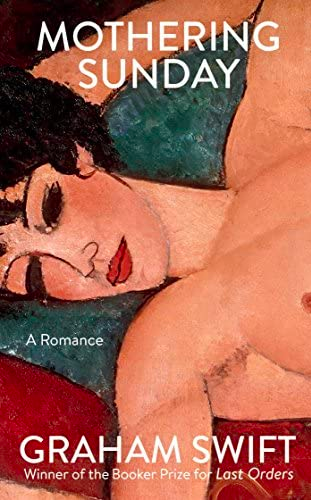
Finally, the adult novel Mothering Sunday by Graham Swift, which my husband picked up for me in a street library because we'd watched the recent movie adaptation -- I have to say the book was better than the film! Honestly it did seem to me like a very male idea to invent this 1920s maidservant wandering naked around the empty mansion (while we watch her) -- it didn't sound particularly comfortable to me! But the crossover point with the other two books was the the maidservant character, Jane, who later becomes a writer, falls in love with the works of Joseph Conrad in the same way that Gabrielle Carey fell in love with Ivan Southall's book, and so we came full circle. Mothering Sunday is also an exploration of the intersection of fiction and reality, and the invention and re-invention of the self.

I suppose the more I read, the more likely it is that I'll pick out points of similarity, but I really wasn't expecting these three very different books to each approach this topic from differing angles. Synchronicity!
 

15.7.22

The Writer Laid Bare


Something terrible happened as I was unloading the car after borrowing Lee Kofman's The Writer Laid Bare (as recommended by Susan Green) from the local library. I had my hands full -- handbag, book basket, letters, my daughter's keep cup, keys. And of course the inevitable happened: the keep cup tilted, and coffee dribbled out into the book basket, all over the library books... which were in the worst possible position, spines down, pages up... So I have thoroughly ruined two perfectly good books. I haven't confessed to the library yet (I've been in iso with the dreaded spicy cough) but I will of course pay for their replacement. However! You should have heard me cursing Daughter Number One and her abandoned coffee -- it was not an edifying scene.

ANYWAY. I've read a few of these how-to-write guides lately and Kofman's is definitely one of the most enjoyable. Temperamentally we are quite different; Kofman relies more on instinct and intuition than I do (though I could probably stand to loosen up a bit), and it was delightfully refreshing to see the way she tosses all those 'rules' overboard. So you love adverbs? Go ahead and use them! You want to 'tell', rather than 'show'? Who cares, sometimes that's a more efficient way to go. Start in the middle of the action? Sure, you can do that, but who says you have to?

I so enjoyed Kofman's personal story. She is generous is sharing her own failures and misfires in a way which is very reassuring. She is frightening accomplished, fluent in several languages, and has read widely. She quotes from a huge range of other authors, including one of my favourite non-fiction writers, Robert Macfarlane, whose book The Old Ways I was co-reading (it is really spooky how often this happens). I wonder if I'll get to keep this book now I've destroyed it? If I'd had to choose a how-to-write guide to keep, it would probably have been The Writer Laid Bare.

18.5.22

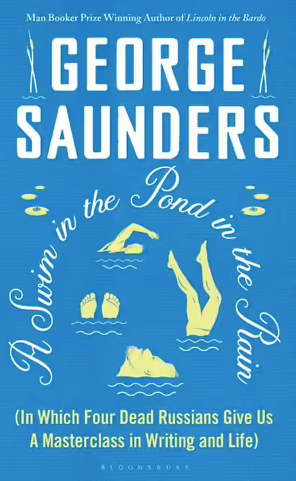
A Swim in the Pond in the Rain


A Swim in the Pond in the Rain was another title with a long waiting list at my local library. The subtitle of George Saunders' book is (In Which Four Dead Russians Give Us A Masterclass in Writing and Life). I don't know that I've read another book quite like this one. It's an instruction book that teaches us how to read, how write and how to life.

Saunders reprises the creative writing class he has given at university for twenty years, inviting us to closely read these seven short stories by four classic Russian authors (Chekov, Tolstoy, Gogol, Turgenev), to notice what they do right and how they achieve it, and also to note their flaws. While he's at it, he points out the life philosophies of these authors: what gives these stories greatness as well as technical mastery. And on top of that, he passes on his own lessons from a lifetime of pursing his own writing career.

It was really interesting to read George Saunders' writing advice straight after Graeme Simsion's. While Simsion is a planner, Saunders seems to be a 'pantser' -- his approach is to 'follow the voice' and let it reveal its secrets. He is a great one for tapping into the unconscious creative mind, the writer's intuition, and allowing the unfolding story to emerge with minimal conscious guidance -- the only question, he says, is to examine each line and judge whether it pleases you. I have to say this is not a method that appeals to me much, though I might try it if I'm really and truly stuck.

Saunders is a wonderful teacher, an accomplished, compassionate and humorous writer, and joyful company on this journey through Russian literature. But I'm not sure if he is the writing teacher for me.

25.4.22

The Novel Project


The Novel Project: a step-by-step guide to your novel, memoir or biography comes from a well-credentialled author: Graeme Simsion has written multiple novels, non-fiction and screenplays, both solo and with his partner in life and writing, Anne Buist, so he knows this caper inside out. In particular, his Rosie trilogy has been massively successful. The Novel Project had a waiting list at the library as long as my arm, so I wasn't the only one seeking wisdom at the feet of the master.

I must admit, part of my motivation in borrowing The Novel Project was to reassure myself that I was doing some things right -- after ten novels published, and number eleven coming out next year, you'd hope I'd have some clue. And I did find reassurance here that my methods are mostly sound. But I also found the other thing I was looking for, which was some fresh ideas to shake up my usual routine. 

Simsion has a lot to say about structure, but before planning out an outline (a step I usually take a smidgeon too early, I think now), he recommends building up a bucket of story 'beats' -- scenes or steps that either develop character or take the story forward. He also recommends writing each beat on a separate card, so the whole lot can be laid out, shuffled, recombined and stared at as a whole. I took to this idea with glee and soon had my rug covered with cards. I actually found this process incredibly helpful, to see at a glance where the shape of my work-in-progress was too top-heavy; to mash together 'beats' that weren't contributing to the story's forward momentum but added colour and quirk, with 'beats' that were a little dull but necessary to the plot; to re-balance the four acts that Simsion recommends into a more smoother and more satisfying structure. This was actually also a lot of fun and I think I've emerged with a stronger prospective novel (I should add that I've struggled a lot with the structure of this particular WIP and I'm currently up to my seventh draft).

The Novel Project is packed with sensible, straightforward and reality-tested advice from someone who really knows what he's talking about. I took heaps of notes, and I think I'll definitely go back to the card process again. I won't follow all Simsion's advice -- I don't think I'll ever be someone who seeks out beta readers, I'm way too insecure and suggestible -- but this is one of the best and most helpful How To Write guides I've come across.

14.4.20

The January Stars

I suppose it's about time I talked about MY book: The January Stars.

The plot of The January Stars is quite simple. While their parents and brother are away dealing with a family emergency, Clancy and Tash accidentally kidnap their grandfather from his aged care facility, and take him on a road trip to find him somewhere better to live. Along the way, Clancy becomes convinced that the spirit of their grandmother is guiding them, and the adventure ends up drawing together a family that has drifted apart.

The genesis of the story was my own father's stroke, five years ago, which left him paralysed on the right side and living with aphasia, which means, in his case, that he can read and understand speech, but can't speak (apart from a handful of involuntary words) or write. So he is in very much the same situation as Pa -- except that he is much better off than Pa, as he still has my mum.

The single hardest aspect of the COVID-19 emergency for my family has been that Dad's home has a strict ban on all visitors. Usually my parents spend every day together, either at Bill's home or at our place. Now their only real contact is a nightly FaceTime call, which is a lot better than nothing, but still not enough.

So while in one way it has been absolutely terrible timing to have a new book out, in some ways it's a perfect book for the weird and stressful times in which we find ourselves. It's about pulling together (and pushing -- wheelchair joke there); it's about family and taking care of elderly, vulnerable relatives; it's about community; and it's about travel, which is something we're not allowed to do at the moment.

I've been getting some lovely feedback about The January Stars already. If the virus hadn't happened, I would have had a launch this weekend. I'm really hoping that when this is all over, I can still have that launch, and that my Mum and Dad can both be there. Fingers crossed.

8.4.20

The Voice That Thunders

What a pleasure and a privilege to revisit this book of essays and speeches by Alan Garner. Not surprisingly, he returns repeatedly to the same themes from slightly different angles: the strength and centrality of myth and story-telling; his personal experience of being torn between his own place and people, and the world of the academy, and his long battle to reconcile those two aspects of himself; his harrowing experience of mental illness and eventual bipolar diagnosis.

Sometimes he is angry. There is a ferocious chapter on the deadening effect of studying books in schools (gulp) wherein he quotes some truly dreadful letters he's been sent by students and teachers. But he also shares some uplifting correspondence, particularly from young readers, and emphasises that this private communication, between writer and reader, is the whole point and purpose of his work.

Sometimes he is sad. His account of his battles with mental illness is difficult to read.

There are gems of insight scattered all through this book. What about this:

A more general aspect of English is that vowels may be seen to represent emotion and consonants to represent thought. We are able to communicate our feelings in speech without consonants, and to understand a written statement when the vowels are omitted. The head defines the heart, and together they make the word.

Garner writes movingly and illuminatingly about the background to his work -- the Welsh myths behind The Owl Service (next on my re-read list), and the story of William Buckley, which inspired Strandloper. Garner is a brilliant man, learned in languages, archaeology, geology, layers of history and legend, psychology and philosophy, and his fiction concentrates all this learning into rich, distilled story, which nourishes and repays repeated reading.

Alan Garner, as I've said before, is the writer I admire above all others. We are so fortunate to be able to glimpse inside his mind and share his hard-won wisdom in The Voice That Thunders.

6.11.19

On Writing

I should confess at the outset that I haven't read much -- or any, really -- of Stephen King's works, though of course I recognise what a hugely successful author he is. His subject matter, often shading into horror, is not my cup of tea.

But he certainly knows what he's talking about when it comes to the subject of writing itself, and this slim volume On Writing has terrific, pithy and straightforward advice about the craft, as well as including an interesting autobiographical section and an equally interesting account of the road accident that nearly killed him while he was writing it.

He has paid his dues, beginning his writing career while holding down a hideous job in a commercial laundry and living with his young family in a trailer, tapping out his first books on his knees. So he's earned his success and I don't begrudge it to him.

But Stephen. Come on. He describes his current working day: mornings, writing with the door shut to prevent interruptions until you reach your daily target (for him, 2,000 words; lesser mortals might aim for 1,000). Afternoons: naps and letters. Evenings: hanging out with the family, walking, reading. That sounds, frankly, idyllic.

When do you do the housework, Stephen? When do you make the lunches and dinner for everyone and do the grocery shopping? When do you drive your mum to the doctor and your anxious teenager to school? When do you clean out the rabbit and vacuum the floors? When do you hang on the phone to Centrelink to sort out the finances of your disabled sibling? How do you shoehorn all that in, Stephen? Or is there someone in the background taking care of all that?

To be fair, he is generous with his acknowledgement of his wife Tabby's help and encouragement along the way, and I have no doubt that he works hard at his job. But wow, wouldn't it be nice to be able to shut that door in the morning and never be interrupted.

27.12.18

Dear Writer

For a slim volume, Carmel Bird's Dear Writer packs in a huge amount of useful advice for a budding writer (or even, dare I say, a more experienced one). Bird has spent many years teaching and writing, and her wisdom is worth listening to.

This book takes the form of a series of letters to an aspiring writer, who has produced one short story, which Bird kindly picks apart -- avoid cliched phrases, try taking out all the adjectives and adverbs, spend time choosing a title. There is advice on writing as a career, too: forget about the housework (tick), never use a word processor (well...)

Though Dear Writer was first published in 1988 and some of its advice has dated (hints about how to post a neatly typed manuscript, for example), I see that a newer version came out in 2013. I suspect that most of the original content was preserved, because the advice in here is very solid. Well worth a read.

28.10.18

How To Write A Novel Using the Snowflake Method

I can't remember exactly when or how I discovered the Snowflake Method. Probably I was stuck one day and in despair googled 'how to write a novel.' I came across Randy Ingermanson's website, which contains a skeleton outline of his theory. The basic premise is that you can build a snowflake, an incredibly complex and intricate structure, by building upon a simple shape that becomes more elaborate with each step. Therefore, you can build a novel by starting with a simple sentence and elaborating it until -- ta da! -- you end up with a book.

Over the years I have found the snowflake method very useful, generally when I've amassed a messy pile of material and ideas, but I'm having trouble shaping it all into a coherent form. The first step is to summarise your plot in a single sentence -- easier said than done! I have found this incredibly productive when I'm attempting to decide exactly what the hell this story is supposed to be about. (Think of this as the description of your book when it appears in the bestseller chart.) The next step is to summarise your story in a four sentence paragraph -- replicating a four act structure, each act ending in a disaster. Now this might not suit your novel, and it doesn't always suit mine, but the paragraph summary is also a useful tool (think of it as the back cover blurb of your published book). Then you start on character work, and from then on you alternate plot and character steps until by step nine you have a list of scenes and a plan for each scene. Then all you have to do is start writing!

I've never done all the steps, and I find some more useful than others. For instance, when it comes to Step 7, I replace Ingermanson's "Character Charts" with a monologue in that character's voice. But this time, I was starting to piece together some ideas for a junior fiction novel and I saw that Ingermanson's manual was only $4 on the Kindle, and I thought, what the hell, why not try and do it properly this time?

So I did. And it was good. I still adapt Step 7 into my monologues, and while I write a Step 8 Scene List, the Step 9 Scene Plan doesn't work for me and I abandoned it halfway through (I did give it a crack though). I spent about a week doing the Snowflake. And now I've started writing!

21.3.18

A Writing Life: Helen Garner and Her Work

As a long-time deep admirer of Helen Garner's work, I was very excited to see Bernadette Brennan's A Writing Life pop up on Brotherhood Books. Why do people get rid of these amazing books? Lucky for me that they do.

A Writing Life is not a conventional author biography. Rather, it examines Garner's body of work, volume by volume, and relates each publication to events in Helen's life at the time. Though Brennan had access to journals and letters, much remains private -- though Garner has always admitted that the substance of her own life has provided the material for her writing, the line between fact and fiction often blurred. From the seminal Monkey Grip (the famous Monkey Grip house is just opposite my daughter's school, where Garner herself was a teacher for a time), through largely autobiographical short stories and novellas, to her later non-fiction examining questions of justice and responsibility (Joe Cinque's Consolation, This House of Grief), Helen Garner has mapped her own relationship to a wider world and wrestled with the same questions through a long and productive life.

This survey of Garner's work has revealed the gaps in my reading -- incredibly, I think I've managed to miss a handful of early stories and essays. And it's also fired me to reread some books that I might understand better for having read Brennan's insightful observations and analysis. The controversial The First Stone will, I think, make more sense to me now. As soon as I get a chance, I'll be returning to it.