11.9.19

The Boy At The Top Of The Mountain

Let me get this out of the way: I have never read a John Boyne book that I've liked. I loathed The Boy in the Striped Pyjamas. The Boy at the Top of the Mountain is not as bad, but I still didn't like it.

John Boyne has been hugely successful (also hugely reviled, most recently for the trans-themed My Brother's Name is Jessica) so he doesn't need my praise or support in any way. I'm only reading this book because it was suggested for our list by a new member of the Convent Book Group, who has now left! (The topic is War.)

The Boy in question is young Pierrot, son of a French mother and German father, who is taken in by his German aunt Beatrix when his parents die. Beatrix just happens to be housekeeper at the Berghof, Hitler's country retreat, and Pierrot, now known as the more Germanic Pieter, quickly falls under the Fuhrer's spell.

The point of the book is to show how easily an individual can be seduced into a corrupt and obnoxious philosophy, and I guess that is a worthy aim. But there is something about the nudging style of Boyne's writing, where the adult reader is always in on the joke (not that it's a joke), that I find really off-putting. We know the mysterious master of the house is Hitler, we know why Pierrot is forbidden to mention his Jewish friend, we know why the showers in the planned concentration camp will have no water. The young readers might not guess these things, but in their ignorance, will they feel the full horror of the big reveal? It feels as if Boyne is having a bet each way, laying clues that only make sense if you already know the secret; if you don't already know, you won't actually learn anything.

This gets to the heart of my objection to Boyne's books. I'm sure it's well-intentioned, but it just feels too cutesy to be playing games like this with such serious subject matter. It makes my blood boil!

9.9.19

The Valley of Song

It has taken me sooooo long to finish this book! I ordered The Valley of Song from Girls Gone By months ago and I have been crawling my way through it since it arrived.

I have very dim memories of reading this book as a child, from the Mt Hagen library, but it wasn't my favourite Elizabeth Goudge (The Little White Horse, Linnets and Valerians) and re-reading it, I can understand why I didn't return to it. In many ways, it's a gorgeous book, all about the joy and wonder of making, and a glorious mixture of myth, religion and fantasy (not unlike the Narnia books).

But... an it's a big but... there is NO STORY. The book essentially consists of a series of visits by Tabitha Silver to the Workshop, a kind of studio of Heaven where animals and flowers and trees are made -- it sounds terribly twee, but it's really not that bad... well mostly -- while she and her companions (adults reclaiming their child-selves -- oh, God, it sounds more twee than ever, doesn't it!) assemble the materials they need to build a beautiful ship.

This is the favourite childhood book of lots of people, and I can see that, at the right age, it might strike an impressionable child like nothing else. There are passages of extraordinary, lyrical beauty; wonderful tableaux; and as so often in Goudge's work, an atmosphere of ineffable joy and wonder and gratitude. But with no plot to propel it along, The Valley of Song remains a rather static hymn of praise.

5.9.19

See What You Make Me Do

Two years ago, a friend of mine was murdered by her intimate partner, so issues of domestic violence and abuse have taken on an immediate and personal horror.

I asked for Jess Hill's See What You Made Me Do as a birthday present, but I actually received it a little early, which I'm grateful for. This is not an easy read; it's one of the most harrowing, disturbing books I have ever read. But it's clear, confronting, and essential.

There is so much information here, so many terrible stories, that I don't know where to start. But two chapters stood out. 'Through the Looking Glass' shows how the Family Court has been so thoroughly captured and corrupted by the aggrieved fathers' movement that if a mother alleges abuse, the presumption now seems to be that she is inventing accusations to 'alienate' the children, and she is more likely to lose all custodial contact, while her children are returned to their abuser. I couldn't believe what I was reading, but the day after I finished this chapter I saw a story in the newspaper where a murdered child had pleaded not to be handed over to his abusive father, because he was terrified of him. This corruption of the Family Court system is a desperately urgent problem, which goes largely unrecognised because reporting on Family Law matters is so restricted (ironically, to protect the privacy of the children).

The other really powerful chapter is about the experience of Aboriginal women. It contains a brilliantly succinct account of the inter-generational damage caused by colonisation, and also some really encouraging stories of the way Aboriginal women have fought back against abuse and social harms in some communities.

See What You Made Me Do ends on a hopeful note, examining some proven pathways in the US and in Australia which have managed to dismantle the structures that enable perpetrators to escalate their abuse. There ARE solutions, there IS hope. All it takes, as Hill points out, is political will and determined people to work together. We have changed social norms before -- smoking, drink driving. And in the long term, it will cost less economically than the alternative, not even considering the cost in human lives and psychological injury.

Women and children are dying every day from male violence, but it doesn't have to be this way. Highly recommended.

2.9.19

Dumplin'

Julie Murphy's 2015 bestseller Dumplin' was the YA selection for the Convent book group this month, with the theme of Body Positivity. By a fortunate coincidence, the movie of Dumplin' is also currently available on Netflix, so I was able to gulp them both down together this weekend.

I can see why Dumplin' has been such a huge hit. Willowdean Dickson is an appealing heroine, both bold and insecure, as she says herself, unashamed of her big body but at the same time beset by images of skinny 'perfection', particularly from her mother, who runs the annual small-town beauty pageant. With Dolly Parton as her inspiration, Will's own doubts are her biggest enemy as she tries to sort out her first boyfriend relationship, and untangle her first serious row with her best friend. Oh, and did I mention, in a moment of madness, she has actually entered the beauty pageant?

I loved the gang of 'misfit' girls who also claim their space in the pageant, and become new friends for Will. I loved sweet Bo, who fancies Will just the way she is, and poor Mitch, who also fancies Will but whom she doesn't fancy back. Overhanging the book is the memory of Will's aunt Lucy, who allowed her weight to dictate how she lived her life (interestingly, this is not the image of Lucy we see in the film version, and poor Mitch also hits the cutting-room floor, as the film focuses much more intently on the pageant and the friendships between the girls, rather than the romance angle. A good decision, I think.)

I must admit, I spent most of my time reading with my phone in my hand, checking out cultural references that mystified me. Dumplin' is set in Texas and it might as well be Timbuktu as far as I'm concerned. Chicken-fried steak? Trunk-or-treat? The whole bewildering pageant scene? Sadie Hawkins? 'Steamer' I eventually figured out was for clothes, not food (maybe the whole dumpling vibe threw me off there). The fact that all these sixteen year old kids, none of them well off, own their own cars? Ambrosia?? Homecoming mums? Not mothers returning home, I can tell you that much, but I'm still not 100% sure exactly what they are. Something to do with chrysanthemums? I think.

27.8.19

Transcription

My friend and piano teacher Chris was giving away a pile of books recently and I couldn't believe my luck when I saw Transcription by Kate Atkinson, which I've been wanting to read for ages (Atkinson already has another new novel out since this one!)

I have absolutely loved just about everything I've read by Kate Atkinson, and Transcription gets off to a cracking start. The wartime setting is very appealing, with naive young Juliet Armstrong press-ganged into working for MI5, monitoring and ultimately entrapping 'fifth columnists' (Nazi sympathisers). We know from some flash-forward, post-war sections, where Juliet is working for the BBC, that Something Bad is going to happen during the war; however, when the Bad Thing is eventually revealed, it's a bit of an anti-climax. In the end, I felt the novel ran out of steam, and the final twist didn't feel adequately prepared for.

It's a shame, because the initial premise was fascinating and the detail of Juliet's wartime and post-war experience was absorbing. Weirdly, this was the third book in a row I've read that featured an unusual funeral!

22.8.19

Constable and Toop

Well, no prizes for guessing why this book leapt out at me from the secondhand book stall at Royal Talbot Rehabilitation Centre (I was there with Dad, a different Mr Constable).

Apparently Constable and Toop is a real funeral firm in London, and it was sitting in a cafe opposite their building that sparked Gareth P. Jones to write this book. This is a real Victorian ghostly treat, teeming with spirits and colourful Dickensian characters. Young Sam Toop is a Talker, who can see and talk to ghosts; Clara Tiltman aspires to become a journalist; Tanner is a Rogue ghost, an urchin with a collection of spirit hounds; Lapsewood is also a ghost, but trapped in the coils of post-worldly bureaucracy. There are many, many more characters intertwining through the pages of this novel (including the wise and kindly Mr Constable!) but the short, pacy chapters never allow the complex narrative to become bogged down.

Constable and Toop is fairly gory, with several murders and ghastly exorcisms, so I wouldn't give this to the squeamish. But on the whole, it's a fun romp and very evocative of Victorian London.

19.8.19

The Vacillations of Poppy Carew

The Vacillations of Poppy Carew is the third Mary Wesley novel I've read, and I'm starting to see some definite patterns. There is a gorgeous but unconfident young girl, shackled to an unsuitable or unappreciative man. There is a highly suitable man waiting in the wings, with some obstacles thrown in the path to true love. There are farcical scenes (in this instance, the rescue of a still-living trout from the fishmonger's slab), moving moments (a lovely horse-drawn funeral) and touches of black humour or horror (the death of a dog, the unexpected hanging of North African rebels in a public square). There is much frank talk of sex and lust, impulsive passion and a background of stifling social convention.

I'm full of admiration for Mary Wesley, who only started writing novels in her 70s and went on to produce a raft of best-sellers. She was no cosy sentimentalist, and no prudish fuddy-duddy. I suspect that the character of elderly Calypso Grant, who reappears in this novel, with her gorgeous woods and garden and her much-mourned husband, might be based on Mary herself. Maybe I'll just read one more novel and then tackle her biography, to see how many of my surmises are actually true.

12.8.19

Why Weren't We Told?

Twenty years old, Henry Reynolds' personal account of his journey of growing awareness of Aboriginal history, Why Weren't We Told? is sadly more relevant today than ever. Perhaps more people are aware of the truth of what happened when Europeans invaded Australia than they were in 1999, but plenty still aren't. There are still lots of myths and misinformation, still plenty of denial and ignorance, and the need for understanding and truth-telling is as urgent as ever.

Reynolds wrote this memoir in the heat of John Howard's condemnation of the so-called 'black armband' History Wars, a conflict in which Reynolds himself was one of the most outspoken voices. And yet just last week I heard a caller to the ABC complaining that the broadcaster placed too much emphasis on telling Aboriginal stories, whingeing that they had an 'agenda.'

I finished reading Why Weren't We Told? during a trip to a regional high school to talk about Crow Country (itself now nearly ten years old). A number of schools have found studying Crow Country to be a useful and not-too-confronting way to raise the troubled history between Europeans and Indigenous people, and I'm very happy to add some extra information into the mix. One student asked me what I thought of the Adam Goodes affair* and I said I was deeply saddened and angered by it. The students had just watched The Final Quarter, and I got the impression that most of them agreed with me. So maybe, slowly, we are getting somewhere? God, I hope so.


*An extraordinarily talented AFL footballer, Goodes started being booed during games when he bagan to speak out on race relations. Eventually he retired, basically driven from the field by the hostility of the crowds. Two recent documentaries have explored this shameful episode.

7.8.19

Staring At The Sun

Irvin D Yalom, psychotherapist and author, wrote Staring At The Sun: Overcoming the Dread of Death when he was only 72! Now he is 88 and still meditating on the same human, existential dilemma -- the reality that death will come to us all.

Staring At The Sun was lent to me by my friend Chris, one of whose jobs is in pastoral care. I found it both confronting and comforting. Yalom is unflinching in facing 'the dread of death' (or 'the terror of death' as it's subtitled in the US), and traces many of the seemingly minor crises of therapy back to the ultimate fear, the fear of ceasing to exist. Yalom is an atheist, and while he doesn't try to talk people out of their personal religious consolations, he doesn't believe in any kind of afterlife. He is quite certain that death is a state of non-consciousness, exactly the same as before our birth.

As usual, the greatest strength of Yalom's writing lies in his case studies, accounts of his clients and their struggles, and his own role in teasing out their fears and assumptions. He readily and refreshingly admits his own mistakes, his own biases and fears; to Yalom, we are all humans travelling the same road together.

As for myself, I think an experience I had a few years ago has done a lot to soften my own dread of death. It was when I went under general anaesthetic for abdominal surgery; I was terrified that I might gag or vomit and die under the anaesthetic, and as I went under I was earnestly explaining my panic to the anaesthetist. Just as I was losing consciousness, I was aware of a sense of liberating surrender. If the worst happens, I thought, I can't do anything about it now. If I do choke and die, I won't know anything about it. This was an immensely comforting thought. So I slipped easily into the dark, and woke up hours later, when it was all over.

Of course I don't know what my own death will be like, and if there is a 'waking up' afterwards, I'll be extremely surprised. But I hope it's something like that experience of losing consciousness under the anaesthetic -- just an inexorable falling asleep.

1.8.19

War Horse

Michael Morpurgo's 1982 short novel War Horse, the story of Joey, a horse who is pressed into service in World War I, is a modern classic. I think it's been constantly in print, made into a film, and adapted into an extraordinary stage show with life-size puppet horses (coming to Australia in 2020, I see).

Therefore it feels slightly churlish to admit that I wasn't completely enamoured of Joey's adventures. Now that I'm thinking about it, it reminds me a lot of Black Beauty, which I read several times as a child -- it shares the same calm, slightly ponderous first person voice, and the same panoramic sweep of potential equine experience. One difference is that Joey doesn't converse with other horses; he makes friends with them, but it's a silent communion. He does overhear many human conversations, on both the English and German sides of the fighting, and he experiences even-handed kindness and cruelty from both sides.

The aims of War Horse are admirable, showing the humanity and futility of the conflict and the way in which innocent animals (and people) became caught up in the machine of war. But somehow I couldn't completely sink myself into the narrative. I've always had a bit of resistance to stories told from an animal's point of view; perhaps this is just my prejudice showing. I'll be interested to see what the rest of my book group make of it.

23.7.19

Parenting from the Inside Out

Another parenting book! Parenting From the Inside Out by Daniel J Siegel and Mary Hartzell comes highly recommended (by Gwyneth Paltrow) and has been in print for over a decade.

But... I have to say that this book wasn't quite as helpful as the last. There were long chunks of text explaining the science behind the psychology, which made my eyes glaze over. My favourite sections were personal examples from the lives of the authors of where they had failed as parents -- this was reassuring and relatable, and if the whole book had consisted of these stories, I would have enjoyed it a lot more.

The theory covered a lot of ground that I was already familiar with, which is my own fault for reading so many of these damn books.

I'm relieved I only borrowed this from the library and didn't actually buy it.

22.7.19

The Scorpio Races


This month's theme for the Convent Book Group is Horses. As a child, I read pony books and ballet books with equal fervour, though I actually had ballet lessons and I had only once in my life sat on the back of a horse. I longed for a pony, though I don't know what I would have done with one if I'd managed to get one. It was all theoretical, but I never gave up loving the idea of owning and riding a horse of my own.

But the horses in The Scorpio Races are not tame, dependable companions. The capaill uische are mythical Celtic horses from the sea -- fierce, wild and lethal. They literally eat people. And on the island of Thisby, the locals catch these horses, tame them as much as they can (using magical charms), and once a year, they race them. Sean Kendrick has won the Scorpio Races four times. Puck Connolly needs to save her family home. They both have a lot at stake, but by the end of the races, they will be risking even more.

This is a thrilling adventure, where the only overt magical element is the wild, terrifying horses. It's also a great love story -- I got chills down my spine toward the end. Maggie Stiefvater is just a terrific writer, knotting plot and atmosphere, emotion and action, into a tight and satisfying pattern. 

The only uneasy aspect of this book for me was that I had trouble pinning down exactly when it was supposed to be taking place. There were cars, and radios, but no computers. The characters talk like twenty-first century people; it wasn't until I was about halfway through that it occurred to me to wonder about the time-setting. Unfortunately, the fact that I couldn't place it made the rest of the novel feel a bit slippery. But overall, that's a minor flaw in a very strong YA novel.

15.7.19

Harnessing Peacocks

I've fully committed to exploring Mary Wesley -- I've bought a box set of her books and her biography. She seems to have lived a full and interesting life before embarking on her writing career at the age of 70: her biography is called Wild Mary.

So far, her novels bear out that theory. There is plenty of sex and high jinks, more than I would have expected from a septuagenarian novelist, but that's my prejudice showing. Harnessing Peacocks stars the gorgeous Hebe Rutter, a single mother who supports herself as a highly selective sex-worker (for middle-aged blokes) and gourmet cook (for old ladies). But who was the father of her son? Even Hebe doesn't seem to know.

There is waspish class commentary, comic misunderstandings, improbable coincidences and social awkwardness galore before the hard-won happy ending. It might not all be quite so funny and jolly if Hebe wasn't from such a posh background and I didn't have to read the novel with Google Translate beside me to translate all the rude bits written in French.

I've just discovered that Harnessing Peacocks was made into a TV movie in 1993, starring someone wearing my glasses (because sex workers never wear glasses) and the love of my life, Peter Davison. It's on YouTube. I might just have to watch it...

10.7.19

The Forgotten Rebels of Eureka

Clare Wright's history of the Eureka Stockade, The Forgotten Rebels of Eureka, was justly awarded and widely discussed when it was published a few years ago, so when I saw a copy on Brotherhood Books, I snapped it up.

It's taken me a while to work my way through it, because it is a very thick book, and quite densely packed with information. I found it best to digest it in small chunks, something that was easy to do because of the clever, readable way that Wright has arranged her story. This was a fascinating account of an episode of which I had only the dimmest knowledge, capturing the full background of the unrest on the Victorian goldfields, the back stories of many of the individual protagonists in the drama, and the tragic lead-up to the disastrous attack on the 'stockade' itself (in reality, a hastily erected and ramshackle defense that never stood a chance against the soldiers).

This is a colourful, intelligent and engaging history which managed to be both educational and entertaining. A deserving winner of all those awards!

8.7.19

Knitting in Plain English

This is not the cover of the edition of Maggie Righetti's Knitting in Plain English which I have. My cover is not as pretty as this, in fact it's a very poor design, which is a shame, because the contents are fabulous.

This was one of several books about knitting which I gathered from Sandra's shelves along with her wool stash. Sandra was my knitting mentor and adviser, and she was always very generous with her encouragement. The other day I pulled out the jumper I knitted for Alice without a pattern, nearly two years ago, and was horrified by its rough edges and general dodginess -- but Sandra, God bless her, had praised it and offered advice without criticism, though she must have been appalled at the sight of it. She was such a good friend.

Anyway, I can see why Maggie Righetti appealed to Sandra. In this book, she offers practical, hands-on, no-nonsense tips on the basics of knitting and explains many things which still mystified me, self-taught novice that I am, such as 'picking up' stitches. Righetti is a big fan of knitting on circular needles and I must admit that at least they don't poke holes in my clothes!

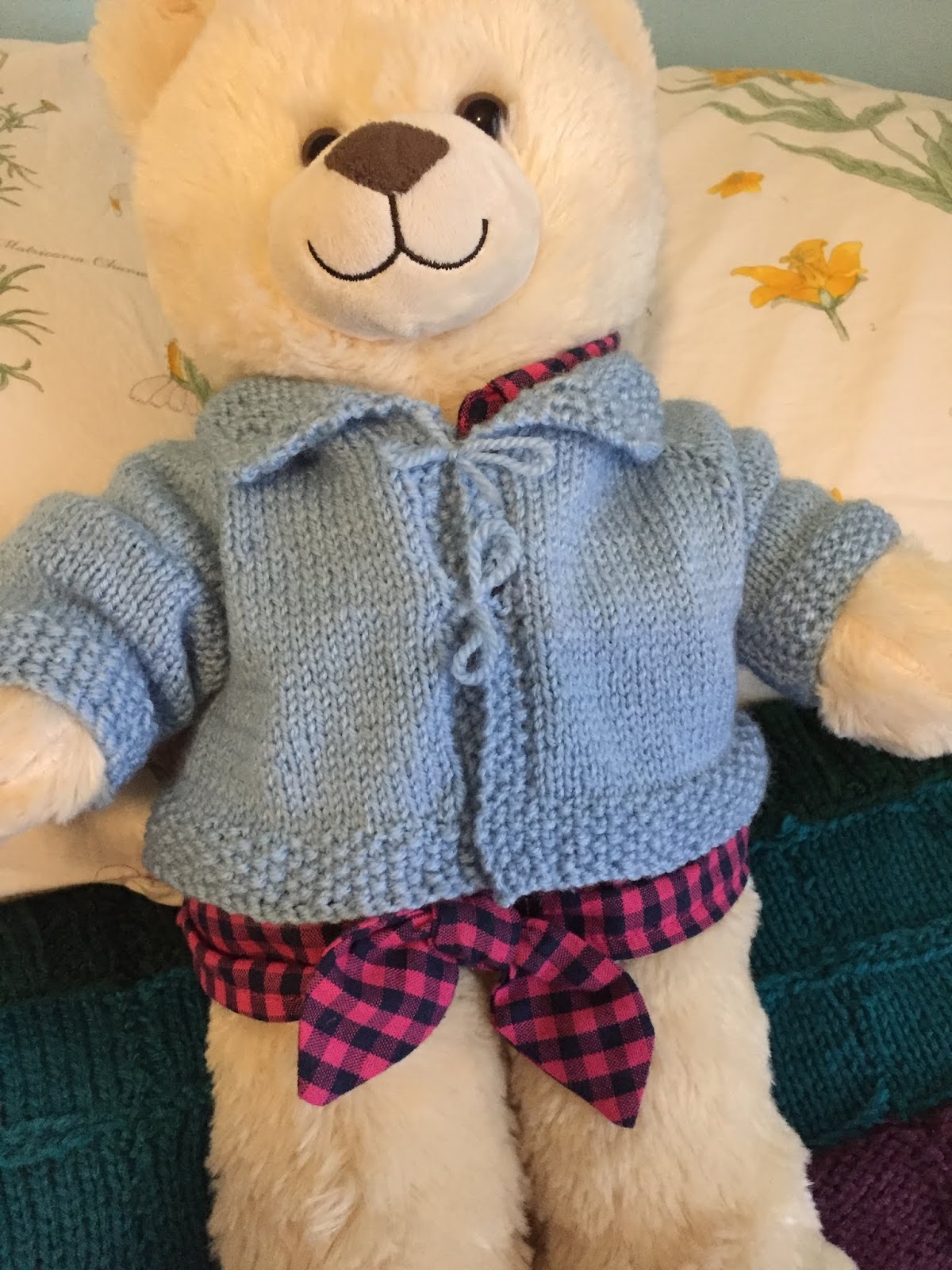
At the end of the book, Righetti offers three practice patterns to demonstrate many knitting techniques: the Dumb Baby Sweater, the Stupid Baby Bonnet and Suzanne's Baby Booties. I managed to successfully produce the Dumb Baby Sweater, here modelled by Octavia the teddy bear:

It's knitted in one piece on circular needles from the neck down, and I'm now going to attempt to scale it up to adult human size. There is something appealing about knitting to size without a pattern, so I'm up for the challenge. I hope Maggie and Sandra are both looking down and wishing me luck.