Showing posts with label ghost stories. Show all posts

14.1.26

In My Time of Dying

Those of you who have been following my reading journey will realise that there is no way I could ignore a book with this title. In My Time of Dying: How I Came Face to Face with the Idea of an Afterlife is not written by a would-be medium or someone claiming psychic powers or the ability to commune with spirits. Sebastian Junger is a hard-nosed journalist, a war correspondent, who has had many encounters with death and near-death, his own and other people's. But the incident that inspired this book was a medical emergency, an abdominal aneurysm that very nearly killed him.

During the moments when Junger was hovering on the border between life and death, he saw something totally unexpected: his dead father, who was a rational, logical scientist and if anything even more hard-nosed than his son. Junger's blow-by-blow account of his medical experience is utterly gripping, and takes up the first half of the book. The second half is devoted to his struggle to understand why he might have seen his father, and takes him into the arcane reaches of quantum theory, the definition of consciousness, and others' accounts of their own near-death experiences, to conclude that perhaps consciousness is woven into the very fabric of the universe, and that we really do rejoin something larger than ourselves when we die. It's a controversial, but (to me) very appealing proposition. I'm certain there is more to reality than our puny brains can comprehend, and it's always seemed the height of arrogance to assume that we could.

Weirdly, just after reading In My Time of Dying, I read Paul Jennings' life story, Untwisted, in which he recounts his own near-death experience, when he saw a cavern filled with people eating and laughing and enjoying themselves, and was drawn to a tunnel that exuded feelings of bliss and tranquillity. He says he hopes when his time does come, that tunnel is still there. Jennings' mother also saw a vision of her sister at the moment of her death, half a world away. Junger argues that there might be biological reasons for many near-death phenomena, but the one that is most difficult to explain is these visions of the dead. I do wonder what is going on; maybe one day I'll find out.
 

19.1.24

The Ghost of Thomas Kempe

The Ghost of Thomas Kempe by Penelope Lively was a formative book for me (what were the others? The Little White Horse, Anne of Green Gables, Little Women, The Long Winter, The Chimneys of Green Knowe, The Summer of the Great Secret, Ballet Shoes, Winter Holiday, The Warden's Niece, Tom's Midnight Garden).

I must have read this book dozens of times. The corners of my copy are all nibbled, and James, at ten, was older than me when I first read it. I'm surprised at how short it is -- just over 150 pages -- because it packed in a lot of ideas that intrigued me. Ghosts, history, people 'having layers -- like onions.' Perhaps this is where my fascination with ghosts began? As an adult, I notice how imaginative James is, always dipping into a private, internal narrative, embarking on experiments, sharing adventures with an imaginary friend (this might have been my favourite element as a child). Bert Ellison, builder and exorcist, is a wonderful character, equally matter-of-fact about shelving and the best methods for laying poltergeists to rest.

Thomas Kempe's reign of terror is quite brief, but it escalates rapidly, from breaking crockery through graffiti to arson in a few chapters. And the final chapter, where the sorcerer's ghost admits bewilderment about the modern world and Bert and James succeed in helping him on his way, is very moving.

The Ghost of Thomas Kempe is a tight, poignant and beautifully written story. I hope modern children are still reading it, it seems to be still in print. It's fifty years old and James himself would be sixty, one of those onion-layered adults he muses about as he walks home in the summer dusk, just as a wide-eyed eight year old reader is still locked away inside me.
 

22.12.22

The Shadow Guests


Another book I picked up in an op shop that I was delighted to discover. As a young reader, I fell in love with The Wolves of Willoughby Chase (and was lucky enough to have my copy signed by the author at The Little Bookroom), and also later became a fan of Dido Twite's adventures, as well as Aiken's wonderful short stories. But this standalone novel, 1980's The Shadow Guests, was new to me.

Poor Cosmo has come all the way from Australia, where his father had unsuccessfully tried to avoid a family curse, and meets a hostile reception at his new school. However, in the tradition of Green Knowe, the ancient family home of Courtoys Mill is far more welcoming, and Cosmo soon encounters several ghostly figures, who are all also victims of the curse on the family, and in their different ways, help him to deal with it.

This is quite a dark book, despite the echoes of Green Knowe; family tragedy, grief and loneliness hang over it. The modern reader shakes their head as Cosmo's new headmaster, quite wise in other ways, advises him not to talk about what he's been through. The meeting with seventeenth century Osmond, member of the Hellfire Club and dabbler in black magic, is also pretty scary, as is the sombre reality of the curse. But I loved cousin Eunice and her willingness to speculate on things beyond our ken, in spite of being a scientist. 

The Shadow Guests is packed with characters and atmosphere and a great time-twisty premise, and I think it would appeal to contemporary readers and fans of time-slip and ghost stories as much as it did to me.

2.11.22

The Goodbye Year


Now this is a cover I could fall in love with -- all my favourite colours, books, cats, cups of tea, trees a dog and a ghostly soldier, as well as a touch of golden spot gloss -- yum! My only tiny niggle is that Harper isn't wearing glasses... How I longed for more protagonists with glasses when I was a glum bespectacled 12 year old.

Inside the lovely cover, there is also much to enjoy inside Emily Gale's The Goodbye Year, which is perhaps my first full pandemic novel. As 2020 begins, Harper is looking forward to her final year at Riverlark Primary School, but then she's mown down by a truckload of changes. Her parents move oeverseas, leaving her with Lolly, the grandmother she barely knows; all her friends becomes school captains of something, leaving Harper with the dreggiest job, Library Captain (ahem, the best job, I think you mean.) And then Harper starts seeing things -- could there be a ghost in the old library?

I loved the parallels that Gale draws between the Covid pandemic and the Spanish flu, and the disruptions of war and the global upheaval that gripped all of us in 2020. Harper is a lovable character, her school friends are sweet, and William's story is spooky and moving. Gale doesn't dwell too long on the lockdowns themselves, focusing more on the periods of freedom in between, but not shying away from either the difficulties or the unexpected joys of a year that none of us will ever forget.

26.8.22

The Haunting of Alma Fielding


English writer Kate Summerscale has carved out a niche for herself as the author of books which examine historical episodes -- a grisly murder, a scandalous divorce case -- which illuminate the social problems and tensions of the time. The stories she chooses are always fascinating in themselves, and she turns them into gripping narratives, though some are more gripping than others. How could I resist a book subtitled, A True Ghost Story?

The Haunting of Alma Fielding takes a case of poltergeist manifestation from the late 1930s which captured the attention of psychical researcher Nandor Fodor. Housewife Alma Fielding is the centre of energetic poltergeist phenomena -- plates flung across rooms, mysterious noises, toppled wardrobes. Fodor was convinced that the phenomena were genuine; but once he and the Psychical Research Society began investigating Mrs Fielding closely, it became clear that she was cheating in one aspect at least, by hiding small objects about her person which she then 'produced,' supposedly from another dimension. For some time, researcher and subject maintained an uneasy, almost flirtatious dance of deception and belief, all recorded in Fodor's case notes, upon which Summerscale has based her book.

Fodor trod a delicate line between credulity and sceptisism, believing that psychological disturbances in a subject could produce genuine physical manifestations (as opposed to the medium channelling spiritual forces from the world beyond). But he was gradually forced to admit that Fielding was, at least sometimes, playing tricks on him, though he never lost his sympathy for her. This highly-charged relationship is set in the equally highly-charged atmosphere of late 1930s London, still haunted by the last war and hurtling with dreadful inevitability towards the next. The Haunting of Alma Fielding is a rich and intriguing tale which combines spooky phenomena with subtle psychological insights. 

PS I forgot to mention that Shirley Jackson used Nandor Fodor's case histories when she wrote The Haunting of Hill House!

4.7.22

The Haunting of Hill House


What is going on with me? I say I don't like horror, and here I am reading another horror story. I say I'm never going to read another Shirley Jackson novel, and look at me, borrowing The Haunting of Hill House. I must admit I'm going through a bit of a paranormal/ghost story phase at the moment, listening to the Uncanny podcast, so let's chalk it up to that.

The Haunting of Hill House is the basis for a Netflix series, but they seem to have changed a lot of details in the story, centring it on a family with several children rather than the team of young investigators who gather in the novel. Hill House is cleverly written, leaving it ambiguous as to whether the phenomena experienced by Eleanor are objectively real (certainly several of them are shared with the other observers) or occurring inside her own mind (there are some things that only she feels).

Likewise, who knows whether the paranormal phenomena reported by ordinary punters (eg on Uncanny!) are influenced by reading books like Hill House, or whether Shirley Jackson herself experienced some ghostly happenings? Certainly there seem to be common phenomena (and apparently Jackson did a lot of research before she wrote her book). Cold spots, footsteps, mysterious thumps and voices, are all frequently reported, as is a sense of dread and senseless fear. But poor Eleanor seems particularly possessed -- by a malign spirit, or her own psychological demons? Again, the novel leaves the question delicately, creepily open.

10.3.22

The Reluctant Psychic


So I've been indulging my woo-woo streak a bit lately -- I've got completely sucked into a podcast called Uncanny, which is basically people telling stories about their paranormal experiences, living in haunted houses etc, which I find absolutely compelling! I'm also an occasional tarot card reader and I like to keep an open mind (hopefully not so open that my brains fall out).

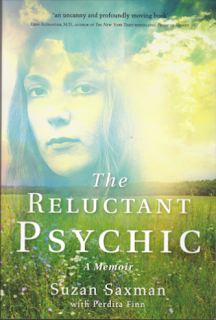
Thus I found hard to resist The Reluctant Psychic, a memoir by Suzan Saxman with the help of ghost writer (ha ha) Perdita Finn. It's hard to know how much salt to take with this book, but Saxman's anecdotes about 'seeing' hidden information about people who consult her certainly sound convincing. There is a spooky narrative threaded through about her obsession with troubled English actor Jack Wild, with whom she felt a mysterious bond; and it turns out (spoiler alert) that it's just possible they were half-siblings. Saxman's timelines are fuzzy at times and she can be vague on some details, while being super precise on others.

The stream of people seeking help and enlightenment from her weirdly echoed the stream of people seeking help from Agnes, the protagonist in Maggie O'Farrell's Hamnet, which I was reading at the same time. And there was one observation that rang strangely true: Saxman surmises that Marion Zimmer Bradley 'channelled' her most successful novel, The Mists of Avalon; and I have to agree with Saxman that nothing else Bradley ever wrote matched that novel for emotional heft, convincing detail or quality of writing. Strange but true.

I'm calling this book non-fiction, but who knows!

15.11.21

A Natural History of Ghosts


I heard Roger Clarke speaking on a podcast and immediately ordered his book, A Natural History of Ghosts: 500 Years of Hunting for Proof. It arrived just in time for Halloween -- perfect timing!

The back cover poses these questions: What explains spectral sightings? Why do we fear the supernatural? Why are some people or cultures more likely to experience hauntings than others? And what proof is there?

All fascinating and intriguing questions, which unfortunately Clarke doesn't explicitly address until the final chapter. The bulk of the book deals with historic cases of ghost sightings -- particularly stories which took on a life of their own (if you'll pardon the pun). So we learn about Hinton Ampner, a Tudor house that suffered from an eighteenth century haunting so severe that it became impossible for anyone to live there; the house was eventually demolished. There is the hysteria around the ghost of Cock Lane,  later proved to be a fraud; a cursed submarine of WWI, Victorian seances, fake clairvoyants and earnest investigations.

Clarke grew up in a haunted house and has devoted much of his life to trying to see a ghost; he examines the historical evidence with admirable objectivity, though he is clearly a believer. His attitude is that while fraud exists, it doesn't mean that ghosts don't also exist; even if a medium has indulged in fakery, that doesn't mean that they haven't also experienced genuine psychic phenomena.

In a basic sense, ghosts exist because people constantly report that they see them. This is not a book about whether ghosts exist or not. This is a book about what we see when we see a ghost, and the stories  that we tell each other about them.

I must admit I find this attitude a reasonable one. I've never seen a ghost either, and I probably wouldn't like it if I did, but my mother-in-law has seen one, and my daughter, as a small child, claimed to have seen an unexplained figure in our kitchen. The final chapter of A Natural History of Ghosts was the most satisfying for me, as Clarke traces the changing history of ghost sightings, from an ancient Roman tale of a ghostly apparition, wrapped in a white burial shroud and shaking chains from wrists and ankles (the absolute original cliche of a moaning phantom!), to monks and nuns dispossessed by Henry VIII's seizure of church property, through to modern era photos and spooky sound recordings (the YouTube series Unsolved Supernatural has some delicious examples of the latter). 

I can't explain what ghost experiences might be, but I'm not game to insist that everyone who has seen or heard or felt a ghost is a liar. Maybe one day we will find out for sure.

22.8.19

Constable and Toop

Well, no prizes for guessing why this book leapt out at me from the secondhand book stall at Royal Talbot Rehabilitation Centre (I was there with Dad, a different Mr Constable).

Apparently Constable and Toop is a real funeral firm in London, and it was sitting in a cafe opposite their building that sparked Gareth P. Jones to write this book. This is a real Victorian ghostly treat, teeming with spirits and colourful Dickensian characters. Young Sam Toop is a Talker, who can see and talk to ghosts; Clara Tiltman aspires to become a journalist; Tanner is a Rogue ghost, an urchin with a collection of spirit hounds; Lapsewood is also a ghost, but trapped in the coils of post-worldly bureaucracy. There are many, many more characters intertwining through the pages of this novel (including the wise and kindly Mr Constable!) but the short, pacy chapters never allow the complex narrative to become bogged down.

Constable and Toop is fairly gory, with several murders and ghastly exorcisms, so I wouldn't give this to the squeamish. But on the whole, it's a fun romp and very evocative of Victorian London.

20.3.17

Thin Air

Borrowed from a friend at book group, Michelle Paver's Thin Air is a ghost story set on a 1935 expedition to climb Kangchenjunga in the Himalayas. For many years thought to be the world's highest mountain, it was relegated to third place only in the 1850s. I was familiar with Kangchenjunga from references in the Swallows and Amazons books, where the hills of the Lake District that the children climb and camp among are promoted to Himalayan status.

This was a wonderfully creepy and atmospheric tale, blending the isolation and terror of the natural geography with the all too human horrors of jealousy, betrayal, rivalry, suspicion and paranoia. The expedition is following in the footsteps of a former, ill-fated trek, and it gradually becomes apparent that something sinister has been left behind on the mountain...

Apparently Paver has written a couple of other ghostly stories, Dark Matter and Without Charity, so I might just hunt those out too. This was enjoyably scary, but not so terrifying that I couldn't bear it!

And just as I was writing this post, a fellow who gives ghost tours of Melbourne happened to come on the radio... Spooky!

13.11.15

The Woman In Black

I don't like scary movies, but I do enjoy a good ghost story, and this modern classic by Susan Hill has been on my radar for a long time. I picked up the movie tie-in edition from Brotherhood Books, and was surprised at how slender it was -- I'd been expecting a fat clunker! But this relatively short tale certainly punches above its weight, and is all the more effective for its economy. In this case, less is more.

Young solicitor Arthur Kipps is quite excited at first when he's sent on a solo mission to sort out a dead woman's estate. But the eerie, isolated Eel Marsh House, set on the end of a causeway that's submerged at high tide, and beset by swirling mists, holds some sinister secrets…

Chills aplenty, simple but effective, and though it was published in 1983, stylistically it reads like a high Victorian ghost story (though it's certainly not a difficult read). This actually confused me in places, as I started out picturing the story taking place in Sherlock Holmes' London (peasouper fogs, fusty lawyers' offices, train journeys), and then suddenly there were motor cars and telephones and electric lights! I'm still not entirely sure exactly when the novel was supposed to be set. There were references to the ghostly figure's clothing dating from 'sixty years ago', but then the date on her gravestone was '190--', and I can't make out how that would possibly work!

I haven't seen the film, though I might if my 14 year old is keen (she is reading the book after me). From the google images, they seem to have done their best to make Daniel Radcliffe look like David Tennant. Which is not necessarily a bad thing...