Showing posts with label Penelope Lively. Show all posts

2.2.24

Astercote

Penelope Lively is an author who is interested in the intersections and echoes between the present and the past, whether it's through the presence of a very real ghost (Thomas Kempe) or a kind of mass possession channelling an ancient ritual (Hagworthy) or a straightforward time-slip story (Cross Stitch).

In Astercote, though there are hints that this might be a time slip story at the beginning (the character of Goacher, who seems almost medieval at first meeting; the sound of the bells), the novel is more like Wild Hunt of Hagworthy in that historical patterns and fears begin to play out in the present day (albeit 1970, when the book was written). The village of Charlton Underwood is haunted by the lost village of Astercote, deserted after the Black Death, and when the chalice that is supposed to have protected the village is lost, people start to behave in irrational ways, barricading the village and fearing an outbreak of the plague.

It was weird to read this book so soon after the pandemic, when quarantine was a sensible response to danger and not a bizarre echo of a vanished past. These days it's irrational to disbelieve in the plague. There is more evidence of Lively's love for a good ruin, giving us not only the overgrown medieval village but also a collapsed manor house with trees growing out of it. There are many borderlines here -- between village and countryside, childhood and adulthood (intellectually disabled Goacher sits in the middle), new and old parts of the village divided by the road, as well as past and present (and is there a hint that young nurse Evadne, the children's ally, might be mixed race?)

Ultimately though, Astercote is a story of mass hysteria rather than magic, as as such, less appealing to me than Lively's other more supernatural stories.
 

19.1.24

The Ghost of Thomas Kempe

The Ghost of Thomas Kempe by Penelope Lively was a formative book for me (what were the others? The Little White Horse, Anne of Green Gables, Little Women, The Long Winter, The Chimneys of Green Knowe, The Summer of the Great Secret, Ballet Shoes, Winter Holiday, The Warden's Niece, Tom's Midnight Garden).

I must have read this book dozens of times. The corners of my copy are all nibbled, and James, at ten, was older than me when I first read it. I'm surprised at how short it is -- just over 150 pages -- because it packed in a lot of ideas that intrigued me. Ghosts, history, people 'having layers -- like onions.' Perhaps this is where my fascination with ghosts began? As an adult, I notice how imaginative James is, always dipping into a private, internal narrative, embarking on experiments, sharing adventures with an imaginary friend (this might have been my favourite element as a child). Bert Ellison, builder and exorcist, is a wonderful character, equally matter-of-fact about shelving and the best methods for laying poltergeists to rest.

Thomas Kempe's reign of terror is quite brief, but it escalates rapidly, from breaking crockery through graffiti to arson in a few chapters. And the final chapter, where the sorcerer's ghost admits bewilderment about the modern world and Bert and James succeed in helping him on his way, is very moving.

The Ghost of Thomas Kempe is a tight, poignant and beautifully written story. I hope modern children are still reading it, it seems to be still in print. It's fifty years old and James himself would be sixty, one of those onion-layered adults he muses about as he walks home in the summer dusk, just as a wide-eyed eight year old reader is still locked away inside me.
 

16.1.24

The Wild Hunt of Hagworthy

Penelope Lively has had a successful career as both an adult novelist and a writer for children, in fact I think she used to write books for adults and children alternately. I've enjoyed her adult novels but personally I think her books for children are superior. (She is still with us, aged 90.)

The Wild Hunt of Hagworthy, published in 1971, has echoes of Alan Garner's The Owl Service: a local boy, made an outsider by education, stirring uncomfortably beneath the weight of expectations that he'll take up a family responsibility (in this case, becoming the local smith and implicitly, the ancient, sacred role that also involves), a hot summer, a girl from outside the community who is drawn to the boy, and people messing with deep powers they no longer understand. The Wild Hunt centres on younger children than The Owl Service, and doesn't include the undercurrent of adolescent hormones in the earlier book, but it conjures up a similar oppressive atmosphere and tension, as the Hagworthy Dance is revived and the local boys become a pack, almost possessed by ancient forces.

Penelope Lively and Alan Garner, and perhaps Lucy M Boston, all wrote quite a few books in the 1970s (perfect timing for child reader me) that explored English folklore and ancient traditions, books that enthralled me. I was inspired to re-read Wild Hunt after reading about the wild hunt in Dogsbody (1975), but I was thrilled to see that Yeff, the wild hound in Dogsbody, is named for the Yeff Hounds of Somerset. Another coincidence -- I've started reading The Salt Path, which is set in the same part of the world; Ray and Moth's long walk begins in Minehead, the big town closest to fictional Hagworthy. I never tire of the way that these threads dart between different books, connecting them in unexpected ways.

14.1.22

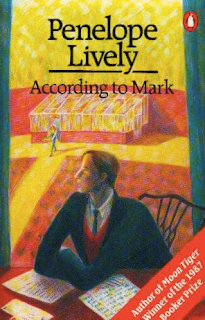
According to Mark


I really love Penelope Lively's books for children but I'm less keen on her adult fiction. According to Mark seemed like a pretty minor novel to me and I was surprised to learn that it was shortlisted for the 1984 Booker Prize (Lively won the Booker three years later with Moon Tiger). It reminded me strongly of A. S. Byatt's blockbuster Possession which appeared a few years later and tackled head-on topics that According to Mark brushes past more lightly -- the relationship between biographer and subject, the dance between biography, fiction and truth, the gaps in the record of a life, which might be deliberate or accidental.

According to Mark does deal with a literary mystery similar to the one central to Possession, but it's principally the story of the biographer Mark and his mid-life crisis infatuation with the grand-daughter of his subject. Carrie's reluctance to plunge into an affair -- she goes along with Mark out of politeness more than anything -- makes uncomfortable reading in a post-Me Too world, though it's played for comedy here. By three quarters of the way through I was becoming impatient for the revelation of the secret life of Gilbert Strong which Possession had conditioned me to expect, and its final arrival was a satisfying relief.

According to Mark is a pleasant, diverting novel but for my money, it doesn't compare to The Ghost of Thomas Kempe!


25.11.21

A Stitch in Time


I think I must have picked up almost all of Penelope Lively's children's books over the years, starting with my all-time favourite, The Ghost of Thomas Kempe, when I was about nine. So I'm not sure how 1976 Whitbread Award winner A Stitch in Time has eluded me for so long. I thought I must have read it at some point, but I couldn't remember any of the details of the book this time round, so maybe I hadn't!

It's pitched as a time slip story, but it isn't really. Solitary Maria comes to Lyme Regis (having recently watched Ammonite, I could picture this very clearly) on holiday with her parents, and becomes intrigued by a former Victorian-era inhabitant of their house, a young girl called Harriet, who seems have mysteriously disappeared before reaching adulthood. The creak of a lost swing, the bark of an invisible dog, a shadowy face glimpsed in a window, all provide clues into the past; but in the end, it's the present that Maria is able to fully enter, making connections with the boy next door and his family tribe, and making friends with her own mother.

A Stitch in Time is a very gently paced book, more of a meditation on the links between past and present than a true time slip novel. There's not much in the way of incident, but I enjoyed the atmosphere, the hints of humour and shy Maria gradually coming out of her shell. This is a sweet, quiet, comforting book.

5.10.12

Making It Up

Penelope Lively describes this book as an 'anti-memoir.' She looks back over her life and selects certain turning points where things might have turned out very differently, and imagines the alternatives in a series of short stories: what if the ship on which she, her mother and nanny escaped war-time Egypt had been torpedoed, instead of delivering them to safety? What if she had fallen pregnant at eighteen? What if her future husband had been sent to the Korean War during his national service, instead of being reprieved at the last minute?

It's an intriguing idea. How many times do we really face a genuine crossroads in our lives, and how often is it our own choice that determines the path we follow, rather than a trick of chance or fate? I can't help thinking that such moments are actually quite rare. And perhaps the moments we think are so important are not really the most crucial ones.

I enrolled in Law at university, which seemed a momentous, agonising, life-shaping decision, but one which ultimately has had almost no effect on where I've ended up. However, the decision to live in at a residential college, and the particular college I put my name down for, was taken very lightly -- I only went to look at colleges because my friend Amy had wanted to -- I didn't even know what a college was -- and I signed up for JCH because it had the prettiest building. And yet the friendships I made there have lasted for twenty-five years, and had an incalculable effect on my life. It was at college I met David, and through David that I met Michael. And the rest is history...

I've always loved Lively's books because of their keen awareness and preoccupation with the past, and how it moulds and bleeds through into the present. This odd, but oddly satisfying book, takes that awareness and twists it into an entirely new shape.


6.6.11

Do You Hear The Bells?

I've been indulging in a Penelope Lively binge. I've written elsewhere about The Ghost of Thomas Kempe, and while that remains my favourite Lively, the three books I've read in the last week or so all share a common theme with the story of James and his battles with Kempe's recalcitrant spirit. In these three novels, all written in the early 1970s, some element from the not-quite-buried past irrupts into the present day, with dangerous consequences. This is absolutely my favourite kind of story, and it's the kind of story I hope I've written in Crow Country (albeit transposed into an Australian setting).

In Astercote, a sleepy village is galvanised with fear and paranoia when a hidden treasure goes missing. In The Wild Hunt of Hagworthy, a re-enactment of an ancient ritual calls up unsuspected power and peril for the ignorant performers. And in The Whispering Knights, for a slightly younger readership, three children who make a witch's brew are dismayed to find that they've accidentally unleashed a very old and very frightening being, who threatens their whole village.

The English countryside is a strong presence in all these books. There is a sense of history bubbling beneath the landscape like a current -- invisible to the naked eye, but immensely powerful, and ultimately uncontrollable.

'... There's a funny feeling about this place sometimes, and the wood specially.'
'Oh,' said Evadne casually. 'The bells, I suppose you mean.'
Mair stared at her. 'Do you hear them?' she asked in astonishment.
'Not now. But I used to years ago when I was younger. About your age, I suppose -- no, younger, I think... You have to be in the right state of mind to hear them. Kind of open, receiving things from all directions, not thinking too much -- dreaming in the daytime, not knowing if its Monday or Tuesday, or morning or afternoon... that really only happens when you're a kid.'
In Lively's novels, the children spend long, idle (unsupervised!) days wandering the fields and woods, fishing, lying in the sun reading, exploring cliffs and quarries, brewing up magic spells in deserted barns.

I wonder if kids, these days, still have a chance to dream in the daytime; if their senses aren't so crowded with electronica and organised activities, that they're still open to receive those faint signals from beyond. Can any of us still hear the lost bells of Astercote?