Showing posts with label time slip. Show all posts

29.8.26

On the Calculation of Volume 1

I heard On the Calculation of Volume by Danish author Solvej Balle being discussed on the Radio National Book Shelf program, and because it has a timey-wimey plot, I was instantly intrigued. Main character Tara finds herself trapped in a time loop, where she wakes up day after day stuck inside the 18th November, just like Groundhog Day, except without the comic slant, and with the difference that she wakes wherever she fell asleep the night before, rather than returning always to the same starting point.

Tara is away from home in Paris when the pattern strikes; in a panic, she flees for home and explains her situation to her husband Thomas. But the day is not repeating for him; every 18th November happens for the first time. Again and again Tara has to explain her plight. They experiment together, try to stay awake all night, try to figure out why some things reset and others remain used up or transported. Eventually Tara separates from Thomas, withdrawing into their spare room and living a shadow, unseen life around his movements (he, of course, assumes that she is away in Paris). As Tara draws closer to a full year having passed for her, having experienced 18th November 365 times, she wonders if the loop will close -- or is there some significant action she must take to break the spell?

On the Calculation of Volume has to be the dullest title I've ever heard, especially for such a weird, haunting little book. Maybe it sounds better in Danish? And I can't have been listening properly to the Book Shelf, because I entirely missed the fact that this is just volume 1 of a projected seven book series!I absolutely flew through this novel, unsettled and delighted. Needless to say I have already reserved volume 2. 

25.9.25

How to Survive 1985

As you know, I'm a sucker for a time slip story and How to Survive 1985 is right up my alley. Shannon goes into a Sydney cinema in 2025 and emerges into 1985. This is not her first supernatural experience, so she's not as phased as you might expect. She quickly comes up with a plan: she'll track down her mum, who is sixteen years old in this world. This idea works surprisingly well, and her mum becomes an ally in Shannon's quest to find her other friends (who were all part of her previous adventure).

Shannon explains in some detail what happened to her and her friends in the book before this one, Royals, where they were all trapped in a time loop inside a shopping centre. That time, the earth seemed to be trying to teach them something about the perils of consumerism, but this time round the lesson is a little more vague -- something about climate change, something about plastic, something about caring for the planet? There are plenty of reflections about how much the world has changed (or not) in the last forty years, but How To Survive 1985 keeps a light, pacy touch which makes it a hugely enjoyable adventure.

I ended up really loving this novel. It's not long, and it never flags, and it's made me hungry to track down the gang's prior magical adventure, which annoyingly is not available at my local library. I hope Shannon, James, Akira and the others have more strange experiences in store.
 

15.8.23

Firewatcher: Brimstone

The first in a trilogy, Kelly Gardiner's Firewatcher: Brimstone weaves together not one but two exciting historical events in a neat time slip structure. When Christopher Larkham finds a mysterious ring on the banks of the Thames in the London Blitz, it seems to give him the power to travel back three hundred years to the Great Fire of London in 1666. Kit darts back and forth between two cities in fiery extremis, using his knowledge of the past to combat the slow-moving but catastrophic seventeenth century blaze -- but he also has to contend with the sinister Brother Blowbladder and his evil plans.

There is plenty of action in this fast-paced adventure, and the other volumes in the Firewatcher series take Kit further back in time, to Saxon Lundenwic and Roman Londinium. I love the concept of getting two historical timelines in a single book, and the idea of linking fires from different eras. An engaging story for younger readers.

22.12.22

The Shadow Guests


Another book I picked up in an op shop that I was delighted to discover. As a young reader, I fell in love with The Wolves of Willoughby Chase (and was lucky enough to have my copy signed by the author at The Little Bookroom), and also later became a fan of Dido Twite's adventures, as well as Aiken's wonderful short stories. But this standalone novel, 1980's The Shadow Guests, was new to me.

Poor Cosmo has come all the way from Australia, where his father had unsuccessfully tried to avoid a family curse, and meets a hostile reception at his new school. However, in the tradition of Green Knowe, the ancient family home of Courtoys Mill is far more welcoming, and Cosmo soon encounters several ghostly figures, who are all also victims of the curse on the family, and in their different ways, help him to deal with it.

This is quite a dark book, despite the echoes of Green Knowe; family tragedy, grief and loneliness hang over it. The modern reader shakes their head as Cosmo's new headmaster, quite wise in other ways, advises him not to talk about what he's been through. The meeting with seventeenth century Osmond, member of the Hellfire Club and dabbler in black magic, is also pretty scary, as is the sombre reality of the curse. But I loved cousin Eunice and her willingness to speculate on things beyond our ken, in spite of being a scientist. 

The Shadow Guests is packed with characters and atmosphere and a great time-twisty premise, and I think it would appeal to contemporary readers and fans of time-slip and ghost stories as much as it did to me.

13.5.22

Only A Monster


I so enjoyed Only A Monster by Vanessa Len -- maybe I'm swinging back round to liking YA again, after a fallow time? Maybe I just need to be careful about the novels I choose? Anyway, Only A Monster shares some common ground with House of Hollow -- both by young Australian women authors, both set in London, both centring on young women with a secret family heritage that needs to be unravelled in a spooky Gothic atmosphere of chases down darkened streets, glamorous parties and mysterious, attractive strangers...

Only A Monster is built on a brilliant premise -- that there is a race of beings who look human, but who can steal time from human lives in order to time travel (a little like the original conception of Dr Who's Weeping Angels). These 'monsters' consist of twelve great families, each of which possess particular extra powers (like perfect memory, or the ability to hide and retrieve objects in thin air). I'd love to know more about their world and surely there will be further volumes which explore this universe more fully and wrap up some of the loose ends left dangling at the end of this novel. I should make it clear that Joan is one of the 'monsters' -- the only slight quibble I had was that I found it hard to apply this term to the super-charismatic, elegant and gifted characters who people this world!

Only A Monster is terrific, rich and atmospheric fun.

18.3.22

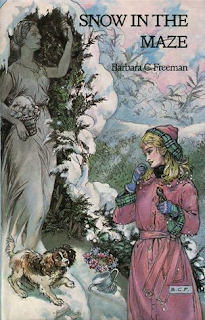
Snow in the Maze


Snow in the Maze is such a weird little book.  It looks like antique fiction but it was only published in 1979, so not all that old. I couldn't resist it when it turned up on Brotherhood Books, it looked like my cup of tea and the cover was so appealing. However, it started out as a mother-daughter conflict story -- sixteen year old Rosa has been painted in a series of celebrated portraits by her artist mother, and is thoroughly sick of being known as Rosa from the cards, calendars etc. It was quite hard to barrack for Rosa initially as she kept moaning on about how hard it was to be so beautiful and famous!

Then the story took a left turn by becoming the tale of 18th century brother and sister, careless Vialis and mean Cytherea, and their oppressed little orphan cousin Hebe, recounted by guardian of Briarcourt House, the mysterious Jackman. Then it took another turn and became a spooky time slip story, which is frankly, what I'd been expecting in the first place.

I've never read any other Barbara Freeman novels but from the blurb on the back cover it sounds as if they all quite similar in flavour -- gentle ghosts and time slips -- which is right up my alley. I can't say I fell in love with Snow in the Maze but if I come across any more Freemans I will probably surrender.

12.3.22

Op Shoppery


One of my great pleasures is to fossick in a second hand book shop or one of the local op shops in the hope of unearthing unexpected treasures. But the op shops have been closed for a long time and it must be two years since I was able to rummage freely. Last week I ventured into our local Helping Hands Mission shop and scanned the shelves, and came up with a couple of books by favourite authors that I'd never heard of before, let alone seen, let alone read.

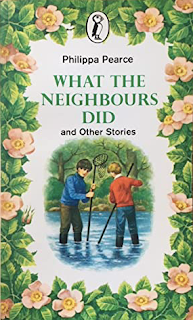
Philippa Pearce's Tom's Midnight Garden is one of my all-time beloved favourite children's books, but this short story collection, What the Neighbours Did and Other Stories is more in the vein of A Dog So Small or Minnow on the Say: slight, domestic stories about fishing and dogs and cutting down trees. I must admit I was surprised to discover that there were several editions, though some of the stories have a great deal of quiet charm. I particularly enjoyed Still Jim and Silent Jim about a sneaky outing of a grandfather in a wheelchair and his grandson -- shades of The January Stars!

I was even more surprised to learn that Monica Dickens' The Messenger is just book one in a series of four which brilliantly marry magic, time slip and horses! The Messenger is Rose, who is sent back in time by a great grey magical horse to solve a mystery and defeat the fear and anger in the past with an act of love. I so enjoyed the structure of this book, which sees Rose going further back each time until she uncovers the original crime that has scarred this particular house and made it an unhappy place; it's not a million miles away from the time-slip book that I'm working on myself at the moment. 

I can't believe I've never come across these books before; I only know Monica Dickens from her realist adult fiction and her horsey-animal books, like the World's End series. But The Messenger was published in 1985, so I was too old. I found one online reviewer who said she was absolutely obsessed with these books, and I can understand why -- it's an irresistible combination! But on the other hand, another reviewer said she was confused by the jumps back and forward in time, which I could also understand. I definitely need to seek out the other three volumes in this series: I'm hooked!

6.7.20

Charlotte Sometimes


Charlotte Sometimes was a book that I admired as a young reader, but didn't return to very often - it was so eerie, so uncanny, that it disturbed me. With the benefit of age I admire it and enjoy it all the more. It is probably Penelope Farmer's best known work and inspired not one but two songs by The Cure ("Charlotte Sometimes" and "Splintered in her Head"; and also possibly the title of their next album, Disintegration?)

It was Penni Russon who enlightened me that Charlotte Sometimes is actually book three in a trilogy about Charlotte and her sister Emma, the first two being The Summer Birds and Emma in Winter. All three books share that dark, uncanny quality that makes Charlotte Sometimes such a haunting experience. (Thanks to Penni for lending them to me; I'm still on the hunt for copies of my own.)

In many ways this is a very bleak book. Set in boarding school, and later in grim lodgings, during winter, Charlotte swaps places with Clare in 1918. At first the girls change places every night, with no worse consequences than confusion over homework and bewilderment from Clare's sister; but then Charlotte finds herself in the wrong bed on the wrong night, with no way of getting home to her own time. 

There are some genuinely terrifying moments: when Charlotte fears she's swapped places with Agnes, the spinster daughter in their lodgings, even further back in time; when she's spent so long impersonating Clare that she begins to forget that she was ever Charlotte; the excursion to the shadowy sick bay. It's almost a horror story, truly creepy. It's a story about the slipperiness of identity -- who is Charlotte, what makes her Charlotte apart from people seeing her that way? The theme of identity and twinship is one that Farmer, herself a twin, has returned to repeatedly.

I've just learned that my 1985 copy is different from the original. The ending was changed by the author  and some material was removed. So now I'll need to find myself a 1969 edition too, because that would have been the one that I first read.

23.11.19

When the Lyrebird Calls

I'm not sure if this is the first time I've found myself reading three books at the same time, all by Australian women writers.

I've been meaning to read Kim Kane's time slip novel, When the Lyrebird Calls, since it first came out, and I found this copy at Brown & Bunting. My ladies' book group thought highly of it, but someone said, what a shame the cover is so drab.

Having read the book, I think the designer (ooh, I just discovered it's Debra Billson, who has produced a gorgeous design for my forthcoming middle-grade book, The January Stars) has done an amazing job of tracking down contemporary photographs that resemble the four girls in the story. And, spookily, yesterday I happened to look up that first classic Australian time-slip novel, Ruth Park's Playing Beatie Bow, and noticed the original Puffin edition cover:


As Kim Kane makes a point of referencing Beatie Bow in her acknowledgements, the similarity in these covers can't be a coincidence. But I'm not sure how many readers, especially young readers, would pick up on the homage, particularly as it eluded a bunch of highly experienced school librarians and children's literature enthusiasts (shame on us).

Aanyway, I wasn't sure I was going to enjoy this book when it opened with a scene of three young girls destroying a fancy doll. I have a tendency to feel sorry for inanimate objects and this overt cruelty didn't endear the young protagonists to me. But once the time slip happened, I was all in. Madeleine doesn't travel back and forth but stays in 1900 for an extended period, which gives a good solid look at the issues of the time (Federation, suffrage, racism, spiritualism) as well as the tangled family dynamics of the Williamson household where Madeleine ends up. (Extra points to Gertie for attending my alma mater, PLC!) It's not till the final chapter, back in her own time, that Madeleine discovers some family secrets that make sense of what she's seen.

Kim Kane has a quirky and often humorous turn of phrase that adds to the enjoyment, and I appreciated the feminist emphasis as well as the sensitive portrayal of a young Aboriginal man (he deserves his own book, I reckon).  Loved it!

22.4.18

King of Shadows

For some reason, it hadn't really occurred to me that Susan Cooper might have written other books after she finished the superb Dark Is Rising series. Luckily for me, she did, and the first one I've laid my hands on is King of Shadows. Time slip! Shakespeare! Two of my favourite things! So I knew I was onto a winner.

And it is. Nat Field, a young American actor brought over to London to play in the 'new' Globe theatre, wakes up one morning to find himself not just in Shakespeare's London, but part of Shakespeare's company. Cooper manages with a light touch to evoke the atmosphere of Elizabethan times and the bustling but much smaller city, and also weaves in Nat's emotional journey with a gently political plot.

It was a little disorienting to read yet another version of William Shakespeare, having recently re-read Antonia Forest's The Players and the Rebels, which covers much of the same ground and characters (the clown Will Kempe, distinguished actor Richard Burbage etc), and even watching the Doctor Who episode, The Shakespeare Code, filmed in the Globe itself. All these different versions of Will's world, overlapping, contradicting, reinforcing, much as the different iterations of Shakespeare's play echo down the centuries. But I can't help feeling that Will himself would approve.

4.9.13

Timey-Wimey Wibbly Wobbly

Yesterday at my book group, we discussed time-slip, time travel and backwards-history books (When You Reach Me, A Wrinkle In Time and My Place), and I was surprised by the number of people who said that they didn't enjoy time-travelly stories. There were three particular books of my childhood, all timey-wimey in theme, which I think have influenced my taste as a reader and my ambitions as a writer.

A Wrinkle In Time
It was weird re-reading Madeleine L'Engle's 1962 classic, because despite its enduring reputation, especially in the US, I felt it didn't actually stand up that well. To begin with, I was annoyed by the cover blurb, which insisted on casting it as Charles Wallace's story, not Meg's -- which perhaps goes to show, the pressures of marketing to boys were around even in the 1960s! When I first read (and re-read) AWIT at about the age of ten, I was fascinated by the Big Ideas it contained - the tesseract, five dimensions, the power of faith and love to defeat the grey and banal (but still very frightening) face of evil.
I still love those ideas, and I love Meg, and her family, and her mother's science lab where she cooks stew over the bunsen burner. But some elements seemed horribly clunky -- just who the hell are the Mrses Who, Which and Whatsit anyway? Winged horses? Seriously? The giant pulsating brain? Hm...
However, this book still remains a true original -- part fantasy, part science fiction, part parable, part realistic family drama (except that Dad hasn't deserted them, he's trapped on another planet. Um, okay...)
Time-slip mechanism rating: 1/10. Loses points because no actual time travel.

Charlotte Sometimes
By contrast, Penelope Farmer's 1969 time-slip proved to be rather better, on an adult re-read, than I'd remembered it. Charlotte wakes up in her boarding-school bed to find that she's swapped places with Clare, who lived forty years before (during WWI). This deeply eerie story takes seriously the possibility that they may not succeed in swapping back, and in one disturbing section, Charlotte finds herself doubting her own identity, slipping into becoming Clare without even realising what's happening to her. This is very scary stuff, and perhaps explains why I re-read CS sparingly as a child, though it always haunted me.
It was only thanks to Penni Russon that I found out that Charlotte and her sister Emma also feature in two previous books by Farmer, both equally weird in their own ways, The Summer Birds (where children learn to fly) and Emma In Winter (where Emma enters a dreamscape which she realises is dragging her gradually backwards in time).
Time-slip mechanism rating: 8/10 (the girls share the same bed and wake up in each other's times; elegant)

Tom's Midnight Garden
I must have talked about TMG before, haven't I? I always credit this book as the single greatest inspiration behind my own Cicada Summer. Though Philippa Pearce's beautiful 1958 novel is perhaps a little wordy for modern tastes, I read it over and over again as a 10 or 11 year old, spellbound by deeply satisfying structure and its detailed exploration. Tom, sent to stay with relatives in a big old house long since converted to flats, finds that when the clock strikes thirteen, he can open the back door and enter the original, sprawling garden of the house, seventy years ago. He befriends a little girl in this other time, Hatty, and they help each other combat their respective loneliness. At the end of the book it's revealed that Hatty is in fact old Mrs Bartholomew, who lives upstairs and has spent night after night dreaming of her childhood. The final scene, where she and Tom at last recognise each other and fly into each other's arms 'as if they'd known each other for years and years' still brings a lump to my throat.
Time-slip mechanism: 10/10 (the grandfather clock, and the old woman's dreams - perfect!)