27.12.21

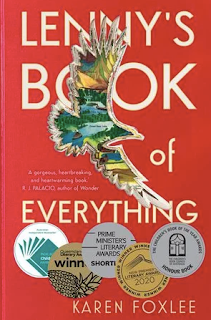
Lenny's Book of Everything


See all the medal stickers on the cover of Lenny's Book of Everything? This is one of the most awarded and shortlisted books I've ever seen! It also comes highly recommended by many readers whose opinion I value. 

I think I've found a new favourite author: Karen Foxlee is wonderful. She is Australian, but Lenny's Book is set in the US. Lenny is growing up in the 1970s in a small American town. Her father has disappeared and her mother is struggling to support Lenny and her little brother Davey. Except that Davey is not so little -- he has a rare form of gigantism, and he just won't stop growing. As Lenny and Davey collect each issue of their build-your-own encyclopaedia, Lenny falls in love with insects and Davey with birds of prey, and Lenny gradually begins to realise that their little family is under threat.

Poignant, gentle, thoughtful, beautifully written, and often wryly humorous, Lenny's Book of Everything belongs to a particular genre which I call Children's Book for Adults. I absolutely adored this novel but I'm not sure how many ten year olds would fall in love with it -- it's so sad! The author's note reveals that Foxlee has cared for a seriously ill relative, and the final chapters of Lenny's Book ache with that experience.

It also powerfully reminded me of growing up in the 1970s with my Hutchinson's New Twentieth Century Encyclopaedia as the fount (font? fount?) of all knowledge -- I must have read that single volume from cover to cover a dozen times. Until the dawn of the internet, so well into the 1990s, I also used it as my main reference for my weekly general knowledge crossword in The Age. Those were the days, when everything you would ever need to know could be contained within a single set of covers.

Lenny's Book of Everything was one of my favourite reads of 2021.

24.12.21

After Story


 Larissa Behrendt's After Story was one of the most purely enjoyable novels I read this year. It combines several of my favourite areas of interest: Indigenous narratives; landscape and architecture; troubled families; literature; feminism; Australian and English history... A rich soup of delightful stuff!

The premise of After Story is simple: mother and daughter Della and Jasmine take a tour of British literary sights -- the home of the Brontes, Oxford, Virginia Woolf's house etc, and they narrate their travels in alternate chapters, so we get to see the same events through different eyes (multiple viewpoints, another of my favourite things!) Della and Jasmine have a difficult relationship, forever shadowed by the death of Jasmine's sister as a child. Della doesn't know much about literature or history, but she knows about people, and grief, and love, and her reflections are a poignant and often humorous counterpoint to Jasmine's more academic thoughts about feminism, racism and the power of story. You don't need to have read the classic novels discussed here to appreciate this book, though it does add an extra layer of enjoyment if you have.

After Story was such a pleasurable reading experience, but it also incorporates some dark themes. Della is an alcoholic, battling the demons of her daughter's disappearance as well as her own childhood trauma. Jasmine has tried to distance herself from her home town, without realising that this has also distanced her from her family and her heritage. Watching mother and daughter achieve a tentative reconciliation and acceptance of each other's flaws is very moving. I'm giving this one to my mother-in-law for Christmas.

19.12.21

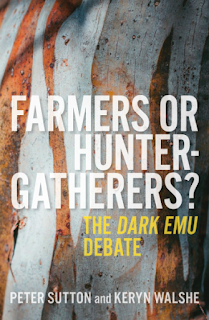
Farmers or Hunter-Gatherers? The Dark Emu Debate


When I found about the existence of this book, I was filled with righteous indignation. Who were these people trying to tear down Bruce Pascoe's work? How dare they provide an excuse for gleeful racists to cry, see, I told you it was all rubbish?

But after reading Farmers or Hunter-Gatherers? The Dark Emu Debate, I've changed my mind. Peter Sutton and Keryn Walshe are experts, academic anthropologists who know their subject inside out and have spent years researching and learning from First Nations people. It does seem that perhaps Bruce Pascoe has exaggerated, over-generalised and perhaps valorised a Western ideal of agricultural 'progress' at the expense of valuing the hunter-gatherer lifestyle as a rich, balanced and sustainable achievement in its own right.

Sutton and Walshe are at pains to point out that some of the facts Pascoe highlights as 'new discoveries' have been known in the field of anthropology for decades; however, I think they do underestimate how long it takes for this 'common knowledge' to filter through to the general public. I think they overestimate how much most of us learned about Indigenous culture at school. I don't think they realise the depth of ignorance of the ordinary, non-academic person, and they don't fully appreciate what I believe is the most important secret to Dark Emu's outstanding success: the hunger for more knowledge about, and appreciation for, the ancient traditions of Aboriginal Australia, not via academic textbooks or scholarly articles, but in a gripping, simple to understand narrative, which is what Dark Emu achieved.

It would be a wonderful outcome if Farmers or Hunter-Gatherers? helps to continue the conversation about Australia's history and present that has been sparked by Dark Emu, and leads to a greater depth of knowledge and curiosity. It would be a shame if this careful, nuanced book becomes co-opted into the mindless shouting of the culture wars.

6.12.21

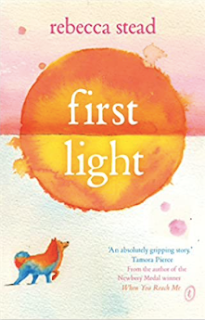
First Light


 First Light was Rebecca Stead's first novel. It's not as perfect as When You Reach Me but it's still pretty good. The book is told from two perspectives: Peter, who has travelled to Greenland with his scientist parents, and Thea, who lives in a mysterious community beneath the surface. Inevitably Peter and Thea's lives collide and intertwine.

I enjoyed many aspects of this novel -- the frozen world of the Greenland ice, the mystery of Peter's mother's depression, the beautiful clever dogs, the strong women of Thea's family, the gifts of ear-adept and eye-adept. But I did have a major problem, which was that I had a lot of trouble, particularly early on, in visualising Thea's 'cold world.' It wasn't clear to me for far too long (I'm sure this was my fault, not Stead's) that she and her community lived in a world carved under the ice. For a while I thought they lived on another planet, or in a parallel reality, and it wasn't until much more of the society's backstory emerged that I understood how they had come to live under Greenland's surface.

You can see in this book some of Rebecca Stead's great strengths beginning to flower -- complex, intertwining plot lines, sympathetic young characters, and a fully realised fantasy world. I've seen First Light described as science fiction but I think I would class it as fantasy -- it certainly had much more of a 'fantasy in the real world' feeling to me, though its underlying climate change message is more pertinent than ever. It was also fun to discover a blurb from my old mate Kirsty Murray on the cover!

1.12.21

Love and Virtue


I heard about Love & Virtue on Annabel Crabb and Leigh Sales' Chat 10 Looks 3 podcast which I listen to sometimes, and even before Annabel Crabb started raving about Diana Reid being the new Sally Rooney, my attention was caught by the fact that the novel is set in an Australian residential college. I have to admit that my first reaction was annoyance, because I've been working on a novel set in a residential college myself! Ain't it always the way?? But in the end it's been a positive thing, because reading Reid's novel has pushed me to take my own WIP in a different, and stronger, direction.

Helen Garner has described Love & Virtue as 'an absolute cracker' and I can only agree. I read it greedily, with recognition (even though my own college experience was 30 years ago and Reid is only 25!) admiration and dismay (at the subject matter, not the writing). Not much has changed in colleges, it seems, except that students today are more aware that the behaviour they encounter, and participate in, is not good! This is a work of fiction, but firmly grounded in personal experience.

First year Michaela ticks off all the usual uni boxes: making new friends, meeting boys, feeling out of her depth in lectures, falling in love. But each of these events has a twist to it which leaves Michaela wiser, sadder and more vulnerable than when she arrived. Reid skewers campus culture and sexual politics with wit, elegance and real feeling. This is a terrific, timely, and extremely readable novel.

25.11.21

A Stitch in Time


I think I must have picked up almost all of Penelope Lively's children's books over the years, starting with my all-time favourite, The Ghost of Thomas Kempe, when I was about nine. So I'm not sure how 1976 Whitbread Award winner A Stitch in Time has eluded me for so long. I thought I must have read it at some point, but I couldn't remember any of the details of the book this time round, so maybe I hadn't!

It's pitched as a time slip story, but it isn't really. Solitary Maria comes to Lyme Regis (having recently watched Ammonite, I could picture this very clearly) on holiday with her parents, and becomes intrigued by a former Victorian-era inhabitant of their house, a young girl called Harriet, who seems have mysteriously disappeared before reaching adulthood. The creak of a lost swing, the bark of an invisible dog, a shadowy face glimpsed in a window, all provide clues into the past; but in the end, it's the present that Maria is able to fully enter, making connections with the boy next door and his family tribe, and making friends with her own mother.

A Stitch in Time is a very gently paced book, more of a meditation on the links between past and present than a true time slip novel. There's not much in the way of incident, but I enjoyed the atmosphere, the hints of humour and shy Maria gradually coming out of her shell. This is a sweet, quiet, comforting book.

22.11.21

The Chosen


To my delight, I discovered my old copy of Chaim Potok's The Chosen on my book shelf, inscribed with my name and Year 12 class number. I don't think I'd picked it up since doing HSC many years ago. Looking for an image to include with this post, I came across a very recent article written by the director of the film version, celebrating the movie's 40th anniversary. Synchronicity! I've never seen the film, I hope I can find it somewhere.

Typically for Chaim Potok's novels, the story is slow-paced, but dense with detail and atmosphere. This was my first introduction to the world of Hasidic Judaism and on my first reading, much of Danny's world was a mystery to me -- the patriarchal community (women barely appear in the novel), the centrality of Torah, the almost mystical reverence for the rebbe, Danny's father. The book centres on the friendship between two boys: brilliant Hasidic Danny, destined to follow his father as leader of the community, but drawn to secular studies; and Reuven, observant but not extreme, who is ironically called to become a rabbi himself. The four way relationship between the two sons and the two fathers structures the novel.

The Chosen is set during and after the Second World War and it was odd to read of the death of President Roosevelt one day and the next day, see the same event portrayed on Band of Brothers (which my husband has been re-watching). It's really strange how often these threads of connection arise with my reading! I don't remember being struck by the almost complete absence of women in the book on first reading, even though I was at an all girls school, but it was glaring to me this time around. Now I want to revisit Potok's My Name Is Asher Lev, which I don't remember much about except that I found it moving, strange and intriguing.

18.11.21

Chocky


I read all of John Wyndham's books in high school, but haven't returned to them since. My memory of 1968's Chocky, his last published novel, was that it was very creepy, but I didn't find it frightening this time round at all. Perhaps my memory was clouded by the fact that I tried to write my own version of a Chocky story, which my mother read and worried that I'd developed schizophrenia!

Chocky is the story of 12 year old Matthew (narrated by his concerned father) who seems to have an invisible friend (always a fascination of mine); however 'Chocky' seems to have access to knowledge and abilities that Matthew himself doesn't possess. The family doctor is no help, a psych consultant brushes off their anxieties, Matthew's mother is in denial, but gradually his father becomes convinced that Chocky is real. But exactly who or what are they?

You read John Wyndham for the ideas and the plot rather than for character development, but I had forgotten how thin his characters are. I'd also forgotten the strand of casual misogyny that runs through this novel. Much like Nevil Shute's On the Beach, of similar vintage, women exist in this world purely as anxious mothers, whose 'irrational' fears need to be soothed by their calm, sensible husbands. Some prescient predictions by Chocky, though; if only we'd listened...

15.11.21

A Natural History of Ghosts


I heard Roger Clarke speaking on a podcast and immediately ordered his book, A Natural History of Ghosts: 500 Years of Hunting for Proof. It arrived just in time for Halloween -- perfect timing!

The back cover poses these questions: What explains spectral sightings? Why do we fear the supernatural? Why are some people or cultures more likely to experience hauntings than others? And what proof is there?

All fascinating and intriguing questions, which unfortunately Clarke doesn't explicitly address until the final chapter. The bulk of the book deals with historic cases of ghost sightings -- particularly stories which took on a life of their own (if you'll pardon the pun). So we learn about Hinton Ampner, a Tudor house that suffered from an eighteenth century haunting so severe that it became impossible for anyone to live there; the house was eventually demolished. There is the hysteria around the ghost of Cock Lane,  later proved to be a fraud; a cursed submarine of WWI, Victorian seances, fake clairvoyants and earnest investigations.

Clarke grew up in a haunted house and has devoted much of his life to trying to see a ghost; he examines the historical evidence with admirable objectivity, though he is clearly a believer. His attitude is that while fraud exists, it doesn't mean that ghosts don't also exist; even if a medium has indulged in fakery, that doesn't mean that they haven't also experienced genuine psychic phenomena.

In a basic sense, ghosts exist because people constantly report that they see them. This is not a book about whether ghosts exist or not. This is a book about what we see when we see a ghost, and the stories  that we tell each other about them.

I must admit I find this attitude a reasonable one. I've never seen a ghost either, and I probably wouldn't like it if I did, but my mother-in-law has seen one, and my daughter, as a small child, claimed to have seen an unexplained figure in our kitchen. The final chapter of A Natural History of Ghosts was the most satisfying for me, as Clarke traces the changing history of ghost sightings, from an ancient Roman tale of a ghostly apparition, wrapped in a white burial shroud and shaking chains from wrists and ankles (the absolute original cliche of a moaning phantom!), to monks and nuns dispossessed by Henry VIII's seizure of church property, through to modern era photos and spooky sound recordings (the YouTube series Unsolved Supernatural has some delicious examples of the latter). 

I can't explain what ghost experiences might be, but I'm not game to insist that everyone who has seen or heard or felt a ghost is a liar. Maybe one day we will find out for sure.

12.11.21

The Giant Under the Snow


I learned about John Gordon and The Giant Under the Snow through a Facebook group about Alan Garner, and I'm amazed that I had never heard of this book or this author before, because it is very much my cup of tea. First published in 1968, The Giant Under the Snow follows three children who discover a huge mysterious figure in the woods, with an ageless guardian figure called Elizabeth Goodenough who watches over him. Soon the three friends, Bill, Arf and Jonk (short for Jonquil, which I adore!) are being pursued by a sinister warlord and a terrifying black dog, along with the creepy faceless 'leathermen.'

The Giant Under the Snow is light on plot (it's basically a chase story) but thick on atmosphere. Elizabeth gives the children small backpacks which enable them to fly, and the flying scenes are detailed and evocative, as the three learn to control their new gift and fly over the darkened snowy landscape by night. It reminded me of Penelope Farmer's The Summer Birds, published a few years earlier, and also Alan Garner's Elidor (1965), where the children also become guardians of precious relics. Giant and Elidor both feature the half-demolished streetscapes of slum clearances, a spooky setting for a world between myth and the everyday.

This book slots in very comfortably with other 1960s authors like Penelope Lively who were also exploring deep history and myth. Gordon also wrote The House on the Brink which also deals with an Arthurian figure, so I'm intrigued to track that one down, too.

9.11.21

Three Women


 An unusual book for me, in that it is very adult! Lisa Taddeo's Three Women caused quite a stir when it was published a couple of years ago, for its frank and explicit exploration of female desire through the life stories of three women -- one who has sex with other men for her husband's pleasure, one who is having an affair with a married man, and one young woman who was abused by her high school teacher. Taddeo spent eight years working with the women, so these portraits are extremely intimate, sometimes sad, sometimes shocking.

The story I found most gripping was (perhaps not surprisingly) the high school student, Maggie, who ended up suing her teacher -- you can find pictures of the court case online -- after he was awarded Teacher of the Year in North Dakota. The gradually unfolding story of his grooming her, her growing crush on him, the abuse (which she experiences at the time as a love affair), and then her sense of betrayal, is incredibly poignant and painful. 

At the beginning of this book I wasn't sure if it was going to be my cup of tea, but by the end I was totally involved, and bitterly sad for Maggie. All three women are straight, cis, able and white; it would be interesting to hear similar stories from diverse points of view.

Occasionally the writing strives little too hard to be interesting, as when 'the wild black water [of a secret waterfall] rushes... like a vibrant truffle.' Sometimes less is more!

6.11.21

Seventeen Against the Dealer


 Seventeen Against the Dealer, the final Tillerman book, is not an easy read. It's great to bring the focus back to Dicey, now in her early twenties and embarking on her big dream, a boat-building business. But Dicey, always so resourceful and self-sufficient, is still young and raw; it's painful to read about one thing after another going wrong, as she loses her precious tool collection (uninsured), agrees to take on work she can't yet manage, and trusts people who don't deserve it. Dicey's way has always been to barrel on, to work hard, tackle the problem in front of her, and then work harder; but she needs to learn that that isn't the only, or even the best way, to handle life. Perhaps the most painful lesson of all, which we see unfolding before she does, is that she almost loses faithful Jeff by taking his loyalty for granted. And in neglecting her family, she almost loses Gram, too.

This is a satisfying conclusion to Cynthia Voigt's masterful Tillerman series, though I still think Homecoming is my favourite of them all. This last book is about taking chances, and making the most of the chances you're given, and also about picking yourself up again if those gambles don't pay off. Seventeen Against the Dealer also prompted me to cook jumbalaya, which was delicious! I'm looking forward to revisiting the Tillermans again in another ten years.

3.11.21

Books That Saved My Life


 I've always enjoyed Michael McGirr's book reviews in The Age, and also Bypass: The Story of a Road, a gentle road trip. He is a humane, compassionate and thoughtful commentator, a man of faith who teaches English at a boys' private school (lucky boys).

In Books That Saved My Life, McGirr reflects on forty books, in short chapters of a few pages each, that have touched or inspired him over a lifetime of reading, some fiction, some poetry, some memoir, some non-fiction. He interweaves his observations with some biographical information about each author and some personal anecdotes about the place of each book in his life, how he discovered it, or the person who introduced him to it. It's like reading a bunch of pithy newspaper columns, perfectly weighted and structured, or taking recommendations from a trusted and well-read friend.

There are lots of books here that I'd never heard of, as well as plenty of old friends, who I enjoyed viewing in a fresh light, from Harry Potter to Jane Austen to Heart of Darkness (blerch) -- plenty of female authors, too. If you were embarking on a serious reading program, you could do worse than take Michael McGirr as your guide.

27.10.21

In the Beginning


A proper grown up literary novel, the first one I've read for a long time. I read quite a few of Chaim Potok's novels in high school and was fascinated by the glimpses into a different cultural world, the world of Orthodox Judaism, that they showed to me; that fascination has never left me, as my recent television adventures with Unorthodox, Shtisel and Unchained have proved. But I haven't read In the Beginning before.

In the Beginning is an adult novel, but for most of its length David Lurie is a child or an adolescent, growing up in the Bronx during the Depression and the Second World War. We see through his eyes the hostility of the goyim, the oppression of history, and he is particularly haunted by his father's past, fighting in Poland. David is a sickly, gifted child, perpetually anxious, dreading 'accidents', and aspiring to a courage he is sure that he lacks. But in the end, the courage he finds is not physical bravery but a more demanding intellectual strength which will rip him away from the security of his tight community and family.

In the Beginning is a slow burn of a novel. Small incident piles upon incident, there is a growing sense of dread, although the violence and horror all occurs either in the past or many miles away in Nazi Germany. And I'm still fascinated that there is a world so utterly foreign to me, the world of Torah scholarship, which is so burningly important to many people and about which I know absolutely nothing.

22.10.21

Exciting News!


The January Stars has been shortlisted for the 2021 Prime Minister's Literary Awards!

It's such a thrill and an honour, especially as the authors on the shortlist are some of the Australian authors I most admire: Jaclyn Moriarty! Meg McKinley! Danielle Binks! The only one I don't know is Remy Lai, but her book looks absolutely delightful.

What a lovely day!